
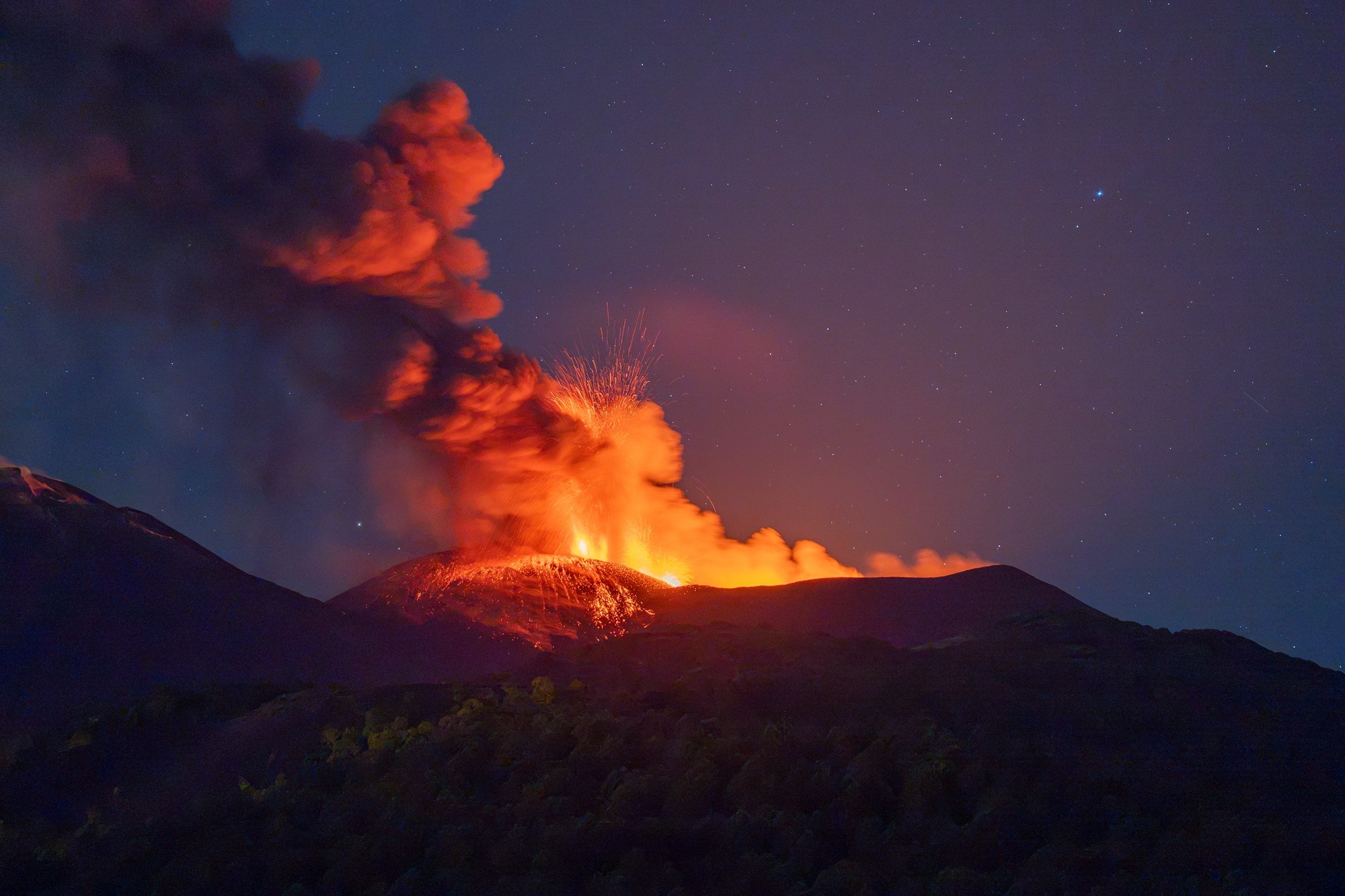
Due to the continuous eruption of volcanic ash from Mount Etna, which is located at an altitude of about 3,400 meters, the Catania–Fontanarossa Airport in Sicily, Italy, announced on Wednesday (12th) the suspension of all flights taking off and landing. It later extended the closure time, with the latest arrangement being a suspension until 2 a.m. local time on Friday (14th).
Catania Airport is an important aviation gateway in eastern Sicily and one of the busiest airports in Italy. The eruption of Mount Etna has been ongoing for the sixth day, severely disrupting air traffic in Sicily.
The operators of the airport, Sicily Airport Company (SAC), stated that aviation authorities have extended the closure of airspace in eastern Sicily affected by volcanic ash. SAC urged passengers to confirm flight statuses with airlines before heading to the airport and pay attention to subsequent announcements.
According to flight tracking data, since the eruption of Mount Etna started on Tuesday (11th), approximately 388 outbound flights were canceled, and on Wednesday (12th), around 55 more outbound flights were canceled. Several flights have been rescheduled or diverted to other airports in Sicily such as Palermo, Trapani, and Comiso.
The Mayor of Palermo, Roberto Lagalla, mentioned that the city’s airport has already received 190 flights that were originally scheduled to depart from Catania Airport.
Some passengers diverted to Palermo expressed concerns about inadequate transportation arrangements, as the demand for buses and taxis increased due to the influx of passengers. The airport operators noted that the additional passenger flow also led to flight delays at Palermo Airport.
Furthermore, Italy’s Minister of Civil Protection and Maritime Policy, Nello Musumeci, expressed that the flight cancellations, delays, and disruptions at Catania and Comiso airports have impacted both residents and tourists, reigniting controversies over airport selection and relocation in Sicily.
He revealed that a proposal had been made in the past to construct a new airport on the plain between Catania and Enna to completely avoid the effects of volcanic ash, but it was not adopted at the time. “The events of these days show: it’s not the volcano that’s in the wrong place, but the airport.”
The effects of this volcanic activity have spread beyond Sicily. The Toulouse Volcanic Ash Advisory Center indicated that the volcanic ash cloud has moved south and southwest, with low-density volcanic ash extending to the seas east of Malta and northern Libya; Mount Etna is approximately 220 kilometers from Malta.
Malta International Airport stated that some local flights experienced cancellations and significant delays. A music society in Attard, Malta, announced that they decided to postpone a fireworks display scheduled for Tuesday (11th) after consulting relevant authorities due to the fireworks launch site being close to the airport approach path.
While the disruption to local flights in Malta had temporarily improved, Malta International Airport warned passengers to stay informed about flight changes.