
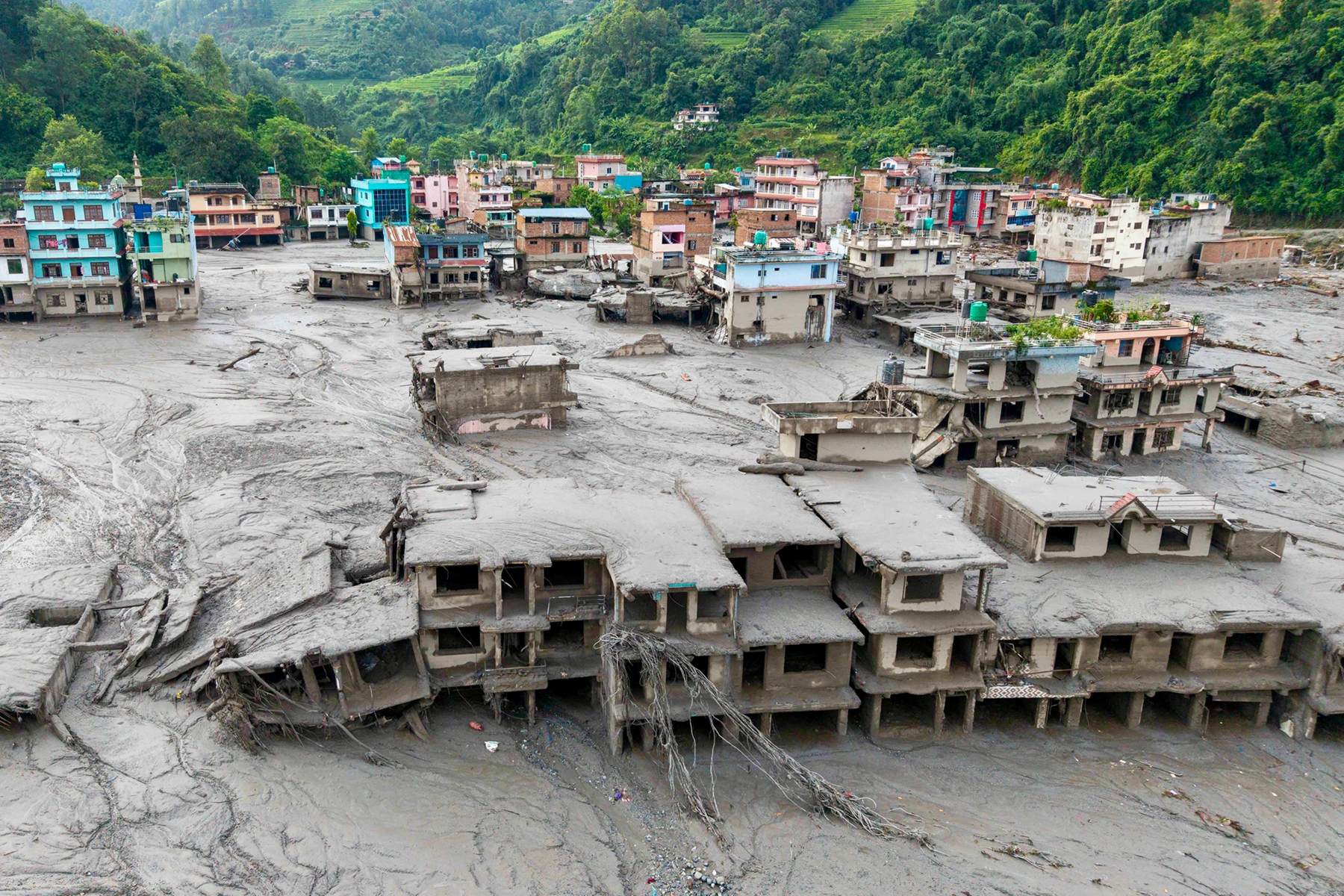
On Wednesday, August 26, a flood triggered by a glacier collapse swept through the border area of Nepal and Tibet, causing severe damage. Scientists point out that such glacier disasters originating from high mountain regions not only threaten the Himalayas but also pose similar risks in places like Alaska in the United States and western Canada.
According to a report by Reuters on Thursday, as of Thursday, at least 392 bodies of victims have been found in the flood and debris flow disasters in the border areas of Tibet and Nepal, with over 1,400 people still missing.
The US Geological Survey (USGS) preliminary analysis suggests that this disaster may be related to a glacier collapse of ice and rock in the high mountains. After the ice and rock fall into the river channel, a temporary blockage may form, followed by a large amount of accumulated water breaking through the blockage, creating a powerful flood peak that carries mud and debris downstream.
Experts point out that floods triggered by glacier changes have become a significant risk faced by high mountain regions in recent years. When glaciers melt to form new glacier lakes or weaken the ice layers that support the mountain, it may increase the likelihood of glacier lake outburst floods, landslides, and glacier collapses.
According to a report by Newsweek on Thursday, experts note that flood and debris flow disasters related to glacier melting are not unique to the Himalayas. The tragedy in Nepal has also prompted the United States to reexamine similar risks it faces. In particular, Juneau, Alaska’s “Suicide Basin” is one of the most closely monitored glacier flood risk areas in North America.
The Mendenhall Valley in Juneau is downstream from “Suicide Basin,” which is a lake system connected to the Mendenhall Glacier.
Since 2011, this basin releases large amounts of accumulated water into the Mendenhall River annually, repeatedly impacting local homes, roads, and infrastructure.
Unlike many glacier disasters that occur in remote areas, the threat in Juneau directly affects a populated city community. Therefore, researchers and emergency management personnel often regard it as one of the most typical urban glacier flood cases in North America.
In recent years, the scale and destructiveness of floods in the Juneau area have continued to rise, causing damage to the community. In August 2024, floods submerged parts of the Mendenhall Valley in Alaska, damaging around 290 homes. The following year saw another record-breaking flood in the area. The most recent occurred on August 13, 2026, when the river water levels rose again to a level of significant flooding.
Fortunately, a well-functioning early warning system has been established in the area. Local forecasting agencies issue alerts when signs of water discharge appear, and residents can understand the extent of damage to different communities under various water levels through inundation maps. The government has also developed evacuation guidelines for high-risk areas.
According to a global database of glacier lake outburst flood events compiled by researchers, the Northwest regions of North America, especially Alaska and western Canada, have the highest number of recorded events globally. Such floods have been occurring locally for over a century.
However, experts note that this does not mean that disasters on the scale of Nepal will be repeated in North America. The most deadly glacier floods often occur in densely populated downstream areas, while most glacier systems in North America are located in remote areas with relatively sparse populations.
Nevertheless, scientists warn that climate change is accelerating changes in mountain terrain, leading to the formation and expansion of glacier lakes in some areas, requiring governments to continue monitoring locations that may threaten downstream communities.
In addition to Alaska, near the Place Glacier northeast of Pemberton, British Columbia, Canada, ice dam failures caused glacier lake outburst floods in 2024 and 2025, prompting authorities to issue evacuation warnings and enhance monitoring.