
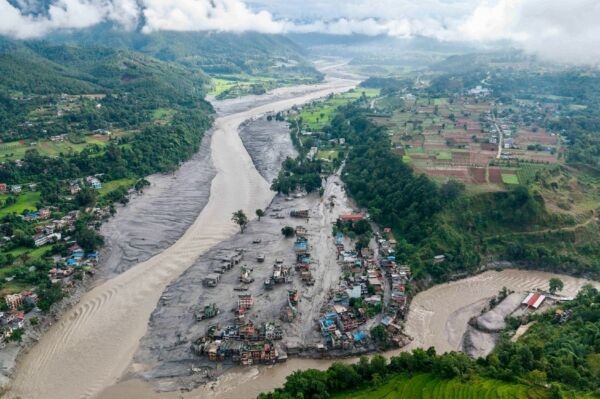
On August 26th, a catastrophic glacier collapse occurred on the border between Tibet and Nepal, once again exposing a fundamental weakness of the Chinese Communist regime – its political system being too obsessed with controlling the narrative. It views disaster management as a means to maintain its own image and survival rather than prioritizing rescuing the people.
Millions of cubic meters of hanging ice, shattered bedrock, and permafrost collapsed from the mountain ridges, instantaneously pulverizing into a high-speed flowing, dense mudslide resembling wet concrete.
This fierce torrent raced along the narrow Gyirong and Trishuli rivers, destroying border checkpoints, washing away hydropower facilities to steel skeletons, and wiping out riverside settlements in Rasuwa and Nuwakot districts in Nepal.
This natural disaster transcended borders, but the starkly different political responses on either side of the border showcased two incompatible worlds.
In Nepal, this tragedy unfolded with painful and even chaotic information disclosure: local officials being interviewed by the media, reporters conducting live broadcasts from the muddy disaster area, and the officially confirmed death and missing persons numbers quickly escalating to hundreds. As of August 31st, this devastating mudslide had claimed the lives of 903 people in Nepal with 4,247 individuals still missing.
On the other side of the border in Tibet, the Chinese Communist Party (CCP) initiated a starkly different governance mechanism – a political response model that had been in use for half a century. Its purpose was not to address the natural and physical aspects of the crisis but to uphold the political image of “absolute correctness, never making mistakes”.
Within hours of the glacier collapse, while scientists were still reconstructing the events based on earthquake and satellite data, the official Chinese media promptly provided a decisive conclusion: the glacier collapse originated from the Nepalese side.
The Chinese Embassy in Nepal swiftly issued a public statement condemning it, dismissing any doubts about possible upstream dam collapses or unnotified flood releases as malicious dissemination of “fake news”. The statement ended with a profound moral admonition: “Blaming is of no help, only through cooperation can lives be saved.”
Beijing’s rapid deployment of a propaganda offensive was not due to having sufficient scientific evidence but was instead a result of a systemic instinctive reaction. Under the CCP’s governance model, major sudden natural disasters are seen as a serious political vulnerability.
Based on past practices, the CCP seems to have a standard procedure for dealing with major disasters: concealing casualty numbers, attributing systemic responsibility to external factors, downplaying the impact of human factors, ruthlessly reducing domestic rescue efforts, shifting towards grandstanding geo-political stances, and transforming people’s grief into celebrations of national mobilization capabilities.
This model was evident in the figures initially released by CCTV, where only 3 confirmed deaths and 558 missing persons were reported. By August 31st, Beijing reported 16 fatalities and 546 missing in Gyirong County. Given the situation of an entire multi-story border checkpoint being buried under several meters of slurry, such casualty ratios seemed contradictory, especially considering the reported hundreds of deaths on the Nepalese side.
However, within the administrative system of the CCP, confirming deaths triggers bureaucratic accountability and public anger, whereas the number of “missing” individuals is politically less impactful and allows scrutiny institutions time to block and control on-site information.
With over 260 missing individuals being foreigners, among whom many may have been pilgrims heading to Mount Kailash in Tibet, completely blocking information is no longer feasible. Nevertheless, the official Chinese TV swiftly shifted the focus from civilian suffering, airing carefully crafted footage showing Chinese Premier Li Keqiang inspecting the muddy disaster area.
This instinct to uphold the regime at all costs and shield it from external scrutiny is deeply rooted in the history of the CCP.
In July 1976, a massive earthquake struck Tangshan near Beijing, nearly leveling the industrial city. Local officials reportedly ignored earthquake warnings due to fears of causing “social panic” during the final days of Mao Zedong, the CCP’s founding leader (1893-1976). The CCP classified this disaster as a state secret, concealing the staggering death toll of over 242,000 for three years and rejecting all foreign humanitarian aid.
During the 2008 Wenchuan earthquake in Sichuan, around 69,000 confirmed deaths and 18,000 missing persons were reported. Among these were thousands crushed by the collapsed shoddy public schools, while neighboring government buildings remained intact.
In the imagery broadcast on official CCTV during the disaster, Premier Wen Jiabao holding a megaphone, standing amid the rubble to offer condolences became part of the official propaganda. However, when grieving parents compiled and publicly released lists of deceased children, the government’s attitude hardened; these parents were arrested, and civilian investigators were imprisoned.
A more recent example is the 2021 Zhengzhou flood. The local government failed to halt public transportation during consecutive red alerts, resulting in 139 deaths in the subway and underground tunnels; however, the city government later concealed these death tolls.
During the 2023 Hebei flood, authorities deliberately directed the floodwaters into designated storage areas around densely populated regions in Hebei, including Zhuozhou. Simultaneously, the Hebei party secretary designated Hebei to act as Beijing’s “moat” and prioritized flood protection for Xiongan, a highly esteemed government project.
In the 2025 Beijing Miyun flood, investigative reports revealed that in a nursing home not receiving flood warnings, several elderly individuals drowned in the floodwaters; related reports were promptly deleted from the internet within hours.
The heightened severity of this recent Himalayan mountain disaster also stems from its close relationship with China’s strategic push abroad for infrastructure development. The Gyirong Gorge in Tibet is a vital land route for the China-Nepal Economic Corridor and a core project of the Belt and Road Initiative (BRI). Over the years, engineering companies supported by the Chinese government have continued to blast mountains, construct transportation tunnels, build land ports, and construct dams along this geologically fragile passage.
With the recent passing of former Chinese Premier Zhu Rongji (1928-2026), the term “tofu-dreg projects” that he criticized during the 1998 Yangtze River flood disaster resonated again with the public.
During that time, Zhu Rongji inspected breached embankments during the flood and discovered corrupt officials using rubble and sawdust instead of reinforcing materials. Zhu Rongji publicly rebuked local officials on national television. For several decades, the CCP allowed technical bureaucrats a brief period for self-criticism, but that space has long been defunct.
There is currently no direct evidence confirming whether the blasting operations in the Belt and Road construction triggered this glacier rupture, but this possibility deserves thorough investigation. However, under Beijing’s current political system, independent glacier scientists, domestic investigative journalists, and foreign engineering teams may never be allowed to enter the mountainous regions for on-site surveys.
It is hard to believe that in a superpower industrial nation like China, one capable of constructing tens of thousands of miles of high-speed rail, building space stations, and pouring more concrete within a decade than Western countries in a century, cannot tolerate unvarnished casualty statistics or accept transparent post-disaster investigations. This raises questions about whether China’s grand engineering projects can truly ensure long-term safety.
Under the political system of the CCP that demands comprehensive control over society, the regime must maintain the illusion of “omnipotence, never making mistakes.” While a normal government can bear the cost of governance failures through elections and power transitions, an authoritarian system recognizes admitting systemic flaws as a threat to its legitimacy and survival.
As high-altitude glaciers in the Himalayan region continue to melt, cross-border flash floods and rockfalls may recur along these shared valleys and passages. For residents downstream in South Asia, the real danger is not just the drastic environmental changes in the upstream mountain areas but a political system that places information control above warning data.
Ultimately, it is always the ordinary people living below the valleys who pay the price.