
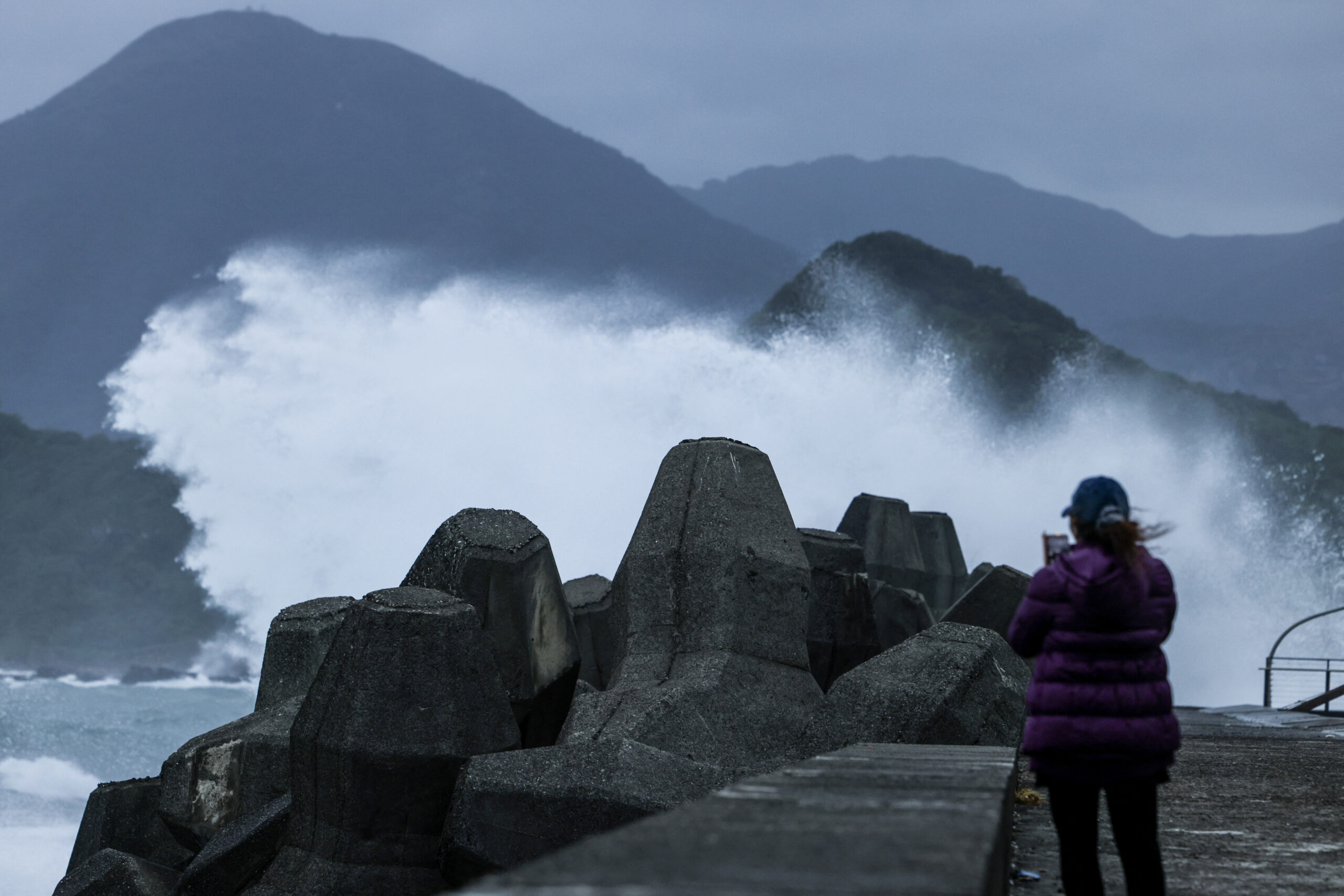
A powerful typhoon named “Qiangpi” is approaching Taiwan and the southwestern islands of Japan, forcing the United States and Japan to adjust their joint military exercise, “Keen Sword”. This has led to the cancellation of a training session in Okinawa, a reduction in the scale of exercises in Kuchinoerabujima, and the cancellation of the docking plans for two ships of the Japan Maritime Self-Defense Force. Additionally, over 200 flights in total have been cancelled between Taiwan and Japan.
“Keen Sword” is a large-scale joint military exercise held by the US and Japan once every two years. This year’s exercise began on October 19 and was scheduled to continue until the 29th, with approximately 56,000 military personnel from the US and Japan participating, along with forces from other partner countries. The exercise focuses on Japan’s defense and includes coordinated land, sea, and air operations, missile defense, and amphibious landing training.
The US Navy’s 9th Carrier Strike Group is also participating in the exercise. Their flagship, the USS Theodore Roosevelt, departed from Yokosuka, Japan on October 19 to take part in the exercise. The exercise also involves the operation of the US Navy Marine Corps’ air defense and anti-ship missile systems.
According to a report by “Stars and Stripes” on Wednesday, the spokesperson for Japan’s Joint Staff Office confirmed the cancellation of a training activity in Okinawa, but did not specify the details. Training in Kuchinoerabujima will be scaled down, and the prefectural government has announced adjustments to related activities.
The Japanese side stated that if the typhoon directly impacts the training areas, more activities may be cancelled.
Ephesian Poinsette, spokesperson for the “Keen Sword” exercise and a US Army Major, stated that commanders are closely monitoring the typhoon’s path and adjusting training arrangements daily.
He said, “Safety is always our top priority.”
Poinsette noted that some training has been adjusted based on weather forecasts and ongoing safety assessments, but the “core training objectives will still be achieved”. The US military will continue to cooperate with the Japan Self-Defense Force to maximize the benefits of bilateral training.
The Japan Joint Staff Office stated that the typhoon has had “no significant impact” on the overall exercise schedule.
The typhoon has also forced the Japan Maritime Self-Defense Force to cancel docking plans for at least two ships.
Local government spokespersons reported that the destroyer JS Setogiri cancelled its trip to Ishigaki Island, and the general-purpose landing ship JS Nihonbare cancelled its planned stopover at Yonaguni Island.
According to statistics from the Civil Aviation Administration of Taiwan, as of Thursday morning, a total of 125 flights have been cancelled due to the impact of Typhoon “Qiangpi”. 91 domestic flights, and 34 international and cross-strait flights have been affected. Affected routes include international flights between Taiwan and Okinawa, as well as flights to islands such as Penghu, Kinmen, and Matsu.
In Japan, according to reports by Reuters, Japan Airlines (JAL), All Nippon Airways (ANA), and Skymark Airlines have cancelled over 100 flights from the 22nd to the 25th, mostly domestic routes, affecting more than 11,000 passengers.
Taiwan’s Central Weather Bureau stated that on Thursday, typhoon “Qiangpi” still had gusts near its center exceeding 227 kilometers per hour, with storm force winds extending up to 320 kilometers. According to the predicted path, the typhoon is also expected to pass through the Yaeyama Islands of Okinawa, Japan.