
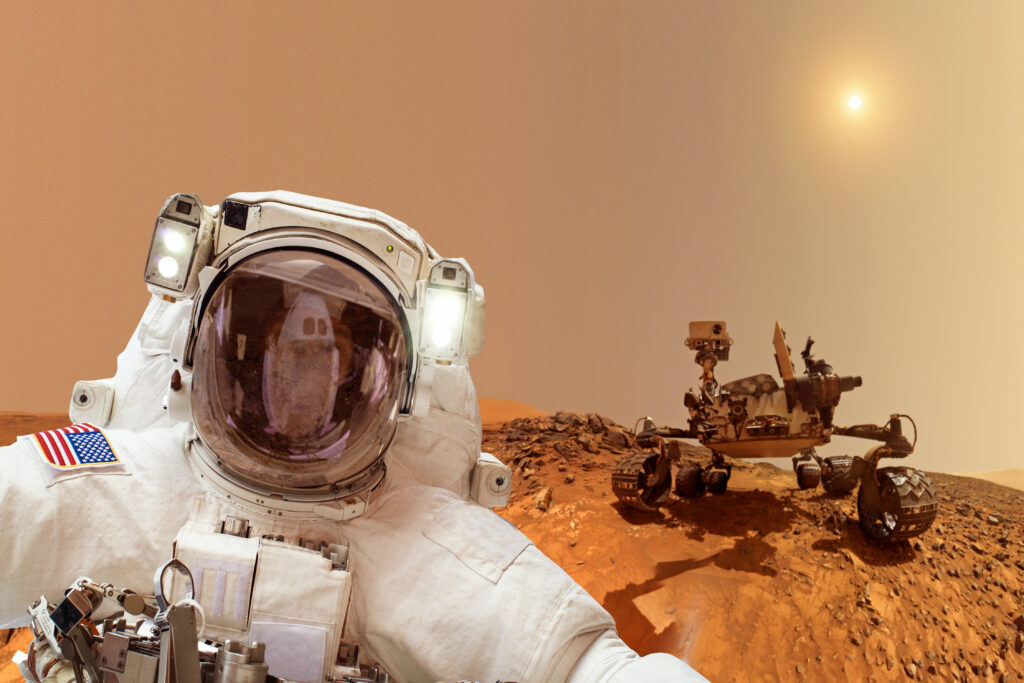
A recent study conducted by Northwestern University and other institutions has closely monitored the health of 13 astronauts who spent approximately six months aboard the International Space Station (ISS). The research revealed that while the astronauts experienced an initial decline in cardiac function during the early stages of their time in orbit, their heart performance gradually stabilized. Following their return to Earth, astronauts showed no significant deterioration in heart function when tested under simulated Martian gravity. This pivotal research was published in the September 2026 issue of the journal “Circulation.”
The journey to Mars involves several months of space travel. Astronauts not only need to adapt to a microgravity environment but also must adjust to Mars’s gravity, which is only about 38% of Earth’s gravitational force upon arrival. The ability of the human heart to cope with such drastic changes has remained a critical concern regarding manned missions to Mars.
Prior to, during, and after the mission, researchers conducted echocardiograms to capture detailed images of the astronauts’ hearts. While in orbit, astronauts scanned each other every few weeks, with these images sent back to Earth for analysis. The lead researcher, James Thomas from the Feinberg School of Medicine at Northwestern University, provided real-time remote guidance during these operations. Since the ISS operates on Greenwich Mean Time, Thomas frequently logged in around 3 AM local time.
The findings indicated that during the first two weeks in orbit, astronauts experienced a decrease in heart filling and stroke volume (the amount of blood each heartbeat pumps) as their bodies adapted to the microgravity environment and expelled excess bodily fluids, subsequently reducing their total plasma volume. Other cardiovascular metrics also showed a corresponding decline. However, throughout the remainder of the mission, these metrics gradually returned to levels close to those observed before launch.
Upon their return, researchers positioned the astronauts at a 22-degree incline from a supine position, simulating approximately 38% of Earth’s gravity through hydrostatic pressure along the body’s longitudinal axis. Under these simulated Martian conditions, the astronauts’ cardiac performance remained stable and demonstrated the capability to handle the gravitational load akin to that on Mars’s surface, showing no signs of significant cardiovascular stress. Thomas remarked, “We now have reason to believe that we can reach Mars.”
In support of their research, NASA’s exercise countermeasures program required astronauts to engage in approximately two hours of exercise daily. This regimen included 30 to 45 minutes of endurance training and 60 to 75 minutes of resistance training. The research team believes this approach is effective in maintaining overall cardiovascular regulatory function and muscle mass, thereby assisting astronauts in adjusting more easily upon returning to a gravitational environment. After landing, astronauts often experience orthostatic hypotension, a condition characterized by a sudden drop in blood pressure upon standing. Thomas emphasized, “Exercising in space is crucial to combat this issue.”
However, the study does have its limitations. With only 13 participants, the sample size is relatively small, and the Martian gravity was simulated using an inclined bed on the ground rather than a true landing on the Martian surface.
Overall, this research marks a significant step toward understanding the effects of space travel on human health and raises optimism about future missions to Mars.