
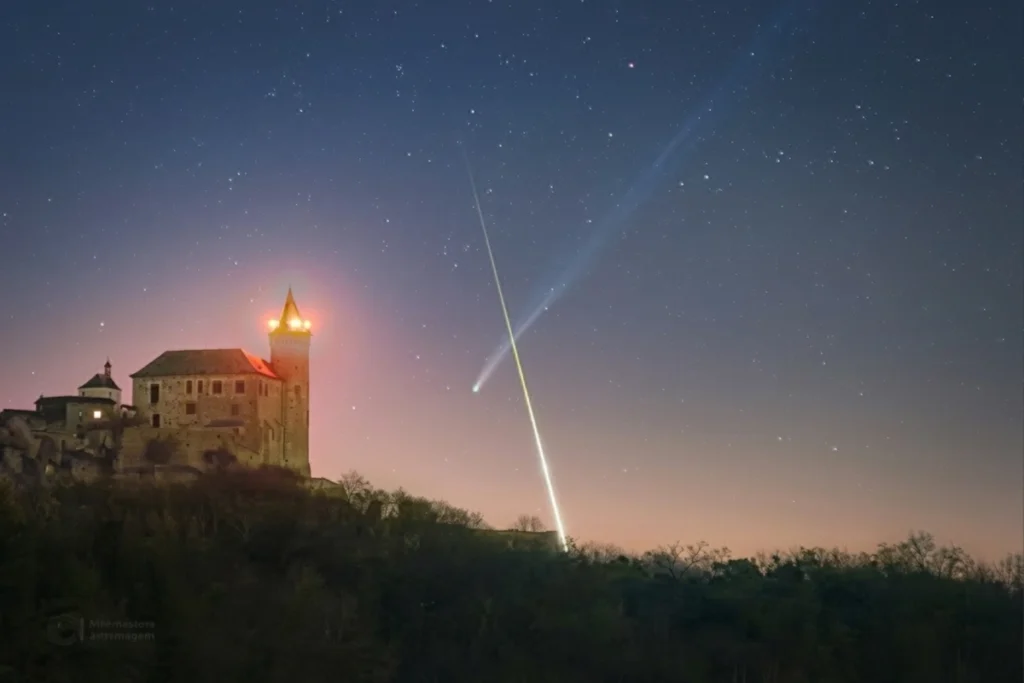
In the early hours of the morning, when most people are still asleep, Petr Horálek chooses a different path. At around 3 AM, he sets off in his car from his hometown of Seč, Czech Republic, on a mission to capture the awe-inspiring sights that lurk in the depths of the night sky.
Horálek is acutely aware of the challenges posed by urban lights, which make observing celestial events such as comets and meteors a daunting task. In cities heavily afflicted by light pollution, it is almost impossible to witness both phenomena in tandem, which is precisely why he seeks solace in the darkness of the countryside.
This time, he has decided to position himself at the foot of a secluded medieval castle, specifically the 15th-century Kunětická Hora Castle. With its towering spires and stone walls standing proud on a volcanic hill, the castle presents a striking visual centerpiece against the vast backdrop of the dusky night sky.
As an ambassador for the European Southern Observatory (ESO), Horálek had been looking forward to a cosmic visitor for several months. In April 2026, the comet C/2025 R3 was expected to enter the inner solar system, and he was determined to find the prime location to document it. Since he would need to leave his home to escape the light pollution regardless, he thought, why not choose a visually stunning backdrop? His choice of the castle aligns perfectly with his artistic vision.
“In terms of photography, the most captivating aspect of this castle lies in its unique grandeur,” Horálek shared in an interview. “It gained prominence during the reign of the powerful Pernštejn family, who transformed it into a formidable Gothic fortress.”
The castle’s sharp, conical towers and robust walls rise dramatically from a steep volcanic peak, surrounded by an expanse of flatlands that offer ideal vantage points for capturing its dramatic silhouette. Thanks to the nearby Elbe River Plain, one can photograph the castle from afar, enhancing the scale of the celestial bodies in the background. Horálek hopes to leverage this stark visual contrast to create a truly unique photographic effect.
However, capturing a perfect moment of the castle alongside the comet is no simple feat. Without precise mathematical calculations to guide him, finding the right angle to frame the comet as it rises behind the castle would be nearly impossible. Thus, he diligently began to plan his photographic strategy.
“The predicted location for the comet’s rise closely coincides with where the moon will rise a few hours later,” he explained. “To pinpoint suitable spots for moon observation, I used applications like PlanIt Pro and PeakFinder.”
Fortuitously, the moon wouldn’t ascend the horizon until after dawn, preserving the night sky’s clarity and providing optimal conditions for the comet to shine brilliantly.
On April 18, Horálek made his way to Kunětická Hora Castle, arriving about 40 minutes before the comet was expected to emerge from the horizon. He found an ideal shooting position next to a dirt road marked by clear tire tracks, awaiting the arrival of his friend, Josef Kujal, from the Hradec Králové Observatory. Together, filled with anticipation yet tinged with tension, they hoped that Horálek’s meticulous calculations would bear fruit.
“Our joy was indescribable when we discovered that our calculations were spot on!” Horálek recounted.
As the dense head of the comet, or nucleus, slowly ascended, it radiated a brilliant light while trailing a long gas tail behind it. Horálek’s camera captured a vivid bluish-green hue, a reflection of the comet’s coma, while the silhouette of the castle became increasingly pronounced against the twilight backdrop.
At that moment, an unexpected event unfolded: a meteor streaked through the comet’s tail.
This occurrence was sheer serendipity.
“Both of us witnessed the meteor simultaneously and quickly pressed the shutter to capture the moment,” Horálek said. “What were the odds of capturing such a photo? One in ten million? It’s these unique moments that make our travel for astronomical photography worthwhile.”
Although Horálek’s comet image was not as clear as Kujal’s, the two later collaborated to enhance their photographic data, merging Kujal’s comet image with Horálek’s photo and ultimately publishing the combined work online.
“This photo gained rapid popularity and sparked interest in astronomy among many people, at least for a time,” he noted.
In an April 2026 interview with Live Science, Horálek revealed that the European Fireball Network confirmed the bright object captured in their photo was indeed a fireball meteor. This meteor was formed when a small asteroid entered Earth’s atmosphere and exploded over Belarus. The network recorded the event as a fireball sighting.
“This bright meteor, termed a bolide in professional terms, does not originate from the comet. However, its trajectory indicates that its material might come from a comet or perhaps a distant ancient comet,” Horálek explained.
As he had hoped, this remarkable photograph successfully drew attention from a wide audience.
In his role as an ambassador for the European Southern Observatory, Horálek promotes the protection of dark night skies through his astronomical photography. When he is not out searching for rare subjects, he teaches at Silesian University in Opava. He emphasizes that dark night skies are not just a treasure for astronomy enthusiasts; they are a vital resource for everyone. Light pollution can negatively affect public health and the ecological environment.
Modern urban development relies heavily on streetlights, yet artificial lighting inevitably disrupts the natural rhythms of ecosystems. Millions of migratory birds become disoriented due to intense lights, often colliding with buildings. Additionally, nighttime brightness can inhibit the secretion of melatonin in humans, disrupting sleep patterns. Adequate sleep is crucial for bolstering the immune system.
Horálek’s journey into astronomy began when he was just 11 years old, guided by his grandmother, who first introduced him to the wonders of the night sky, pointing out the Big Dipper. Today, he serves as a bridge between the public and the field of astronomy, opening up opportunities for many to discover its allure. He is also the official representative of DarkSky International in the Czech Republic, an organization advocating for responsible outdoor lighting, such as the use of warmer amber LED lights to replace bluer, harsh lighting.
This October, as an ambassador, Horálek will collaborate with Nikon to host a photography workshop in northern Sweden, where he aims to capture the Northern Lights beneath the dark night sky—an endeavor he hopes will be met with favorable weather and observational conditions.