
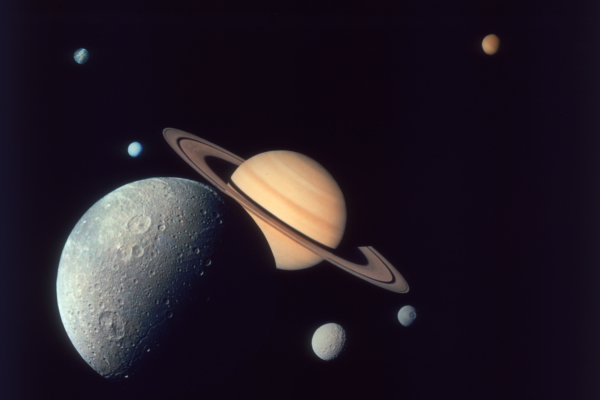
In New York, autumn has arrived, bringing relief from the summer heat and humidity. The night sky appears clearer, marking the beginning of the peak stargazing season. Saturn reached its opposition position on October 4, aligning roughly in a straight line with Earth and the Sun. It is currently at one of the best times for observation throughout the year. Following this event, the Moon, Jupiter, the Draconid meteor shower, and the Orionid meteor shower will take center stage. Even in the brightly lit city of New York, there are plenty of celestial spectacles to behold this October.
During Saturn’s opposition on October 4, the planet appears brighter and closer to Earth, visible for most of the night. This celestial event, known as opposition, occurs when an outer planet is on the opposite side of the sky as observed from Earth, with Earth positioned between the planet and the Sun. According to NASA, this is one of the prime opportunities this year to observe Saturn.
The viewing pleasures extend beyond a single night. Throughout October, following sunset, one can still spot the yellow-orange glow of Saturn in the southeast. With a telescope, there is a chance to catch a glimpse of its iconic rings.
On the morning of the 6th, a scene of “Moon with Jupiter” will unfold in the sky. Before sunrise, a crescent Moon will be accompanied by the bright planet Jupiter in the eastern sky, appearing about 4 degrees apart, easily visible to the naked eye.
From the evening of the 8th to the early hours of the 9th, the Draconid meteor shower will peak. With the Moon close to its new phase, there will be minimal lunar interference. Under ideal dark conditions, about 5 meteors can be seen per hour. An appealing aspect of this shower is that it doesn’t require staying up late; it’s best observed after nightfall.
Taking over on the night of the 21st to the early morning of the 22nd is the Orionid meteor shower. These fast-moving meteors streaking across the night sky are remnants from Halley’s Comet, with about 10 to 20 meteors visible per hour under a dark sky. Some of the dimmer meteors may be obscured by moonlight this year, so NASA recommends viewing after the moon sets and before dawn.
For those who prefer not to navigate the stars themselves, there are guides available. On the night of the 24th, the Amateur Astronomers Association of New York will hold the 30th Autumn Starfest at Inwood Hill Park in Manhattan. Approximately 20 high-powered telescopes will be set up for the public to observe Saturn’s rings, star clusters, and the Andromeda Galaxy, located about 2.5 million light-years away. The event is free and will be rescheduled in case of rain to the following night. Link: https://tinyurl.com/yx9b2nzy
This autumn, from the radiant glow of Saturn to the shooting stars across the sky, the skyline of New York City is alive with celestial wonders, making it well worth looking up.