
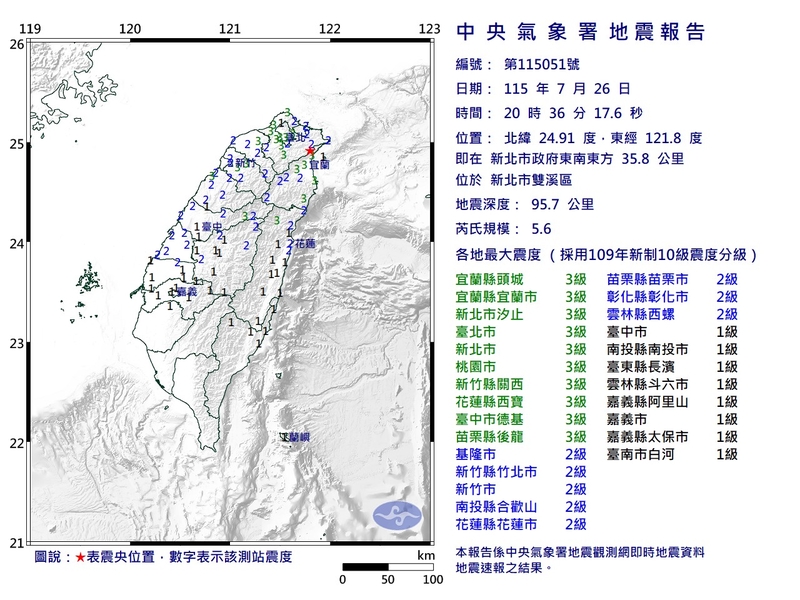
On July 26, 2026, at around 8:36 pm local time, the Central Weather Bureau of Taiwan reported that a noticeable earthquake occurred in the northern region. The epicenter was located approximately 35.8 kilometers southeast of the New Taipei City Government (in Shuangxi District, New Taipei City), with a depth of about 95.7 kilometers. Residents in some affected areas received a national-level alert on their mobile phones.
The areas in Taiwan that experienced the highest intensity level of 3 were Yilan County, New Taipei City, Taipei City, Taoyuan City, Hsinchu County, Hualien County, Taichung City, and Miaoli County.
Locations with an intensity level of 2 included Keelung City, Hsinchu City, Nantou County, Changhua County, and Yunlin County.
Areas with an intensity level of 1 were Taitung County, Chiayi County, Chiayi City, and Tainan City.
This seismic event serves as a reminder of the geologically active nature of Taiwan, situated along the Pacific Ring of Fire where earthquakes are frequent. The authorities urge residents to stay vigilant and be prepared for potential aftershocks following the initial quake. Earthquake drills and emergency preparation measures are crucial for ensuring the safety and well-being of the public in the event of natural disasters.
Efforts to enhance earthquake monitoring and early warning systems continue to be a priority for the government to mitigate potential risks and improve response capabilities. The collaboration between the Central Weather Bureau, local government agencies, and various stakeholders plays a vital role in ensuring swift and effective responses to seismic activities. By fostering public awareness and readiness for earthquakes, Taiwan aims to minimize the impact on communities and infrastructure.
Events like these underscore the importance of disaster preparedness and resilient infrastructure to safeguard lives and property. With a history of seismic activity, Taiwan remains dedicated to advancing its disaster prevention and response mechanisms to protect its citizens and enhance overall societal resilience in the face of natural calamities.