
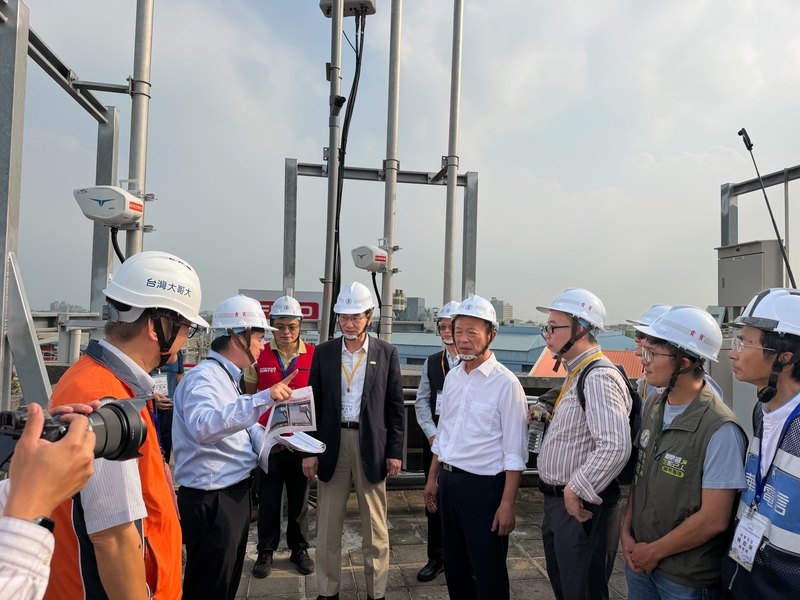
The Ministry of Digital Development of the Republic of China recently announced significant advancements in strengthening Taiwan’s communication network resilience. On a recent visit, Minister Lin Yijing inspected the first high-disaster-resilient base station integrated with Taiwan Power’s substation in Jiayi County, known as the Jatai Substation. This initiative aims to enhance communication infrastructure across Taiwan and ensure its durability during natural disasters.
During her visit, Minister Lin detailed the critical outcomes of this high-resiliency base station, which was completed in June of this year. Following tests during Typhoon Bavi and Typhoon Chantu, the station demonstrated remarkable stability, continuously providing reliable mobile communication services without interruption.
Analyzing past experiences with natural disasters, Minister Lin pointed out that the primary reason for mobile base station failures has often been linked to power outages, followed closely by interruptions in optical fiber connections. To combat these vulnerabilities during crises, the Ministry of Digital Development has initiated subsidy programs that collaborate with telecommunications providers to accelerate the fortification of communication network facilities, enhancing their resilience and backup capabilities.
The Jatai Substation high-resiliency base station serves as a pioneering demonstration site in Taiwan. It incorporates three key aspects of resilience: power supply stability, transmission reliability, and structural integrity.
In terms of power supply, the substation offers a stable electricity source, significantly reducing the risk of service interruption due to outages. For transmission, three telecommunications companies have installed laser optical transmission equipment, providing a secondary transmission route that mitigates the impact of disruptions on communication services. Furthermore, the structural capacity of the base station has been strengthened to withstand winds of up to level 15, ensuring it remains steadfast during typhoons.
From 2023 to 2025, the Ministry announced that, through a forward-looking plan, it would subsidize telecommunication companies to establish or optimize a total of 93 high-resiliency base stations. Each facility will include 72 hours of backup power, a second transmission path, and towers capable of withstanding 15-level winds. Additionally, plans are underway to enhance mobile communication capabilities by acquiring and optimizing 55 mobile base stations and encouraging the purchase of 840 portable generators to further bolster communication resilience and shorten recovery times in disaster-impacted areas.
Moreover, the Ministry has supported telecommunication providers in establishing 46 pairs of microwave systems in mountainous regions and on outlying islands, thereby enhancing the resilience of backhaul networks for base stations.
Looking ahead, from 2026 to 2029, the Ministry will continue its “Strengthening Digital Resilience of Government Key Nodes and Rural Communication Networks” initiative. This program aims to encourage telecommunications companies to expedite the installation of high-disaster-resilient base stations in rural areas, outlying islands, locations susceptible to isolation, and disaster-prone regions. They also plan to expand microwave capacity in these areas and optimize mobile satellite base station vehicles.
The Ministry clearly emphasizes that the development of communication networks goes beyond merely serving the everyday needs of citizens for high-quality internet access. More crucially, these networks must maintain basic and reliable communication services during natural disasters, ensuring that the public can keep in touch with the outside world without interruption. In the future, through public-private collaboration and cross-ministerial cooperation, the aim is to create a diverse and resilient communication system that stands the test of time.