
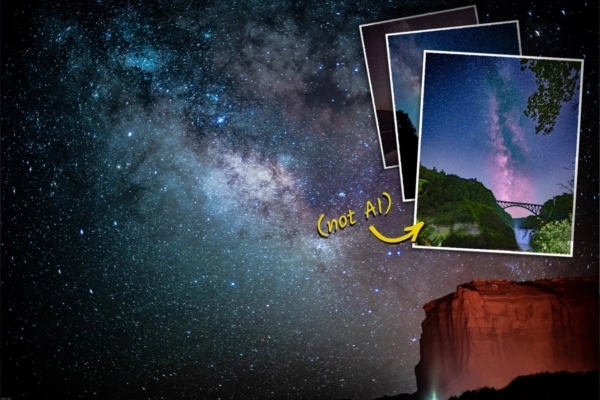
Mary Jo Machnica still remembers that old-school photography style – in the darkroom of her high school photography class in 1978, the scent of vinegar from the developing solution filled the room.
Now, at the age of 64, Machnica has learned some modern photography techniques. She has started using a mirrorless digital camera and post-processing her photos with Adobe Lightroom (though she still doesn’t rely on artificial intelligence). She has also mastered a photography discipline that was almost non-existent in the film era – night photography, tracking the positions of planets, the moon, and the Milky Way with applications like PhotoPills and Stellarium.
Although Machnica may have left the darkroom, the pitch-black night sky has become an essential part of her photography.
A retired pastry chef, Machnica grew up in Hamburg, New York, and still resides there. She told The Epoch Times that in the past, she would spend hours studying the best observational locations at night and searching for skies without moonlight to capture the most magnificent Milky Way.
“Now there are apps that can help you do this work.” She said, “I found a very ideal nighttime observation spot in West Virginia. So my husband and I packed our bags, brought along our German Shepherd Sheba, and drove seven hours to Seneca Rocks.”
Machnica’s goal on this trip was to photograph the Milky Way from the highest point in West Virginia, Spruce Knob Mountain. Sometimes, in photography, the darkest night is not the biggest obstacle; the real challenge lies in the photographer embarking on the journey.
Sometimes, the dark night can deceive the eyes.
“In the absence of streetlights, we drove over 10 miles of mountain road. As we climbed, we saw a series of lights crossing our path.” Machnica said, “We couldn’t figure out what those lights were, and we kept seeing them along the way until we finally realized – they were actually car lights reflecting on spider webs. The spiders were moved by the wind, swaying from one side of the road to the other.”
When they arrived at the parking lot at the top of the mountain, everything was shrouded in darkness. It was the perfect shooting condition.
“We drove up during the day to scout. It’s not feasible to go directly to a place at night without any familiarization.” She said, “After getting out of the car, we found the car covered in hundreds of spider webs. As we opened the car door, the webs were all torn.”
Ironically, Machnica originally planned to photograph the Milky Way at that location, but the plan was not successful. Unbelievably, a sudden influx of clouds obscured the view from the mountaintop, leaving them with nothing to see. However, the beautiful starry sky and Milky Way photographs were taken later that evening when they returned to their cabin, with no clouds obstructing the night sky.
Speaking of the work with a small cabin chimney as the foreground and the Milky Way across the night sky, she said, “I set up all my equipment, and everything went smoothly.”
For Machnica, living east of the Mississippi River poses the biggest challenge for night photography. To escape light pollution from New York, she had to travel west extensively, sometimes even to far western regions because “the darker the place, the better my shots.”
During a short trip, she went to Monument Valley in Utah to photograph, where the rugged terrain made her realize that it was dangerous to carry equipment across narrow rock edges in the darkness. However, the awe-inspiring sandstone mesas rising from the desert, some over 1,000 feet high, and the Milky Way arched across the night sky made the journey totally worthwhile.
In 2018, she organized a photography trip and visited this sacred area. The scene might be somewhat like people going to a remote, uninhabited place for an all-night music festival. When shooting at night, she would take out a glow stick – not to dance coolly under the light show but to mark the position of her tripod. She uses a red headlamp, which allows her to see the surroundings clearly without compromising her night vision.
A lens heater prevents condensation on her wide-angle lens, helping her capture the night sky above the canyons clearly. She avoids using complex equipment like equatorial mounts (star trackers) and barely employs some of the composite or image stacking techniques commonly used by photographers, which can merge different foregrounds with the night sky.
Her equipment is very simple. “I only use Lightroom for post-processing.” She said, “I don’t use any artificial intelligence, my photos are authentic.”
Most city dwellers are surprised to see the Milky Way at night. She believes this is probably because they rarely spend long periods staring at the night sky, allowing their eyes to truly adjust to the darkness. She added that they would be “blown away” by what they see.
On this photography journey, she was accompanied by a friend who had traveled and lived around the world but seldom looked up at the stars. That night, over the desert in Utah, she saw a meteor streak across the dark sky for the first time. Machnica, accustomed to gazing at the night sky all her life, said she felt a twinge of sadness for her friend missing those experiences.
“But also very happy,” she added, “that she finally saw a meteor in the dark night sky!”
More Milky Way works by Mary Jo Machnica:
For the English report, please refer to The Epoch Times:
Photographer Chases Dark Skies to Capture Milky Way the Old-School Way—From Mountaintops to Desert Valleys