
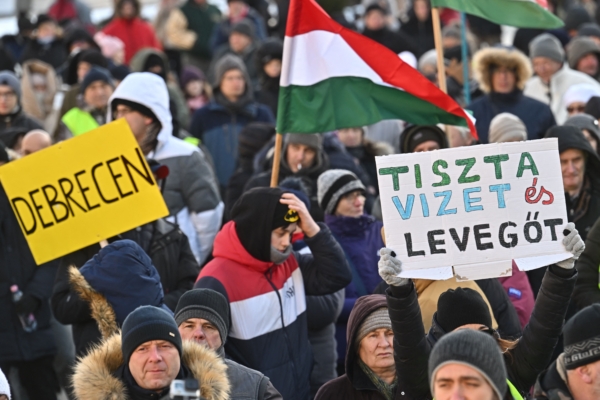
China’s battery giant CATL, located in Debrecen, eastern Hungary, is facing legal action from Hungarian authorities for illegally discharging “green liquid” into the sewer system. Meanwhile, the newly elected TISZA Party government is also conducting a review of Chinese electric vehicle manufacturer BYD.
On June 5th, the Hajdú-Bihar County government in Hungary initiated legal proceedings against CATL for violating regulations by discharging “green liquid waste” directly into the local municipal sewer system on the evening of May 5th. As a direct punitive measure, the relevant water management department immediately revoked the factory’s industrial wastewater pretreatment permit. The court also required CATL to clean up the affected municipal sewage network and stormwater discharge system within a specified deadline.
Although CATL remedied the pollution within the stipulated time, the water resources and environmental protection departments are still planning to fine the company for its illegal actions. Victoria Lőrincz, Minister of Regional and Rural Development of the TISZA Party government, has ordered a special investigation into the case.
Previously, during the tenure of the China-friendly Hungarian Prime Minister Viktor Orban, Chinese state-owned enterprises often enjoyed preferential policies and exemptions from scrutiny. However, with Orban’s recent electoral defeat and the TISZA Party government’s tightening of policies towards Chinese investments, a shift in regulatory approach has been observed.
Another Chinese automaker, BYD, with a new car factory in Szeged, Hungary, is also under scrutiny. According to a report by China Labor Watch, BYD has been accused of using a complex network of subcontractors to airlift Chinese migrant workers to Hungary under exploitative conditions, including long working hours, seven-day workweeks, wage deductions, and fear of retaliation.
These allegations have prompted an official response from Hungarian authorities. The Csongrád-Csanád County government confirmed that three subcontracting companies involved in the factory construction have been penalized, with one of them receiving a fine.
International human rights experts see Hungary’s firm stance as a signal of stronger oversight on Chinese overseas investments. Laura Murphy, a professor at Sheffield Hallam University, noted a fundamental shift in how countries are dealing with Chinese investments, from Brazil’s prosecution of BYD for forced labor to Hungary’s investigation, signaling a significant change in attitude towards Chinese investments.
With the TISZA Party government firmly in place, a large-scale environmental investigation has been launched against the BYD factory. Amid environmental and labor concerns, Chinese car manufacturers and battery factories expanding in Europe are facing stringent tests.
BYD has requested all subcontractors in Hungary to sign commitments to comply with local labor laws. However, there are doubts about the effectiveness of these measures. Murphy stated that addressing systemic issues like forced labor requires more than just paperwork compliance, signaling a need for practical solutions to root problems.
As the TISZA Party government solidifies its position, a comprehensive environmental investigation into the BYD factory has commenced, posing significant challenges for Chinese car manufacturers and battery giants expanding in Europe amidst environmental and labor scrutiny.