
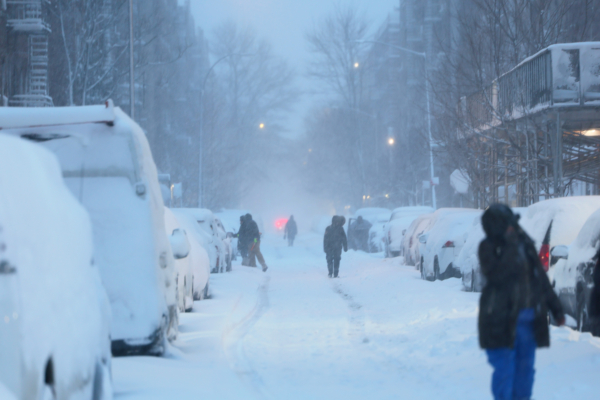
A powerful bomb cyclone officially swept through the Northeastern United States on Monday, February 23rd. This rapidly intensifying Northeast storm brought destructive snowfall and near-hurricane-force winds to the densely populated corridor from Washington D.C. to New England. Over 40 million Americans are currently under blizzard warnings, with major cities like New York, Philadelphia, and Boston experiencing widespread shutdowns.
According to data from the National Weather Service (NWS), the system has undergone what is known as “bombogenesis,” with its central pressure dropping over 24 millibars within 24 hours, currently reaching 972 millibars. This drastic pressure change has resulted in a steep pressure gradient, leading to extremely strong gusts of wind and intense snowfall.
Meteorological satellite imagery shows that the storm center has formed a typical comma-shaped structure, with cold air intensifying spectacular cloud bands over the relatively warm sea surface. However, at ground level, this translates into deadly weather conditions: Montauk Point at the eastern end of Long Island, New York recorded wind gusts as high as 84 miles per hour (135 kilometers per hour), meeting the criteria for a Category 1 hurricane. The combination of strong winds and heavy wet snow has become a lethal mix, causing destruction to trees and power facilities.
As one of the hardest-hit areas by this storm, Central Park in New York City had accumulated over 15 inches (38 centimeters) of snow by 7 a.m. on Monday, marking the most severe snowfall from a single storm in over five years. New York City Mayor Zohran Mamdani declared a state of emergency across the city, enforcing strict traffic bans that prohibit all non-emergency vehicles from being on the roads until noon on Monday for snow removal.
“This is the first traditional snow day for New York City children since 2019,” Mamdani stated in a briefing. He urged residents to stay indoors and announced the closure of all public schools without remote learning options.
Furthermore, the New York City Department of Sanitation (DSNY) deployed around 2,300 snowplows and urgently recruited three times the usual number of temporary snow shovelers to clear sidewalks, fire hydrants, and bus stops.
The storm has taken a toll on the transportation system in a comprehensive manner. According to the latest data from flight tracking website FlightAware, over 10,000 flights have been canceled across the U.S. from Sunday to Tuesday. On Monday alone, more than 5,300 flights were grounded due to the extreme weather, with airports in New York, New Jersey, and Boston suffering the most severe disruptions.
On the ground transportation front, New Jersey Transit has suspended all bus, light rail, and rail services, while the Rhode Island Public Transit Authority (RIPTA) in New England has also halted operations. With snowfall rates reaching up to 3 inches per hour and visibility close to zero, many roads are experiencing whiteout conditions, making travel nearly impossible.
The combination of heavy wet snow and strong winds has resulted in significant infrastructure damage across the Northeastern states. PowerOutage.us reported that earlier on Monday, nearly 400,000 households were left without power. New Jersey faced the most severe outage, with over 116,000 households in the dark, while Delaware and Massachusetts each had around 70,000 households plunged into darkness.
In Philadelphia, heavy snow caused numerous trees and power lines to collapse, leading local authorities to declare a state of emergency and transition to online learning for public education. The United States Postal Service (USPS) issued warnings, stating that the extreme weather would severely disrupt mail processing and delivery in the Northeast region.
Prominent landmarks such as the Museum of Modern Art (MoMA) in New York and Arlington National Cemetery in Washington D.C. announced closures, with Broadway performances also put on hold.
Despite partial federal shutdowns, the Federal Emergency Management Agency (FEMA) assured that core disaster response functions, including safeguarding life and property, would continue uninterrupted.
Local officials have taken emergency actions across the affected areas. New Jersey Governor Mikie Sherrill urged residents to “treat this storm seriously,” while Massachusetts Governor Maura Healey required all non-essential state government employees to stay home. Connecticut prohibited commercial vehicles from traveling on restricted highways on Sunday evening.
This storm has set numerous records or reached new highs in many areas: Freehold, New Jersey saw the highest snowfall at 22.2 inches, Islip, New York recorded 22.5 inches, and Newark, New Jersey received 18.3 inches, the largest snowfall since 2016.
The meteorological department predicts that as the storm center continues to move northeastward, snowfall will gradually diminish on Monday afternoon in New York and Philadelphia. However, strong winds and snow may persist in the New England region, especially in Boston, until Monday night.
Temperatures are expected to rise to 43°F (approximately 6°C) by Wednesday, initiating snowmelt. Before that happens, residents in the Northeast will have to contend with hazardous icy roads and an extended period for power restoration.