
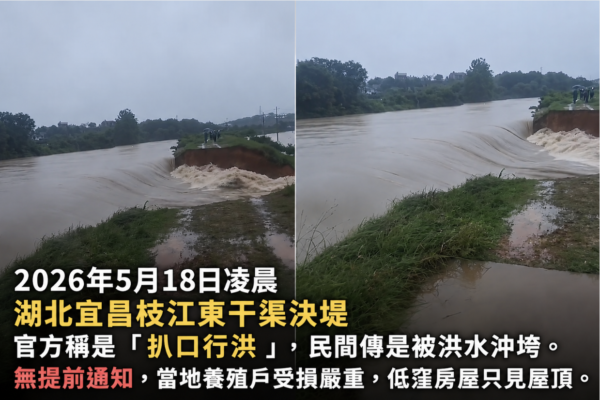
In recent days, multiple provinces in mainland China have been hit by heavy rain and flooding, with 16 rivers experiencing flood warnings. In Yichang, Hubei Province, the official response to rising waters in the East Gank Canal was to intentionally divert floodwaters, a move referred to as “open flood outlets,” which local villagers claim resulted in a breach and significant losses for those who rely on aquaculture for their livelihood.
According to reports from mainland Chinese media, in the early hours of May 18, due to continuous rainfall, water levels surged in the East Gank Canal in Yichang, Hubei Province, posing a risk of embankment breaches in the Yandunbao Village section of Xiannü Town. In order to mitigate the risk, local emergency and water resources departments conducted open flood outlets in the section of the canal at risk of overflow, directing floodwaters downstream to the Yangshi Town to ultimately flow into the Yangtze River.
According to publicly available information from mainland China, “open flood outlets” essentially involve manually opening a section of the embankment, flood canal, or levee to allow floodwaters to enter farmlands, low-lying areas, and buffer zones to reduce pressure on the main river channel. In simpler terms, it is a proactive measure to divert floodwaters.
Reports from the mainland also indicate that in advance of the flooding event, Dongshi Town organized the evacuation of 53 households comprising a total of 161 villagers. Fortunately, there were no casualties during the incident, and the villagers were relocated to a local guesthouse.
However, a resident in Pinghu Village in Dongshi Town, Wang Hua (pseudonym), expressed dissatisfaction when interviewed by Dajiyuan. He claimed that there was misinformation from the Chinese Communist Party (CCP) officials once again. Wang Hua, who is located near the East Gank Canal, estimated that the distance to the canal from his village was likely less than a kilometer. He stated that there was a significant discharge of water around 3 to 4 o’clock in the morning, causing villagers to believe that the canal had been breached.
Wang Hua indicated that the official evacuation notice came around 5:30 to 6 o’clock in the early morning, by which time the floodwaters had already inundated the area. He emphasized that authorities failed to inform residents and aquaculture farmers downstream to take necessary precautions, only urging them to evacuate hurriedly.
Most of the local community engages in aquaculture, with densely packed fish ponds ranging from ten to over forty mu. After the flooding, Wang Hua described how “all the ponds were destroyed, and the fish inside almost disappeared.”
Wang Hua estimated that based on a single pond’s value of 400,000 yuan, more than thirty neighboring families in Pinghu Village suffered losses. Furthermore, the losses extended beyond Pinghu Village, affecting the entire Dongshi Town and even neighboring townships.
Additionally, the reality of the losses was even greater. For instance, Wang Hua explained that his own pond contained nearly fifty thousand catties of Huangju (yellow pomfret) fish, resulting in a loss exceeding five hundred thousand yuan, along with over thirty tons of feed, each costing around eight thousand yuan per ton, all of which were completely ruined. He lamented the sudden destruction of two years of hard work.
In addition to the fish ponds, many residential homes in the area also experienced significant flooding. Wang Hua noted that several dozen homes in their village were submerged, with water levels reaching up to 1.5 meters in some cases. He described how some houses were completely submerged except for the roofs.
Wang Hua underscored that initially, many individuals had to squeeze into the village committee office to shelter on blankets, only later being accommodated in hotels.
He emphasized that while the region had previously experienced consecutive heavy rains, the severity of this disaster had never been seen before. Typically, reinforcing the area around the fish ponds was sufficient. He attributed the current crisis to issues with the canal, stating that suddenly breaching the canal during such a massive flood was unsustainable.
Citing local opinions, Wang Hua pointed out the long-standing neglect of drainage ditches, with vegetation obstructing water outlets. He argued that this was a clear error in government decision-making.
The aquaculture farmers’ most significant grievance was the lack of early warning from the authorities. Wang Hua emphasized that had they been informed beforehand, precautions could have been taken to secure low-lying areas, potentially mitigating some of the losses. However, as floodwaters surged unexpectedly, the fish were driven upstream, leading to devastating consequences.
While the authorities have begun assessing the extent of the damage, including the area of fish ponds, fish quantities, and feed costs, Wang Hua remains pessimistic, expressing doubts that any potential compensation would suffice to cover the losses incurred.
Apart from Yichang, severe flooding, flash floods, and river surges have also been reported in Jingzhou, Enshi, Wuhan, and other areas. Numerous provinces across mainland China are currently facing a pattern of heavy rain and flooding. According to reports from CCTV on the 17th, the Ministry of Water Resources disclosed that fifteen rivers across mainland China had experienced flooding beyond the warning level, with the largest exceeding the warning level by 1.92 meters. The central-southern regions have been hit by heavy rainfall, resulting in casualties with 22 deaths and 20 individuals reported missing. Meteorological authorities predict continued widespread rainfall in China in the coming days.
Yichang is renowned for landmarks such as the Three Gorges Dam, Gezhouba Dam, as well as the prominent Gouhero Rock Reservoir, Gaobazhou Reservoir, Guanzhuang Reservoir, Guandao River Reservoir, Jiudao River Reservoir, and Sansheng Temple Reservoir. The city also hosts numerous medium and small-scale reservoirs, which are prone to high water levels during extreme rainfall events, necessitating emergency flood releases, causing downstream water levels to rise quickly, exacerbating flash floods and urban inundation.
Previously, water resources expert Wang Weiluo in Germany expressed concerns to Dajiyuan, stating that China has a significant number of aging and high-risk reservoirs and dams built in the 1950s that have surpassed their fifty-year operational lifespan and are potentially dangerous.
In addressing the current flood crisis in southern China, the CCP frequently employs the term “scientific flood control” in the context of reservoir flood releases. However, Wang Weiluo dismissed this notion, highlighting that the critical factor lies in the accurate predictability of weather forecasts, which are never guaranteed to be 100% accurate. Therefore, in many cases, the concept of “scientific flood control” becomes impractical.
He further criticized the conflicting purposes of reservoirs, which serve multiple functions such as power generation, water supply, aquaculture, and tourism, in addition to flood prevention. The decision to prioritize flood control over these other functions would require careful consideration from the government.
Director Zhang Wenjie from the Department of Operation and Management at the Ministry of Water Resources of the CCP has emphasized strict adherence to empty reservoir operations during the primary flood season for high-risk reservoirs.
One such measure referred to by Zhang Wenjie is the increasing occurrence of unannounced flood releases from reservoirs, where in cases where a dam is at risk of collapse, it is immediately opened to discharge floodwaters.