
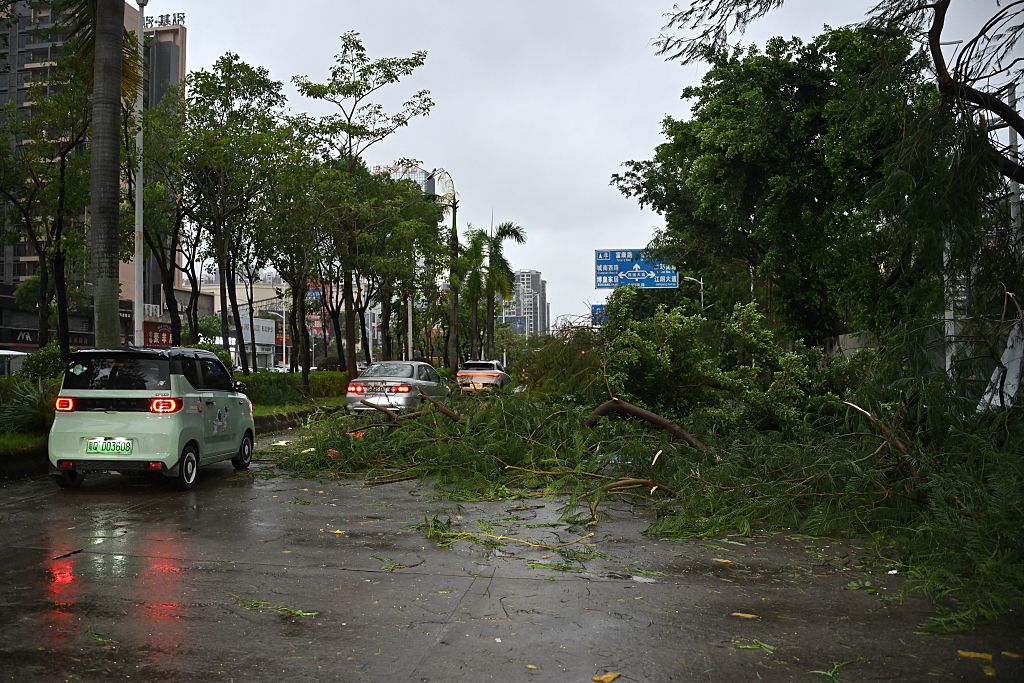
Typhoon “Hongxia”, the twelfth typhoon of the year, is rapidly intensifying and approaching the coast of Guangdong. It is expected to make landfall late on July 25th to the early morning of July 26th. In anticipation of the typhoon’s arrival, all railway services in Guangdong province will be suspended on the 26th. Meanwhile, multiple passenger ferry routes in Guangdong and Fujian have already been halted, and several maritime construction projects in southern Fujian have been put on hold.
As of 6 p.m. on July 24th, the official meteorological agency of the Chinese Communist Party, the China Meteorological Administration, has issued an orange typhoon warning for Typhoon “Hongxia”. At 5 p.m. on the same day, “Hongxia” had intensified to a strong tropical storm level, with its center located approximately 760 kilometers east-southeast of Shanwei, Guangdong in the Bashi Channel, with maximum winds near the center reaching force 10.
The China Meteorological Administration forecasts that “Hongxia” is currently moving west-northwest at speeds of 25 to 30 kilometers per hour. It is expected to enter the northeastern South China Sea on the night of the 24th and make landfall along the coast of Guangdong, from Zhuhai to Raoping, on the evening of the 25th to the early morning of the 26th. At the time of landfall, maximum winds near the center can reach 12 to 13.
From 8 p.m. on the 24th to 8 p.m. on the 25th, strong winds are expected along the coastal areas of Fujian, eastern and central Guangdong, the Taiwan Strait, and the northeastern South China Sea. Wind forces in the areas traversed by the typhoon or near its center may reach 11 to 12, with gusts of 13 to 14.
From the 25th to the 27th, accumulated rainfall in eastern Guangdong, southern Fujian, and southern Jiangxi is predicted to be between 150 to 300 millimeters, locally reaching 400 to 500 millimeters, with isolated areas possibly experiencing up to approximately 600 millimeters of rainfall.
Due to the impact of the typhoon, high-speed and conventional trains within Guangdong province will gradually suspend service starting on the 25th, with a complete shutdown expected on the 26th. Specific train cancellations may still vary depending on the typhoon’s path and rainfall conditions.
Several maritime passenger services in Guangdong have also been halted. As of noon on the 24th, 13 passenger ferry routes and 27 ferry vessels in affected areas had been suspended.
According to the Guangdong Maritime Administration, 198 personnel from wind power platforms in the eastern Pearl River Delta have been evacuated, and over 5,000 personnel from affected offshore oil platforms have also been relocated. Traffic controls have been implemented on certain routes, and vessels have been instructed to steer clear of the typhoon’s impact zone.
By late on the 24th, parts of Chaozhou, Shantou, Jieyang, and Shanwei had issued various levels of typhoon warnings. Chaozhou has halted all activities in childcare facilities, while extracurricular training at off-campus educational institutions has been put on hold. The Nan’ao Bridge in Shantou plans to close starting from 4 p.m. on the 25th.
Southern Fujian’s maritime areas are also under the threat of the typhoon. The Fujian Maritime Department reported that 61 offshore construction projects in Quanzhou, Xiamen, and Zhangzhou have been suspended, with 202 construction vessels being relocated for safety.
Ship towing, sea trials, and other activities have been temporarily ceased, and small boats such as yachts have halted operations. Except for a few essential passenger routes, by 6 p.m. on the 24th, all 14 passenger ferry routes in the aforementioned three cities had suspended service.
After making landfall, “Hongxia” is expected to shift northward, with its outer cloud bands and residual circulation potentially affecting Zhejiang and other regions.
Zhejiang is expected to experience high temperatures and afternoon thunderstorms on the 24th and 25th, with maximum temperatures of 37 to 39 degrees Celsius in some northern areas. From the 26th to the 28th, due to the influence of tropical systems, Zhejiang will see an increase in showers and thunderstorms, though the specific range and severity of these weather conditions remain uncertain.
As “Hongxia” moves inland, subsequent rainfall may also affect Hubei, Anhui, Henan, and Shandong in the following days.