
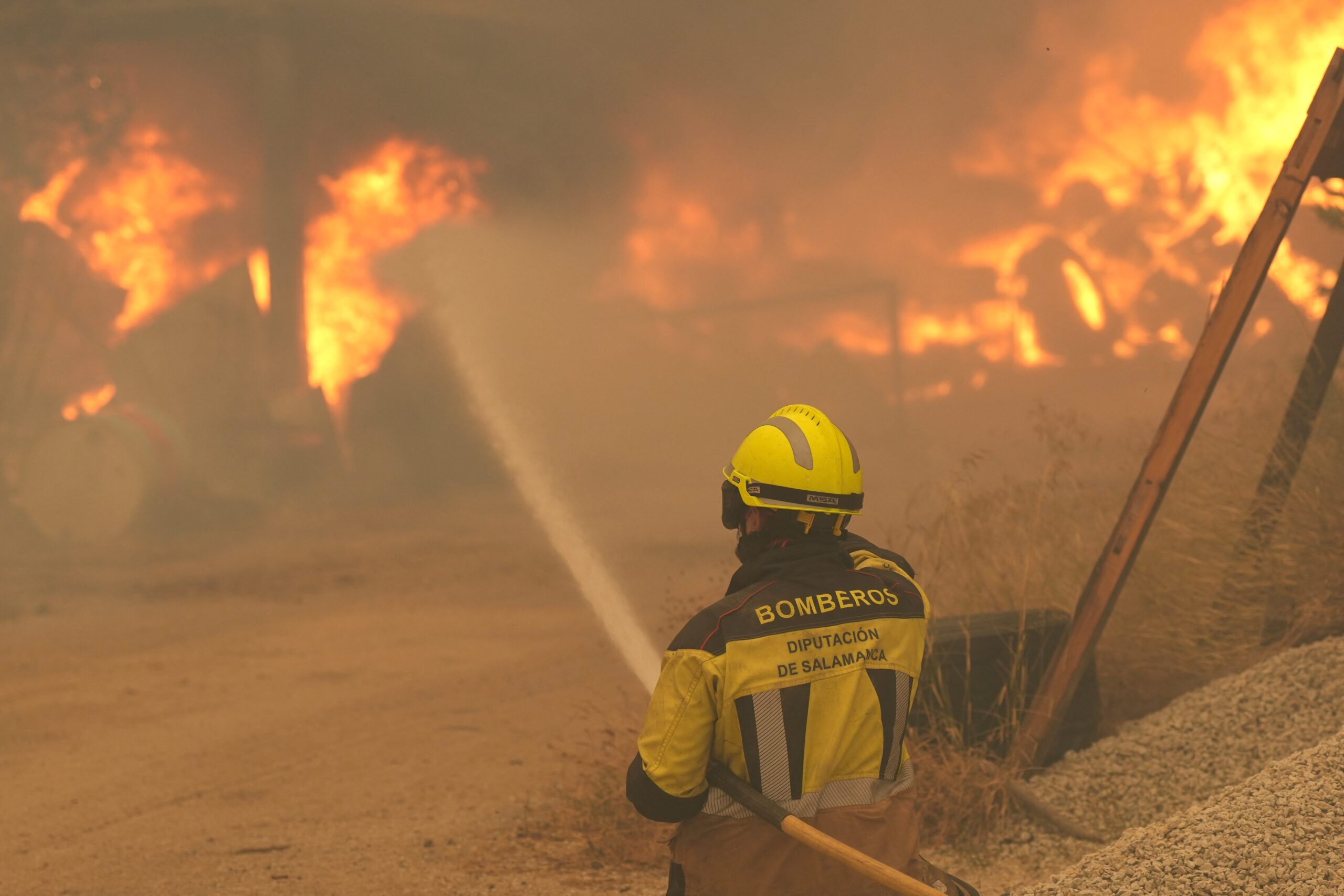
Europe is currently facing the most severe wildfire crisis in its history in the southwest of the continent. As of Saturday afternoon, multiple outbreaks of raging wildfires have resulted in nearly 300,000 people in France and Spain being displaced.
In the hardest-hit region of southwestern France, close to 200,000 people (197,000) have been urgently evacuated, while the number of those affected by the disasters in central Spain, along with those impacted by the fires and evacuation measures, has soared to around 80,000 people.
Fueled by strong winds and scorching temperatures, authorities in Spain have declared the fires near Madrid as the most severe in the region’s history. Particularly in Madrid and the neighboring province of Ávila, three major fires have merged, creating an extremely rare and intense inferno. Spanish Prime Minister Pedro Sánchez, while inspecting the command center, stated that 130,000 hectares of forests in Spain have been destroyed this year, surpassing the average level of the past decade.
Due to the rapid and uncontrollable spread of the fires, the Spanish government has declared a state of emergency for the first time, mobilizing up to 2,600 firefighters, police, and emergency personnel, along with 19 firefighting planes and helicopters deployed to the western battlefront. Fortunately, the drop in wind speed and temperatures on Saturday provided a “window of opportunity” to control the fires.
The heatwave hitting Europe earlier than usual has unleashed record-breaking high temperatures, turning forests and scrublands into potential tinderboxes.
In France, the fires are approaching Bordeaux, the sixth-largest city and famous wine region. Sophie Brocas, the prefect of the Gironde department, stated that strong winds from the west are pushing the fires towards the Bordeaux metropolitan area on an unprecedented scale. Authorities have issued mobile phone alerts in western suburbs such as Le Haillan, Eysines, and Mérignac, where Bordeaux airport is located, urging the emergency evacuation of thousands of residents.
Currently, over 1,300 firefighters are on standby in Gironde and Landes departments in the south. The Bordeaux Exhibition Center has been transformed into a temporary shelter capable of accommodating up to 10,000 people. The day before, authorities even dispatched boats to rescue stranded individuals in the popular resort area of Cap Ferret peninsula.
French Prime Minister Sébastien Lecornu described the wildfires as “unprecedented,” with fires in Gironde already generating their own strong winds. He emphasized, “Our top priority is very clear: protecting lives, evacuation orders must be followed without delay.”
In order to combat this “ongoing and extremely challenging” battle, French Interior Minister Laurent Nunez announced that the government has mobilized additional military reinforcements. The French Air Force is preparing to deploy a specially modified A400M large transport aircraft for the first time, capable of releasing up to 20 tonnes of fire retardant and water in a single drop, three times the payload capacity of the mainstream Canadair firefighting aircraft. This behemoth aircraft will join an aerial firefighting team consisting of 18 water bombers and helicopters.
Furthermore, due to thick smoke blanketing the area, authorities are urgently distributing 1.5 million respiratory masks to the Gironde region. The disaster has even disrupted sporting events, as the Paris police announced on Saturday that due to the need to divert a large number of police forces to assist in the southwestern fires, the final stage of the Tour de France cycling race scheduled for Sunday will be shortened by one-third, from the original 133 kilometers to 89 kilometers.
Although the wildfires ignited by the consecutive record-breaking heatwaves have been fierce, they have unfortunately claimed the lives of two French firefighters near Bordeaux airport, with dozens more firefighters injured. Faced with the extreme disaster, several European countries including Italy, Greece, the Netherlands, Portugal, Croatia, the Czech Republic, and Slovakia have extended a helping hand, deploying rescue aircraft to support the frontlines in France and Spain.
(References: BBC, Associated Press, etc.)