
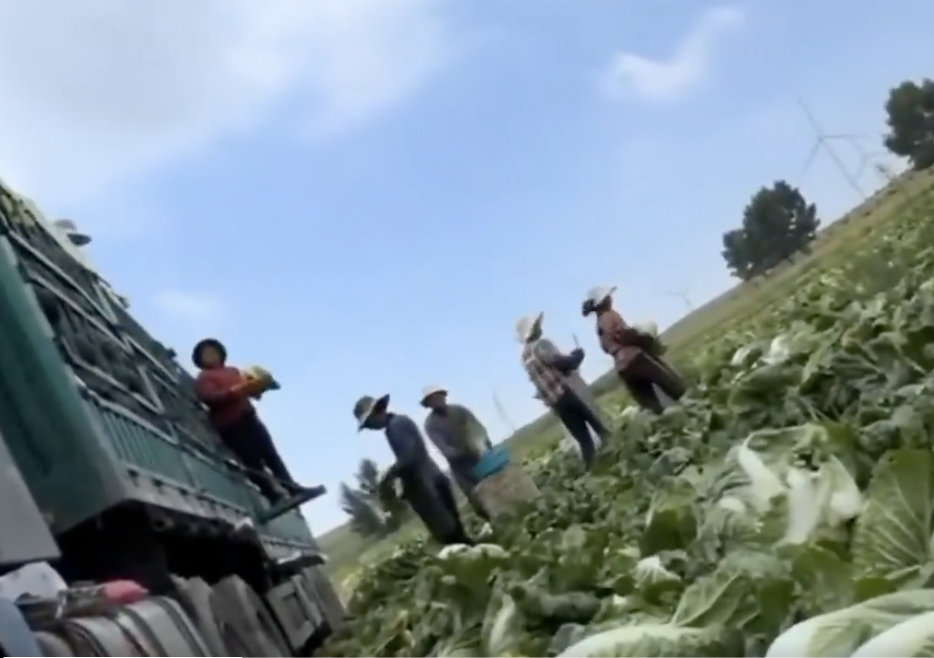
Recently, in Kangbao County, Zhangjiakou City, Hebei Province, it was discovered that operators were using formaldehyde solution to preserve Chinese cabbage during the procurement process, raising concerns about food safety. According to reports, there are four other types of food in mainland China that are also common areas for adding formaldehyde.
Kangbao County in Zhangjiakou City, Hebei Province, is an important production area for Chinese cabbage in China. Environmental blogger “Fisherman Qi Ge” recently conducted on-site investigations and found that Chinese cabbage buyers would dip the cabbage in “formaldehyde solution” before loading them onto trucks for preservation, and then sell them to Jiangsu, Anhui, and other places.
Formaldehyde is an industrial chemical that has long been classified by the World Health Organization (WHO) as a Group 1 carcinogen, strictly prohibited for use in food processing.
In addition to Chinese cabbage, according to reports from various mainland Chinese media outlets, there are four other types of food that are considered “hotspots” for the illegal addition of formaldehyde, including animal offal, pickled peppers with chicken feet, freshwater fish such as hairtail and silver fish, as well as dried goods like glass noodles and tofu skin.
For example, when offal, tripe, and honeycomb tripe appear abnormally snowy white and translucent, feel stiff, lack natural color, and have a pungent medicinal aroma, these are likely problematic ingredients. Chicken feet with pickled peppers that are excessively white, excessively chewy, and have a faint chemical odor or lack the normal meaty aroma may also be the result of soaking in formaldehyde or other substances by the sellers.
Furthermore, after soaking in formaldehyde, freshwater fish such as hairtail appear brightly colored, lack a natural fishy smell, and have firm flesh. Quality glass noodles and tofu skin should be flexible and break easily, while problematic dried goods are extremely difficult to break, do not turn soggy after prolonged soaking, and lack a natural aroma.
Experts warn that even with high-temperature cooking, formaldehyde combined with protein in food is difficult to completely remove. They urge consumers to avoid purchasing ingredients of unknown origin, with abnormally bright colors, or with a medicinal aroma.