
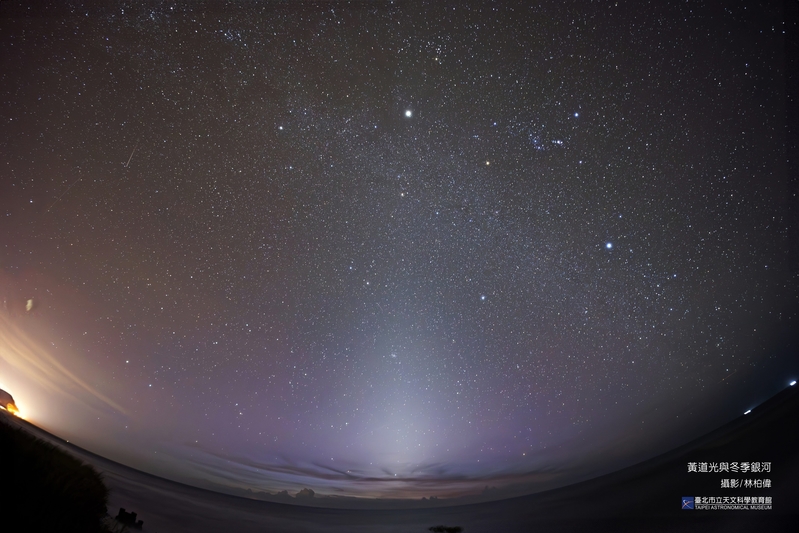
On September 23 at 8:05 am, this year’s Autumn Equinox will arrive, marking one of the twenty-four solar terms and an important astronomical event. During the Autumn Equinox, the sun shines directly on the equator, rising in the east and setting in the west, with approximately equal length of day and night. After the equinox, the position of sunrise and sunset gradually shifts southward, leading to shorter days and longer nights until the Winter Solstice. It is also a great time to observe the “zodiacal light” around the Autumn Equinox, a rare and mysterious glow visible in the eastern sky before dawn in locations with minimal light pollution.
The term “Autumn Equinox” is often interpreted as the day and night being of equal length. However, based on actual sunrise and sunset times in Taiwan, the duration of daylight and darkness on the day of the Autumn Equinox is not exactly 12 hours each. This is due to the refraction of sunlight by Earth’s atmosphere, causing the sun to appear slightly higher than its actual position, resulting in daylight being slightly longer than 12 hours. For instance, in Taipei, on September 23, the sunrise is at 5:43 am and sunset at 5:50 pm, making the daylight around 12 hours and 7 minutes, with a closer approach to equal day and night occurring a few days after the equinox.
In astronomy, the Autumn Equinox refers to the moment when the sun passes through the “Autumn Equinox point.” According to the Taipei Astronomical Museum, this point is the intersection of the ecliptic and the celestial equator on the celestial sphere, located opposite to the Vernal Equinox point. Following the Autumn Equinox, the sun’s position on the celestial sphere gradually shifts southward each day, leading to longer nights and heralding a period suitable for stargazing.
The Taipei Astronomical Museum suggests that in the weeks around the Autumn Equinox, observers can look towards the eastern sky about 2 to 3 hours before dawn on clear mornings to potentially witness the elusive zodiacal light. This phenomenon results from sunlight scattering off tiny dust particles in the solar system’s ecliptic plane, forming a faint white triangular cone, with a base width of around 40 degrees and a height of up to 70 degrees. Its brightest point is comparable to the luminosity of the Milky Way, highlighting the need to view it from locations far from urban light pollution and air contamination.