
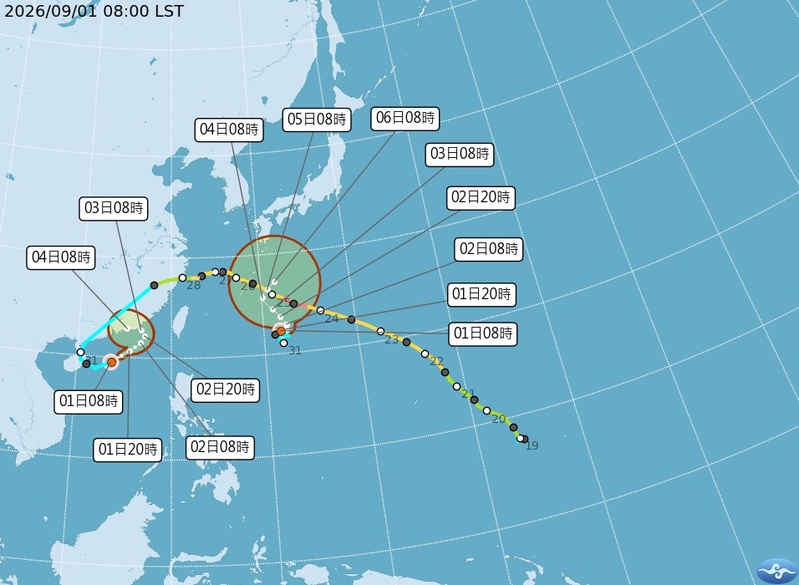
Typhoon Sadel made landfall in Zhejiang, China on August 28 and weakened, but with the replenishment of moisture from a large low-pressure zone, it regained strength and was upgraded to a tropical depression on the morning of September 1. There have been cases in the past where typhoons weaken to tropical depressions and then re-intensify, even striking Taiwan again. Let’s take a look back at those “resurrected” typhoons and their impacts.
Typhoon Wayne was generated on August 16, 1986, and ended on September 6, lasting for 22 days. Wayne had a peculiar path that affected Taiwan back and forth that year, with the Central Weather Bureau issuing 3 maritime and land typhoon warnings.
On August 22, Wayne made landfall near the Zhuoshui River estuary, passing through Yunlin and Nantou, heading north from Hualien, looping near Ishigaki Island.
On August 24, Wayne began moving southwest towards Taiwan, landing south of Dawu in Taitung in the evening, weakening, and further dissipating into a tropical depression off the coast of Kaohsiung.
On the morning of August 28, Wayne strengthened to a mild typhoon over the waters north of Luzon, moving north-northeast, threatening Taiwan for the third time. It lingered unpredictably near the waters south of Orchid Island, then gradually shifted westward on the evening of September 1.
Wayne brought heavy rains to Taiwan that year, with the total and daily rainfall amounts highest in Alishan, Chiayi County at 520.7 and 470.3 millimeters respectively. This led to severe losses in central and southern Taiwan as well as the Penghu Islands, with 68 deaths, 19 missing persons, 6,624 collapsed houses, and 31,532 partially collapsed houses. Typhoon Wayne was the first in Taiwan’s meteorological history to make landfall from the central region and caused a serious natural disaster at the time.
Typhoon Nate was generated on September 16, 1991, initially moving westward near the Dongsha Islands before reversing eastwards, then south of Miyako Island turning northwest. Nate rapidly intensified into a severe typhoon on the 22nd and made landfall in Hengchun Peninsula on the 23rd, swiftly crossing the southern tip of Taiwan before heading west and weakening into a tropical depression.
On the evening of September 28, 1991, Typhoon Nate strengthened again to a mild typhoon westward of Luzon, traveling northward into the Bashi Channel near the northeast waters of the Dongsha Islands, then turned northwest and landed near Shantou, China on October 1. The Central Weather Bureau issued 2 maritime and land typhoon warnings for Typhoon Nate.
Typhoon Bebeng, generated on August 8, 1998, made landfall in the northern Philippines, then moved west to the South China Sea, weakened to a tropical depression, and re-intensified to a mild typhoon on the 9th. Its path continued northwest then west-northwest, landing in Guangdong Province, China on the 11th, with no impacts on Taiwan at that time.
Hagibis, developed in the South China Sea on June 14, 2014, first made landfall in Guangdong, then went back to sea off Fujian, dissipating into a tropical depression. It then bypassed the northern waters of Taiwan and re-intensified into a typhoon in the vicinity of the Ryukyu Islands.
Typhoon Halola originally formed in the Central Pacific and on July 13, 2015, crossed the International Date Line into the northwestern Pacific, still far from Taiwan. It briefly strengthened into a typhoon but gradually weakened into a tropical depression due to unfavorable conditions. However, with improved sea conditions around it, the eye reformed and it intensified back into a typhoon, moving towards Japan and eventually making landfall on Kyushu on July 26, rapidly dissipated thereafter.
Typhoon Lupit, which formed on August 3 in the South China Sea, moved towards Japan, maintaining its typhoon intensity along the Chinese coast, weakening to a tropical depression when passing Taiwan, and re-intensifying into a typhoon near the waters of the Ryukyu Islands, bringing heavy rains to central and southern regions.
Typhoon Zoella developed on July 23 in the western waters of the Philippines, then passed through and made landfall in the northern part of the Philippines before weakening into a tropical depression. Due to favorable atmospheric conditions around the Ryukyu Islands, Zoella regained typhoon status, moving west-northwest, landing successively in Zhoushan and Shanghai in Zhejiang, and gradually weakening.