
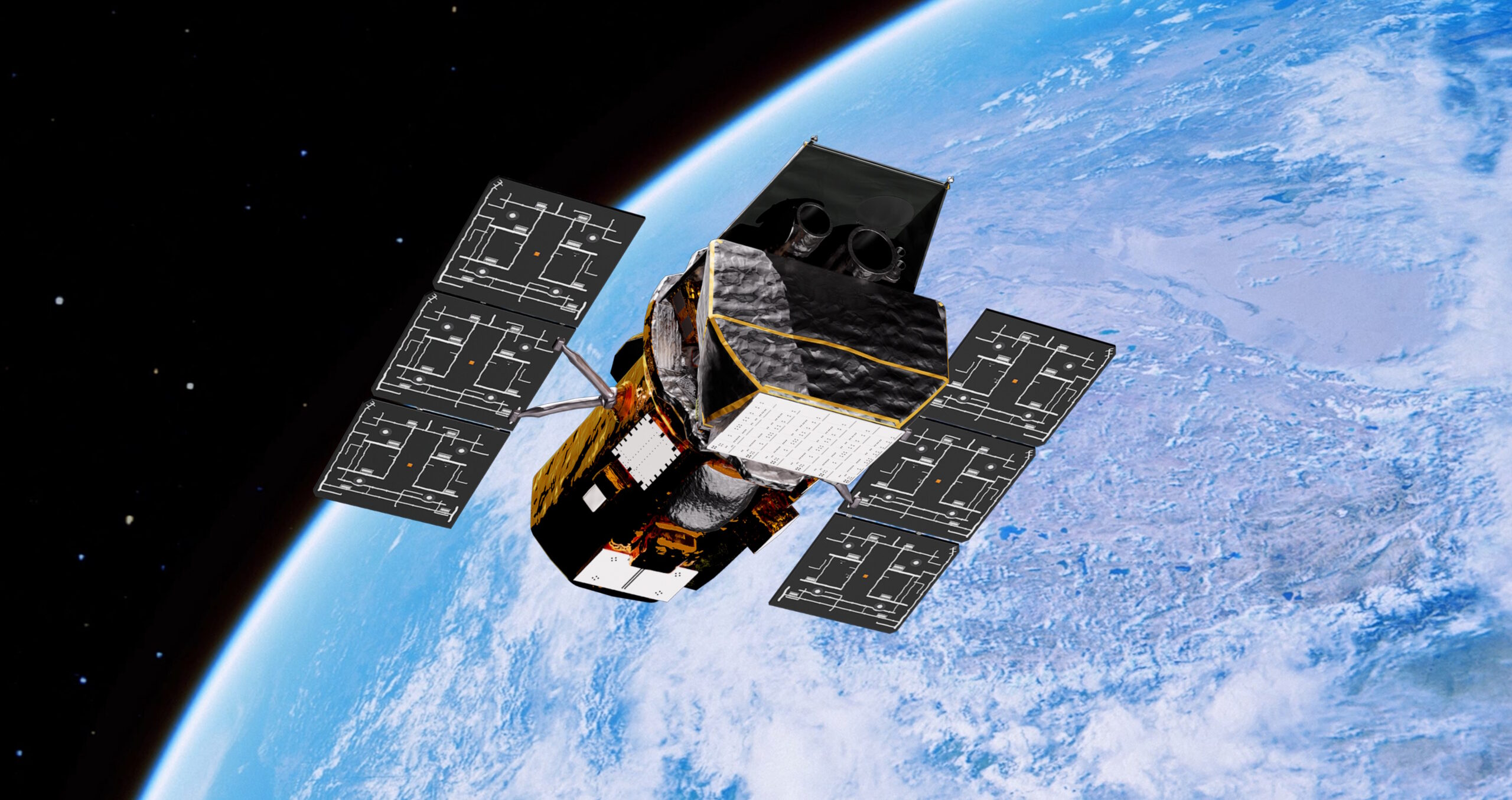
The National Aeronautics and Space Administration (NASA) has reported that the “Swift” satellite dedicated the past 22 years to the study of some of the most powerful energy bursts known in the universe. On Wednesday, November 4, the “Swift” satellite gracefully exited its orbit, descending through the Earth’s atmosphere over Indonesia, where it “burned to its last ember.”
Weighing approximately 3,200 pounds (1,452 kilograms), this satellite, officially known as the Neil Gehrels Swift Observatory, had its mission cut short just three months ago when NASA attempted to boost its orbit to extend its operational life. Unfortunately, this “rescue” mission was deemed unsuccessful.
According to NASA, the United States Space Force confirmed that the Swift satellite re-entered the atmosphere at 7:39 AM Eastern Time on Wednesday. At that moment, it was traveling at around 22 times the speed of sound while entering the atmosphere above North Sumatra in Indonesia, situated about 200 miles (322 kilometers) north of the equator.
NASA estimated that the friction from re-entry would incinerate most of the satellite’s structure at a high altitude, leaving only small remnants to fall to the ground. Fortunately, the agency reported that there were no incidents involving injury or damage to property caused by debris.
Prior assessments by the U.S. Space Force indicated that the Swift satellite posed a minimal risk to densely populated areas, with the likelihood of causing harm to individuals on the ground estimated at just one in 2,100.
In a statement to Reuters, Dean Sladen, an aerospace engineer with Accu Components, a UK-based industrial parts supplier, noted before the satellite’s re-entry: “We expect only a few small, charred pieces to fall to the ground, which would be virtually unrecognizable as having belonged to a satellite telescope.”
The Swift Observatory was launched into low Earth orbit on November 20, 2004, marking an impressive 22 years of operation. The mission of this telescope was to search for violent explosive events in the universe, including gamma-ray bursts and supernovae. The satellite earns its name “Swift” because of its ability to rapidly pivot and respond to such phenomena.
NASA highlighted that Swift not only detected more than 1,600 gamma-ray bursts and over 1,400 stellar explosions, but it also functioned as a “forerunner” to the Hubble Space Telescope and the James Webb Space Telescope. By sending alerts to these and other observatories, Swift provided crucial opportunities for more in-depth studies of relevant celestial bodies and events.
In a recent blog post, NASA stated, “Swift has expanded our understanding of various cosmic objects and phenomena, from active galaxies driven by supermassive black holes and stars exhibiting X-ray flares to supernova explosions and even comets and asteroids within our own solar system.”
Since its launch in 2004, Swift has contributed valuable data that has supported the publication of approximately 7,000 scientific papers.
Originally, Swift was designed for a two-year mission duration but continued operating until last month. Its eventual descent was precipitated by solar activity, which caused its orbital altitude to decrease, eventually leading to its return to Earth.
In July, NASA commissioned Katalyst Space to attempt to rescue the Swift satellite. They deployed a robot named “Link,” equipped with three robotic arms, in hopes of pushing the satellite back to its designated orbit. However, the robot encountered a malfunction shortly after launch and failed to reach within the 7-mile (about 11 kilometers) vicinity of Swift.
By August, NASA made the decision to permit Swift to re-enter the Earth’s atmosphere. The robot, unfortunately, followed suit and re-entered in September.
Swift continued transmitting observational data until late October when NASA determined that its orbital altitude was too low to sustain stable operations, prompting the agency to shut down its systems.
John Nousek, an astronomer from Pennsylvania State University who led the Swift control team, remarked on Monday, “We had anticipated this day long before Swift was launched. The truth is, any object sent into low Earth orbit will eventually fall back to Earth, and this type of conclusion often comes with devastating consequences.”
Nousek further expressed, “We sincerely hope that the lessons learned from Swift’s successful mission can be applied to the next generation of space missions, accelerating our exploration and discoveries about the cosmos.”