
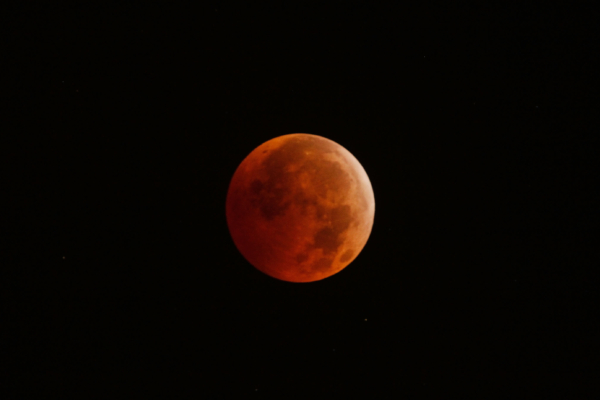
New York City is set to witness a partial lunar eclipse on the night of August 27th (Thursday) into the early hours of the 28th, which will be close to a penumbral lunar eclipse. According to the latest data from the National Aeronautics and Space Administration (NASA), the eclipse is expected to reach its deepest point at around 12:13 a.m. on the 28th, with about 96.3% of the lunar surface entering the Earth’s umbra, potentially giving the moon a coppery-red hue. However, weather forecasts for New York that evening predict showers and thunderstorms, which may affect visibility.
This lunar eclipse occurs when the Earth comes between the Sun and the Moon, casting its shadow onto the lunar surface. NASA categorizes this event as a “deep partial lunar eclipse,” not a total lunar eclipse; although often referred to as a “blood moon,” a small portion of the lunar surface will remain outside the umbra during the deepest phase.
In New York, the subtle penumbral phase is expected to begin at 9:23 p.m. on the 27th, followed by the partial eclipse starting around 10:34 p.m., reaching its peak at 12:13 a.m. on the 28th; the partial eclipse will end at 1:51 a.m., with the entire eclipse concluding at 3:01 a.m.
NASA clarifies that the 96.3% figure refers to the “area ratio” of the lunar surface entering the Earth’s umbra, indicating the coverage rate rather than the proportion of the lunar diameter being shadowed. This lunar eclipse can be observed in most parts of the Americas, Western Europe, and West Africa, with New York falling within the visible range.
Weather conditions will be a crucial factor in determining whether New Yorkers will be able to enjoy the spectacle. Current forecasts suggest a high chance of showers and thunderstorms in the city on Thursday night, with an 80% chance of precipitation. If the clouds briefly clear around midnight, there is still a chance for the public to witness the coppery-red moon nearing the peak eclipse.
If weather permits, observers can gaze towards the south-southeastern sky around midnight and choose waterfront parks, beaches, or other open areas with less artificial obstruction for optimal viewing. The lunar eclipse can be safely observed with the naked eye, without the need for eclipse glasses; for a closer look at the details, binoculars or small telescopes can be used.
This lunar eclipse belongs to Saros Cycle 138, with the previous eclipse in this cycle occurring in 2008 and the next one set to appear in 2044. The next significant lunar eclipse in New York is expected at the end of 2028, with a chance to witness a total lunar eclipse in June 2029.