
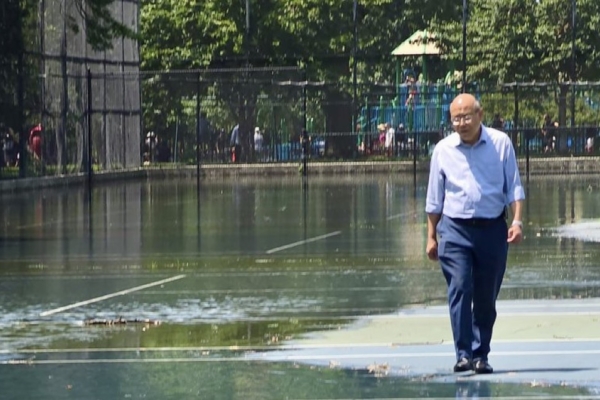
After heavy rainfall brought flooding to parts of Queens following a storm on the morning of the 23rd, New York City Councilman Phil Wong wrote a letter to Mayor Mamdani, urging the city government to adjust resource allocation and increase investment in drainage systems and flood prevention infrastructure to address the long-standing issues of standing water and flooding in the affected communities.
Wong stated, “Throughout the morning, I have received continuous messages and photos showing certain areas in my district looking like lakes. This marks the fourth severe flooding incident in just the past month. It is no longer a once-in-a-decade occurrence but a repeatedly happening event within a month. However, the current administration’s response remains the same: waiting until water has flooded residents’ homes before issuing press releases, distributing sandbags, and arranging photo ops.”
Residents are left repeatedly cleaning up damaged items and drying out their basements, unsure of when the next heavy rain will bring flooding once again.
In his letter, Wong called for the reallocation of hundreds of millions of dollars by the city government to be used for the Department of Environmental Protection (DEP) and crucial flood mitigation projects.
He specifically mentioned reexamining funds diverted from the Water Board, as well as expenditures on projects like new office spaces at City Hall, to redirect more resources into essential infrastructure. “Every year, billions of dollars are siphoned off from the Water Board through so-called rental payments. Many New Yorkers may consider it a form of covert tax because this money is not being used to maintain the water infrastructure paid for by water ratepayers.”
“In just this fiscal year, over $300 million will be taken from ratepayers, increasing to $393 million by the 2029 fiscal year. Your appointed DEP Commissioner has already publicly acknowledged that this money is not being used to enhance the city’s flood resilience efforts.”
“While my constituents are busy draining water from their basements and disposing of belongings ruined by water, City Hall is diverting hundreds of millions of dollars from water fee revenues to elsewhere,” Wong remarked.
Wong proposed various measures, including increasing the frequency of catch basin and sewer cleaning, constructing additional drainage and water storage facilities, aiding homeowners in flood-prone areas to improve drainage on private community roads, supervising utility construction projects to prevent reduced green spaces or redirected surface runoff towards residences, and drafting long-term plans to expand the drainage capacity of New York City’s sewer system.
Wong emphasized that the repeated flooding in some communities has shown that the local drainage infrastructure is ill-equipped to handle heavy rain, urging the city government to prioritize addressing these long-standing issues.
“Provide the resources needed for the DEP Commissioner to tackle the problem,” Wong said. “Basic infrastructure should take precedence over other political projects.”