
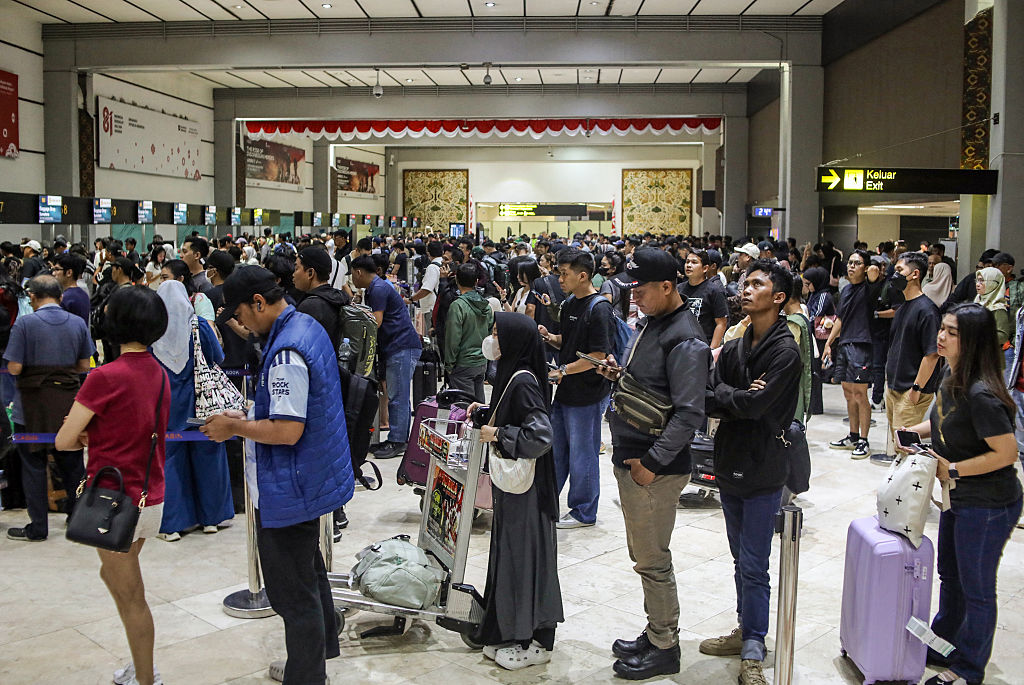
Indonesia’s Anak Krakatau volcano erupted with significant intensity in the early hours of Sunday (September 6th), leading to the cancellation of all flights at the Soekarno-Hatta International Airport in the capital city Jakarta. Due to volcanic ash drifting over the western part of the country, flights at seven other nearby airports were also temporarily suspended.
The Indonesian Geological Department reported that Anak Krakatau erupted at 3:53 am on Sunday, with a stronger eruption lasting for 30 seconds, followed by another eruption approximately 3 hours later lasting for 16 seconds. CCTV footage showed the volcano spewing out a large amount of volcanic ash and lava.
This volcanic island is located in the Sunda Strait between Java Island and Sumatra Island, and it started erupting last Friday, with signs of increasing activity observed on Saturday.
Following the two stronger eruptions on Sunday, Indonesia closed the country’s main airport, Soekarno-Hatta International Airport, and seven other airports. As of Sunday night local time, 1558 flights were canceled, leaving around 170,000 passengers stranded, with 963 flights canceled at Soekarno-Hatta International Airport alone.
After detecting volcanic ash in the airspace around Soekarno-Hatta International Airport, authorities initially announced the suspension of airport operations from 1:30 am to 5:30 am local time on Sunday.
In a statement, the Indonesian Ministry of Transportation mentioned that the operational suspension had been extended multiple times and the latest extension would continue until midnight.
Due to the dispersion of volcanic ash in many areas of Jakarta and Lampung province at the southern end of Sumatra Island, the other seven airports were also forced to halt operations.
The Directorate General of Civil Aviation in the Indonesian Ministry of Transportation stated that they are closely monitoring the impact of this volcanic eruption on air travel and coordinating with airlines, airport operators, aviation navigation service providers, and meteorological departments.
There have been no reports of casualties so far, and Indonesia has not issued any evacuation orders. The nearest residential area to the volcano is 16 kilometers (10 miles) away, but authorities have warned residents and tourists to maintain at least a 3-kilometer (2-mile) distance from the active crater.
Lana Saria, the head of the Indonesian Geological Department, mentioned that the activity of Anak Krakatau volcano has been increasing since July, and Sunday’s eruption was the most intense during this period. She noted that the main hazards posed by this volcanic eruption include volcanic ash, high concentrations of gases, hot rock magma, and other substances ejected around the crater.
However, she added that the recent series of volcanic eruptions are not expected to trigger tsunamis at the moment.
Indonesia lies in the Pacific Ring of Fire, with over 120 active volcanoes throughout the country, experiencing frequent earthquakes and volcanic activities.
In 2018, an eruption of Anak Krakatau triggered a tsunami, resulting in the deaths of 429 people and displacing thousands.