
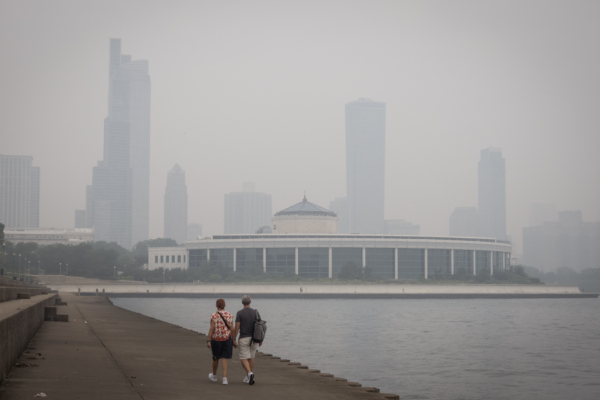
The orange haze that has loomed over the skies of New York for days has finally dispersed, and the acrid smell of burning has quietly faded away, allowing New Yorkers to breathe a sigh of relief and feel at ease. However, the city government has simultaneously issued a warning that as long as the wildfires in Canada are still burning, heavy smoke and dust could return at any moment.
On Sunday the 19th, the New York City government announced that with the shift in air currents and the cleansing effect of the heavy rainfall that swept across the city on the 18th, the smoke and dust from the Canadian forest fires have officially moved out of the greater New York area. Officials confirmed that New York has just weathered the “second most severe” air pollution crisis in modern meteorological records.
This wave of wildfire smoke descended on New York from last Wednesday (15th), causing the city’s air pollution index to skyrocket to dangerous levels. Official monitoring showed that this crisis reached its most threatening peak late on the 16th, with the Air Quality Index (AQI) in the New York area soaring to 289, classified as “extremely unhealthy.”
In New York’s modern history, only the century’s wildfire haze in June 2023 was more severe than this time, with the AQI reaching a hazardous level of 484.
This serious air pollution crisis coincided with an extreme heatwave engulfing the U.S. East Coast. Fortunately, a torrential downpour on the 18th thoroughly washed away the particulate matter in the air, successfully alleviating the smoke and dust crisis. By the morning of the 19th, the AQI in the greater New York area had dropped significantly to 78, returning to a level of “good to moderate.”
Faced with two consecutive years of severe haze lockdowns in the past four years, many New Yorkers are puzzled: doesn’t Canada have forest wildfires every summer? Why did New York get affected in 2023 and this year when previous years were calm?
Meteorological experts point out that this is not a coincidence but rather due to the convergence of three extreme conditions: “geography, climate, and wind direction.”
1. Precise wildfire placement to the “due north”:
Canada’s vast territory normally sees wildfires in the distant west (such as around Vancouver), making it difficult for smoke to reach the east coast. However, the fire locations in 2023 and this year were incredibly concentrated in Quebec and Ontario—directly to the north of New York, essentially igniting at New York’s doorstep.
2. “Powder keg” caused by extreme drought:
Affected by global climate change, eastern Canada has experienced unprecedented warm winters and extreme spring droughts in recent years. The ground is extremely dry, and when lightning strikes, it triggers massive fires, producing a volume of smoke and dust far beyond what nature can dilute.
3. Air pressure acts as a “straight express delivery” for smoke and dust:
During both crises, a special low-pressure system formed between the U.S. East Coast and Canada, acting like a giant “counterclockwise fan,” generating strong north and northeast winds that created a “highway” for smoke and dust, unabatedly pouring southward directly towards New Jersey and New York.
New York City Mayor Mamdani issued a statement on Sunday highly commending the various departments for their response in the face of this dual extreme climate challenge of “high temperatures and haze.” However, the New York City Emergency Management Agency (NYCEM) issued a warning: as of last Saturday, nearly 200 forest wildfires were still burning fiercely in northwestern Thunder Bay, Ontario. Among them, 73 wildfires were in a “completely uncontrolled” state, with the area burned reaching 1.7 million acres.
The city government reminds citizens that as long as the northern wildfires continue to burn, if the atmospheric circulation shifts back to a northerly wind in the coming weeks, the deadly smoke and dust could return at any time. It is crucial to stay informed about the weather conditions and be vigilant against the possibility of recurring air pollution.