
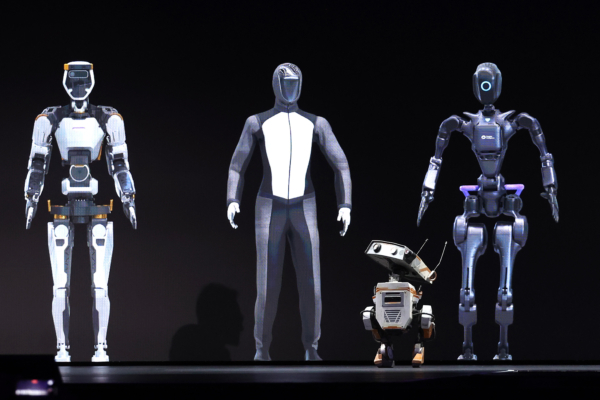
San Mateo County in California may become the state’s first county to regulate humanoid robots for commercial use.
The Board of Supervisors of San Mateo County adopted a resolution proposed by Supervisor Ray Mueller on August 11, instructing county government legal and administrative staff to draft regulations governing the use of cable-free, autonomous, or semi-autonomous humanoid robots, known as “Mobile humanoid robots,” in restaurants, retail stores, and other commercial establishments.
According to a county government memorandum, current state laws regulate autonomous vehicles but do not have specific provisions for the commercial use of humanoid robots. The resolution aims to establish a comprehensive licensing procedure to regulate the commercial deployment and operation of such robots within the county.
Several companies have already begun pilot projects with humanoid robots.
For example, in a pilot program launched by Tau Robotics on July 28, invited San Francisco residents were offered cleaning services at a rate of $30 per hour. According to the company’s website, these robots are controlled jointly by humans and artificial intelligence.
The county government memorandum states that establishing a licensing system before widespread use of these robots will “encourage responsible integration of emerging technologies in a manner that serves the public interest.”
The resolution instructs county government staff to consider requiring companies to pay annual fees specifically for equipping local frontline emergency personnel with hazardous material handling and firefighting equipment to address the risks associated with the use of lithium-ion batteries in robots.
“In recent years, we have seen an increase in fires caused by thermal runaway of lithium-ion batteries,” said Rich Seguine, vice chairman of Local 2400, representing San Mateo County firefighters, during a public comment at the board meeting. “The funding from this type of resolution can be used to purchase necessary specialized equipment.”
The resolution also aims to require robots to be equipped with an easily accessible emergency “kill switch,” have a good manufacturer safety record, and be supervised on-site by trained personnel.
Julie Lind, a member of the San Mateo Labor Council, stated in an online public comment that technological advancements and worker protection are not mutually exclusive goals.
Lind said, “Businesses should understand and consider the impact of deploying this technology on people, including the potential loss of job opportunities.”
Non-humanoid robots are already being used in some local commercial sectors, including Cafe X at San Francisco International Airport, Artly Coffee at Stonestown Galleria in San Francisco, and sidewalk robot delivery company Coco Robotics.