
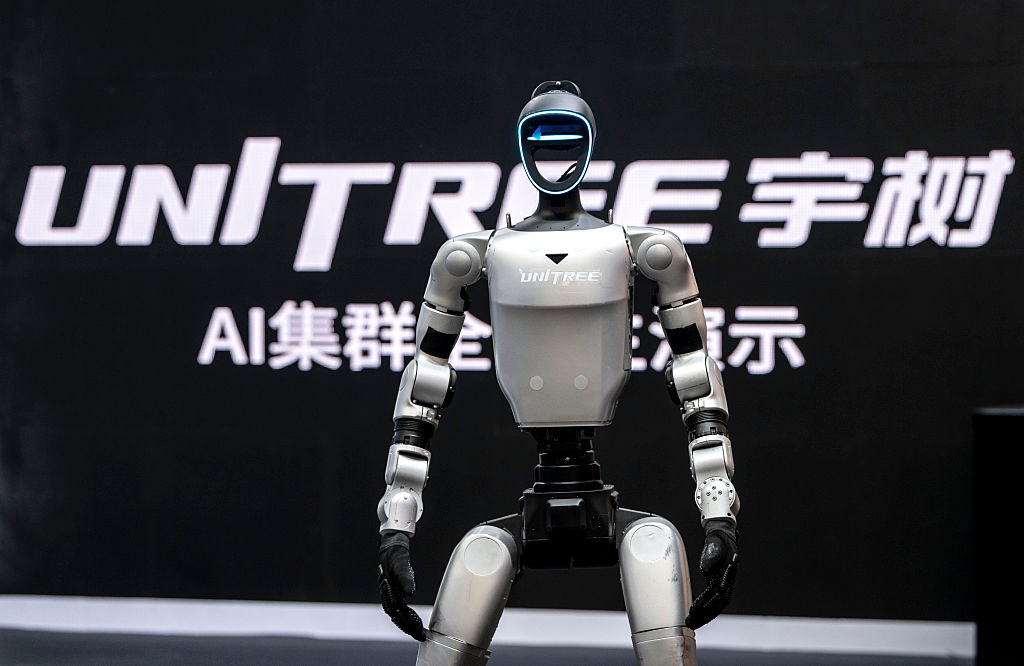
On August 19, 2026, the Chinese robot company Yushu Technology went public, with its stock skyrocketing by 629.44% at the opening before significantly dropping, closing with a 460.34% increase from its initial public offering price. On the same day, over a hundred robot concept stocks experienced declines, with many of them hitting their maximum downward limits.
Yushu Technology had an IPO price of 150.80 Chinese Yuan per share. Based on this price, the company’s market value was approximately 61 billion Yuan.
Throughout the trading day, the stock opened at 1100 Yuan, marking a 629.44% increase from the IPO price. The opening price also stood as the highest price of the day. Subsequently, the stock price fluctuated downward, ultimately closing at 845 Yuan, a 23% decrease from its peak but still up by 460.34% from the IPO price.
Yushu Technology saw a total trading volume of 23.16 billion Yuan for the day. According to the “Daily Economic News,” the company’s price-to-earnings ratio at the opening exceeded 800 times based on current profits. Even as the stock price dropped to around 880 Yuan by midday, the ratio remained over 600 times.
While Yushu Technology garnered strong investment interest, related industry chain stocks collectively experienced declines. As reported by the “First Financial,” by midday, a trading fund tracking robot-related stocks – the Robot ETF Guangfa – dropped over 7%, with the humanoid robot index falling more than 6%, and over a hundred concept stocks recording losses.
Stocks such as Qin’an Holding, Zhongdali De, and Julun Intelligent hit their downward limits, while companies like Shangwei New Materials dropped over 18%, Funguang Precision over 14%, and Greende Harmony and Haozhi Electromechanical over 12%. The selling pressure persisted till the closing bell, with many robot-themed funds declining by over 9%.
In the afternoon of the same day, Hong Kong stocks such as Lai Fu Harmony dropped over 14%, while Uuixuan and Yuejiang saw declines exceeding 10%.
The “Daily Economic News” suggested that the influx of funds into Yushu caused a diversion of capital from other robot stocks. Additionally, the sector had been hyped up since August, and after the IPO news materialized, some investors concentrated on selling to lock in profits.
Citing an investment institution source, the “First Financial” reported that Yushu currently focuses its commercial applications on quadruped robots and humanoid robots in specific scenarios such as research and performance. The current stock pricing more so reflects market sentiment and scarcity of the stock.
Yushu Technology acknowledged in its prospectus that large-scale commercialization of humanoid robots still faces uncertainties, with risks of progress falling short of expectations.
An August 19 report by Deutsche Welle stated that many of Yushu’s products are one-time sales, with a large portion going to universities and research institutions, while the true commercial application remains minimal.
Analyst Su Lianjie from the technology research institution Omdia expressed that robot care for the elderly is still “very distant.” The current high valuations are built on the assumption that robots will eventually become general equipment; if this fails to materialize, the entire industry may face significant impacts.
Chinese economic expert Mike Li told Epoch Times that Yushu’s high valuation and the frenzy on its debut day are linked to factors such as the artificial intelligence boom, policies promoted by the Chinese Communist Party, and capital influx.
Public records indicate that during the first World Robot Conference in 2015, the Chinese Communist Party already prioritized robots and intelligent manufacturing as key areas for national technological innovation. Yushu Technology was founded the following year, capitalizing on the concentrated policy and capital investments in the Chinese robot and AI industries.
Mike Li believes that the frenzy surrounding Yushu’s debut is superficially driven by the AI enthusiasm but fundamentally part of the Chinese authorities’ efforts to create a “get-rich-quick myth” in the technology sector and attract more social funds into the AI industry.
He further noted that Yushu’s debut saw a turnover rate of 85.28%. With many investors choosing to take profits amid the stock’s meteoric rise, a significant amount of shares remain under lock-up provisions, requiring wait times for subsequent lifting, presenting substantial future risks.
According to Li, the Chinese government is “doubling down at all costs on the AI industry,” aiming to compete with the United States in the field of artificial intelligence.