
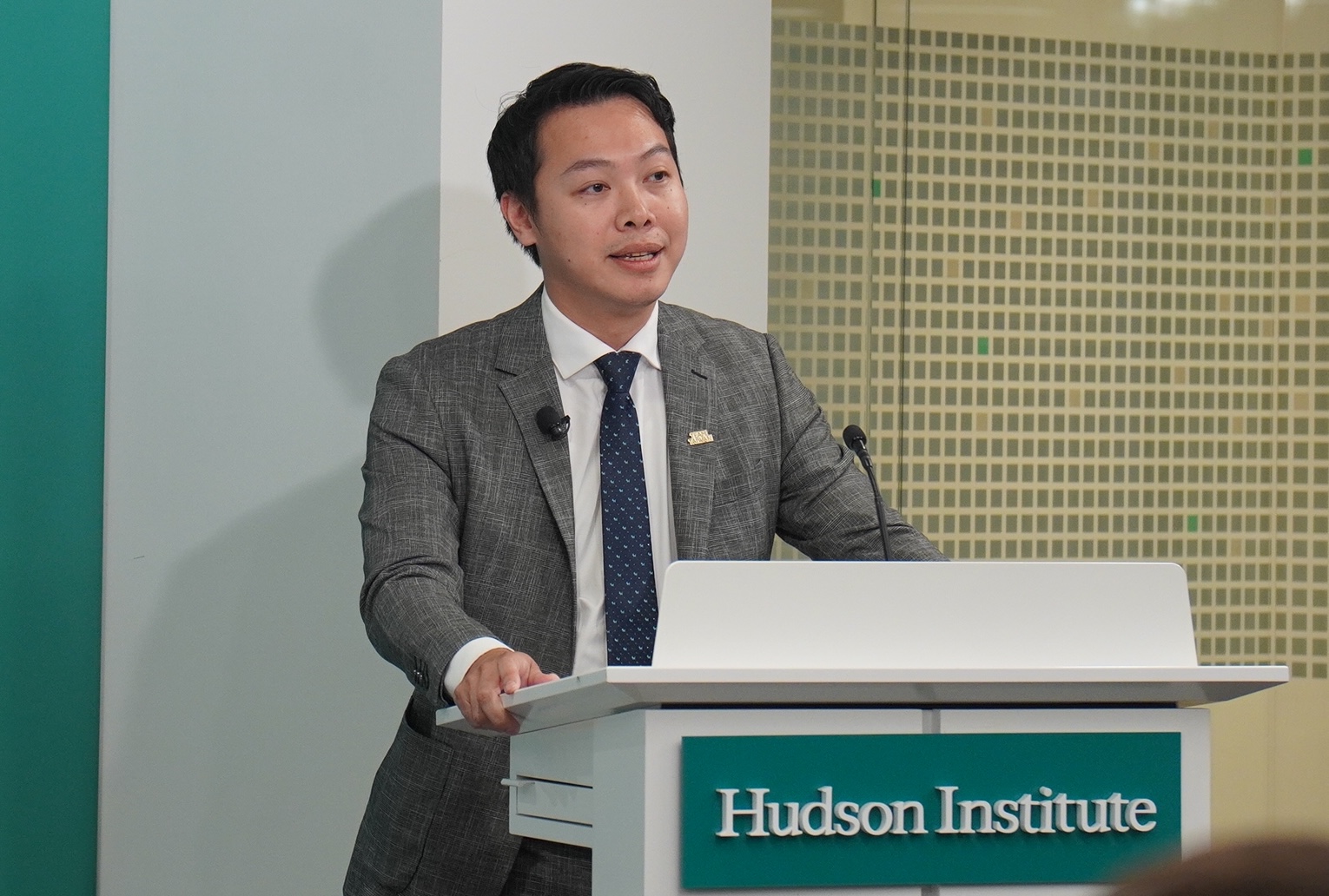
Taiwanese Judge KaiChieh (KJ) Hsu stated during a lecture at the Hudson Institute in Washington, DC, on July 10 that seemingly insignificant information such as military meals or daily training schedules could be entry points for Chinese Communist spies.
Hsu, who presides over cases involving national security, espionage, and infiltration at the National Security Court in Taipei, Taiwan, highlighted three major trends in spy cases in Taiwan over the past decade. He emphasized that seemingly trivial pieces of information have become targets for Chinese intelligence gathering.
One of the trends identified by Hsu is the shift from targeting “high-value targets” to “low-value information.” In the past, espionage activities were thought to mainly involve high-value targets like generals, sensitive weapons technology, or radar diagrams. However, today, anything could potentially be targeted by authoritarian forces. For example, details about military meals or daily training schedules, which may seem insignificant, can serve as entry points for Chinese operatives. Hsu mentioned that they utilize platforms like LinkedIn, Facebook, or Instagram to contact Taiwanese professionals or officials, marking a significant change in tactics.
In a spy case that surfaced in 2024 in Taiwan’s military, Senior Chen Yimin from the Navy’s new training center was recruited as a spy by a Chinese intelligence officer posing as a business manager due to his debt. From April 2022 to February 2023, Chen illicitly took photos of confidential data using his mobile phone during his duty, leaked it to China, and made a profit of NT$170,000. The leaked information included personnel data, training conditions and deployments of the military units, as well as photos of barracks, military ports, and bases.
The second trend highlighted by Hsu is the transition from “recruiting individuals” to “networked infiltration.” This mode of infiltration involves individuals not only providing intelligence but also being responsible for recruiting and expanding relationship networks in a hierarchical and networked manner.
In an example from the 2024 Taiwan Presidential Office Military Police case, individuals involved included retired sergeants of the 211th Military Police Battalion surnamed Lai, Li, and Lin, as well as a Staff Sergeant surnamed Chen from the Ministry of National Defense Communications Electronic Warfare. According to reports from Taiwanese media outlets, these individuals started in April 2022 using their phones to photograph confidential documents inside their units and transmitting them to Chinese intelligence officers, receiving a total reward of NT$1.84 million.
Hsu pointed out that whereas most spy cases historically involved only one to three defendants, recent cases have seen a surge in the number of defendants involved, reaching 10, 15, or even 20 individuals in a single case, depicting a networked infiltration structure.
The third trend identified by Hsu is the shift from “explicit criminal activities” to “activities in legal gray areas.” Using the “Zheng cross-strait exchange personnel case” in Taiwan as an example, a person surnamed Zheng who engaged in cross-strait exchanges and served as an official in several Chinese organizations related to Taiwan was asked by China to invite active Taiwanese military personnel to travel to a third location, arrange meetings with mainland personnel, establish long-term relationships, and persuade military personnel to passively resist in future conflicts.
In another case, retired colonels surnamed Bian and Lin from Taiwan ventured into business in China, were absorbed by Chinese intelligence agencies, instructed to return to Taiwan to develop their organizations. They were offered incentives like free tickets and accommodations to contact retired personnel to meet with People’s Liberation Army personnel in China to gather military secrets of Taiwan.
Hsu noted the prevalence of such activities in alumni associations, local associations, and even in academic research fields.
Miles Yu, Director of the China Center at the Hudson Institute and Professor of East Asian and Military History at the U.S. Naval Academy, highlighted during the event that “united front work” (united front) is the primary weapon of the Chinese Communist Party aimed at countering opponents through non-military means like recruiting elites, massive infiltration, and creating societal chaos.
Taiwan remains one of the primary targets for Chinese spy infiltration, as per the data provided by Hsu. In 2022, Taiwan prosecuted 28 suspected spies, which increased to 168 in 2024 and 101 in 2025.