
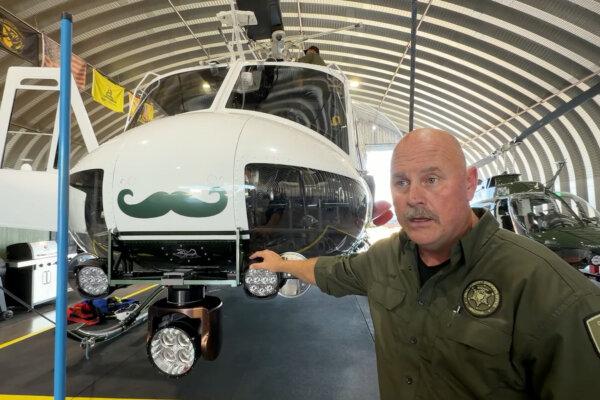
In the city of Coolidge, Arizona, Jeff Love, 48 years old, places his life, the lives of his crew, and those he rescues on the line, relying on a helicopter that was manufactured in 1973—five years prior to his own birth.
Love serves as a rescue pilot, hoist operator, and rescue expert for the Pinal County Sheriff’s Office Search and Rescue (SAR) team. He pilots a modernized Bell UH-1 Iroquois helicopter, commonly referred to as the “Huey,” a model that saw service during the Vietnam War from 1955 to 1975.
Since 2016, this Huey helicopter has been Pinal County’s primary medical rescue aircraft, completing hundreds of missions, often under conditions that are difficult to imagine.
With over 500 hours of flight experience, Love has developed a profound affection for the aging aircraft and possesses immense confidence in its performance.
“We’ve fully upgraded all the equipment,” Love stated while wearing his olive-green pilot uniform adorned with the insignia of his unit.
“It’s a beast—what I mean is, this helicopter can handle all the tasks we need.”
The iconic Huey helicopter, with a shiny fuselage, is stationed in the maintenance area at the municipal airport in Coolidge, Arizona, always prepared for action.
Briston Moore, a 28-year-old deputy sheriff who joined the Pinal County Sheriff’s Office after three years as a police officer in Chandler, emphasizes that the Huey helicopter’s moderate size and powerful performance make it ideally suited for demanding rescue operations.
“I think you could compare it to driving a semi-truck. This thing is an absolute beast,” Moore remarked.
“It feels like a large diesel truck flying in the air. It can lift heavy loads and has plenty of cargo capacity, and the cockpit can hold many people. Driving it feels entirely different.”
Love noted that before the Huey joined the Pinal County’s fleet of three helicopters, it had been utilized by the U.S. Air Force for medical evacuation missions in New Mexico, where it was designated as “Nike.”
“We found it through a federal government program that provided military surplus equipment,” Love explained.
He clarified that although the main body of the helicopter dates back to 1973, most of its principal components have been replaced or upgraded.
“The only old part of this helicopter is the fuselage itself; everything else is under ten years old,” he mentioned.
According to Love, the helicopter underwent phased overhauls at a facility in British Columbia, Canada, funded by the U.S. government.
The upgraded UH-1H3 “Hot, High, and Heavy” program included modifications to the tailboom connections, gearboxes, lift beams, engine mounts, and rescue hoists to enhance performance during rescue, emergency response, and law enforcement operations in hot and high-altitude environments.
Additionally, technicians upgraded the helicopter’s lift capability and modernized the cockpit, transforming this military aircraft into a versatile, high-tech aerial ambulance—the “Super Huey,” as Love described it.
The refurbished Huey helicopter now boasts a Honeywell T53-L-703 turboshaft engine and Bell 212 rotor hubs, enabling it to hoist external loads of up to 5,000 pounds.
The upgraded systems include advanced avionics, cameras, digital dashboards, and powerful searchlights for nighttime operations.
“We have Zoll monitors that function just like the ones on an ambulance,” Love elaborated. “The helicopter is also equipped with oxygen supplies—we have everything. During the summer, we’ve used it to fly to Sedona. The team has also flown it to the summit of Mount Humphreys.”
Love pointed out that for an aircraft that has been in service for over half a century, the structure of the Huey remains intact.
He stated that since its deployment in Pinal County a decade ago, there has never been a malfunction or failure, even no oil leaks.
Love attributes this impressive operational record to the Huey’s design, which has proven its capability as a primary aircraft during both wartime and peacetime operations.
The Bell UH-1 Iroquois helicopter, which entered military service in 1959 and was deployed to Vietnam as U.S. forces increased troop deployments five years later, had its crew use “Dustoff” as their radio call sign while airlifting injured soldiers out of the combat zone.
The distinct “thump-thump-thump” sound of the Huey’s rotor blades typically indicates its approach.
According to the Smithsonian Institution, over 16,000 Huey helicopters were produced, with approximately 7,000 serving during the Vietnam War until the fall of Saigon on April 30, 1975. The nickname “Huey” originates from the Army’s original HU-1 model, shorthand for “Helicopter Utility.”
The modified Huey helicopter from Pinal County is on standby, ready to launch day or night for rescue operations.
“We receive over 200 rescue requests on average each year,” Love reported. He added that smartphone technology has improved the department’s response time significantly.
“We can now accurately pinpoint the locations of those in distress. This not only reduces their exposure to harsh weather conditions but also minimizes the time it takes for us to send people into the mountains for search and rescue, greatly increasing the efficiency of our operations,” he explained.
The helicopter measures 57 feet in length and has a rotor span of 48 feet, allowing it to maneuver effectively in tight spaces. Love stated that in temperatures reaching 120 degrees Fahrenheit, the helicopter can achieve speeds of 115 to 120 knots (approximately 132 to 138 mph) without overheating.
During a rescue operation in Sedona, Love described how the Huey deployed a 225-foot cable to lift a woman to safety.
The SAR team consists of six search and rescue personnel, including a sheriff and three full-time pilots, with a commander overseeing operations and volunteers providing additional support.
Love mentioned that a crew typically consists of a pilot, an observer, and two to three rescue specialists, all of whom have undergone emergency medical response training.
“Training an individual to operate this helicopter takes a long time,” he remarked. “It requires at least five years. I joined as a rescue team member in 2008 and have been with this team since.”
Despite the U.S. Army retiring its last UH-1 Iroquois helicopters in 2016, the legend of the Huey continues. The Air Force still operates a small number of UH-1N helicopters for security and VIP transport tasks.
The Huey helicopter stands as one of the few vintage military helicopters still in service both in the U.S. and worldwide. According to the Federal Aviation Administration (FAA), the New York State Police currently operates four Bell UH-1H helicopters.
Bell ceased production of the UH-1 in 1987, but Love noted that due to its low maintenance costs, the Huey remains a practical option for rescue missions even decades later. Additionally, acquiring replacement parts is relatively straightforward through Bell and other suppliers.
“In Arizona, there’s no mission we can’t undertake,” Love stated.
Luis Mundo, 33, is the aircraft maintenance supervisor for the Pinal County Sheriff’s Office, and he shared that keeping a modified Huey helicopter airworthy is straightforward.
“They are quite easy to maintain due to their simple structure. As long as they receive timely upkeep, they can continue flying steadily,” he said.
Mundo noted that the Huey helicopter is specifically designed for hot, high-altitude, and heavy-lift operations.
“There are many other helicopters that struggle to operate under hot, high-elevation, and heavy-load conditions, but ours does not. We rarely encounter power issues in high temperatures—and long may that continue,” he stated.
He explained that the Huey’s enduring presence is no accident; it was designed to be robust, durable, and dependable.
“If it ain’t broke, don’t fix it,” he said.
Love mentioned plans are still in the conceptual stage for adding two more Huey helicopters to expand the rescue fleet.
In 2025, the rescue team began leasing an Airbus H125 helicopter from the Arizona Department of Emergency and Military Affairs, with an option to purchase it by October 2027.
This green and white Huey helicopter is well-maintained and frequently appears at public events and aviation heritage activities.
At these events, Love often encounters Vietnam War veterans who fondly recall riding Huey helicopters over the Southeast Asian jungles.
“They really adore this helicopter. They’ll say, ‘Wow, this is completely different from what we used to fly in Vietnam. This thing is great.’ This aircraft brings back many memories for them,” Love remarked.
He likened flying the Huey to driving a 1973 Chevy pickup truck with the windows rolled down, except with new parts under the hood.
Moore referred to the Huey as a legendary machine, whose performance far exceeds that of contemporaneous models.
“It really stands out—it’s an amazing helicopter,” Moore concluded.