
Griffith Park: A Hollywood Legacy and Natural Refuge
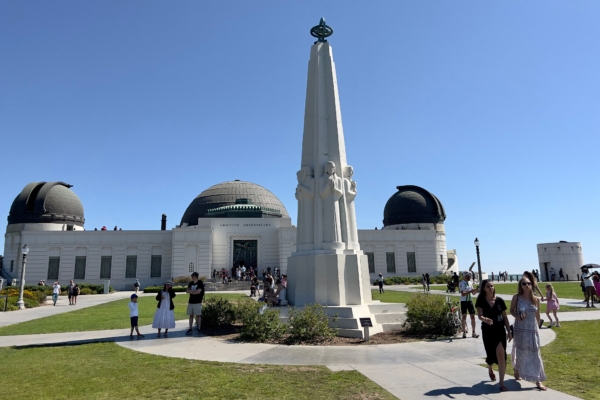
Griffith Park stands as one of Los Angeles’ most beloved destinations, drawing countless visitors and locals alike. This expansive urban oasis, rich in history and natural beauty, is perhaps best known for its iconic landmark: the Griffith Observatory. The building, an eye-catching fusion of Greek architectural elements and a massive telescope, serves as a beacon for both astronomy enthusiasts and casual stargazers alike.
Once a favored location for the golden age of Hollywood filmmakers, Griffith Park’s legacy has often been overshadowed by its natural allure. The park’s unique vantage point offers breathtaking views of the famous Hollywood sign and serves as an excellent spot to witness the stunning sunset over the city. It was in 1935 that Griffith Park began its role as a haven for Angelenos seeking respite from the hustle and bustle of urban life.
The genesis of Griffith Park emerged from the vision of Griffith J. Griffith, a mining magnate who believed very strongly that for Los Angeles to be truly great, it needed a substantial public park. In 1896, he generously donated a sprawling 3,015 acres of land on the Hollywood Hills to the city—a parcel of land that was once part of a Spanish settlement known as Rancho Los Feliz.
Born in Wales, Griffith envisioned a serene space where the community could unwind and connect with nature. When he presented his donation to the city council, he expressed his hope that this land would become a place for the public to relax and enjoy, emphasizing the importance of creating a cleaner, happier, and better city for the people of Los Angeles.
Eventually, Griffith Park emerged as one of the largest urban parks in the United States, boasting significant areas of wilderness. Today, it spans an impressive 4,511 acres, making it not only the largest historical landmark in Los Angeles but also one of the largest municipal parks in North America.
Facilities within the park are diverse and plentiful. From golf courses and tennis courts to sports fields and swimming pools, visitors can find numerous ways to engage in outdoor recreation. Griffith Park also features miles of bike paths and hiking trails, bicycle rentals, the Fern Dell creek, Bronson Caves, horseback riding, a carousel, a bird sanctuary, the Greek Theatre, a museum, and even the Los Angeles Zoo.
Yet the crowning jewel of Griffith Park remains the Griffith Observatory, a realization of another significant vision of Griffith’s. After visiting the Mount Wilson Observatory in Pasadena, he developed a profound interest in astronomy and, in 1912, proposed a donation of $100,000 to build and operate an observatory in the Hollywood Hills. Griffith stipulated that it must include a publicly accessible telescope, a science museum showcasing physical science exhibits, and an auditorium for educational films.
The city government embraced Griffith’s ambitious proposal, placing him on a committee to supervise the construction of the observatory and the Greek Theatre. Unfortunately, political delays hindered the completion of the project during his lifetime. Griffith passed away in 1919, leaving behind detailed plans for the observatory and theatre in his will.
It wasn’t until 1930 that serious planning for the observatory began, and five years later, the construction came to fruition. On May 14, 1935, the Griffith Observatory officially opened its doors to the public. Following its inauguration, the management and operation of the observatory were transferred to the city government from Griffith’s trust fund, and it has been maintained ever since. Notably, in 2002, the observatory underwent significant expansion and renovation, reopening to the public in 2006.
Today, visitors can explore Griffith Park and the Griffith Observatory free of charge, fulfilling Griffith’s original vision. The observatory is open from noon to 10 PM Tuesday through Friday and from 10 AM to 10 PM on Saturday and Sunday, while it remains closed on Mondays. Griffith Park opens daily at 6 AM and closes at 10:30 PM. Although admission to the observatory is free, parking near the summit may require significant fees, especially during peak times such as weekends and sunset hours.
The park is also home to an iconic landmark that emerged somewhat controversially in 1923: a large sign originally intended to promote a new residential development in Beachwood Canyon. Spelling out “HOLLYWOODLAND,” this temporary installation soon became an emblem of the budding film industry. In 1949, the “LAND” portion was removed, leaving behind the unmistakable “HOLLYWOOD” sign we recognize today. While the public cannot access the sign directly, the Griffith Observatory offers one of the best perspectives for viewing it against the backdrop of a breathtaking California sunset.
Griffith Park has consistently served as a sought-after filming location for numerous movies and television shows over the years. Its stunning natural landscapes often substitute for other, more exotic locales. For instance, Bronson Canyon depicted a tropical island in the 1933 film “King Kong,” while Bronson Caves appeared as a remote hideout in the 1956 classic “The Searchers.”
Films set in Los Angeles often feature Griffith Park and the observatory as integral backdrops, with notable titles including “Rebel Without a Cause” (1955) and the more recent musical “La La Land” (2016).
The first film to be shot at Griffith Observatory was the 1935 sci-fi western “Phantom Empire.” Though the observatory had not yet opened to the public at that time, its magnificent dome already featured prominently in the movie.
Thus, Griffith Observatory stands not only as a beloved filming location but also as an exceptional viewpoint for gazing upon the Hollywood sign and as a splendid venue for experiencing the beauty of Los Angeles. A visit to Griffith Park is, undoubtedly, one of the best ways to look up at the radiant starlight of Hollywood.