
“Who forgot to turn off the lights?” is a question often muttered in frustration when household electricity bills come due. However, for astrophotographer Evgeni Tcherkasski, standing in front of Germany’s medieval Eltz Castle, this question suddenly resurfaced in his mind amidst an unexpected experience.
At 47 years of age, Tcherkasski drove over 200 kilometers (about 120 miles) from his home in the industrial Ruhr area, then trekked through pitch-black forests with the singular mission of capturing the ancient stone bridge and towers of the castle under a magnificent starry sky. Unfortunately, upon his arrival, he was astonished to find the entire castle illuminated by a sudden and powerful light.
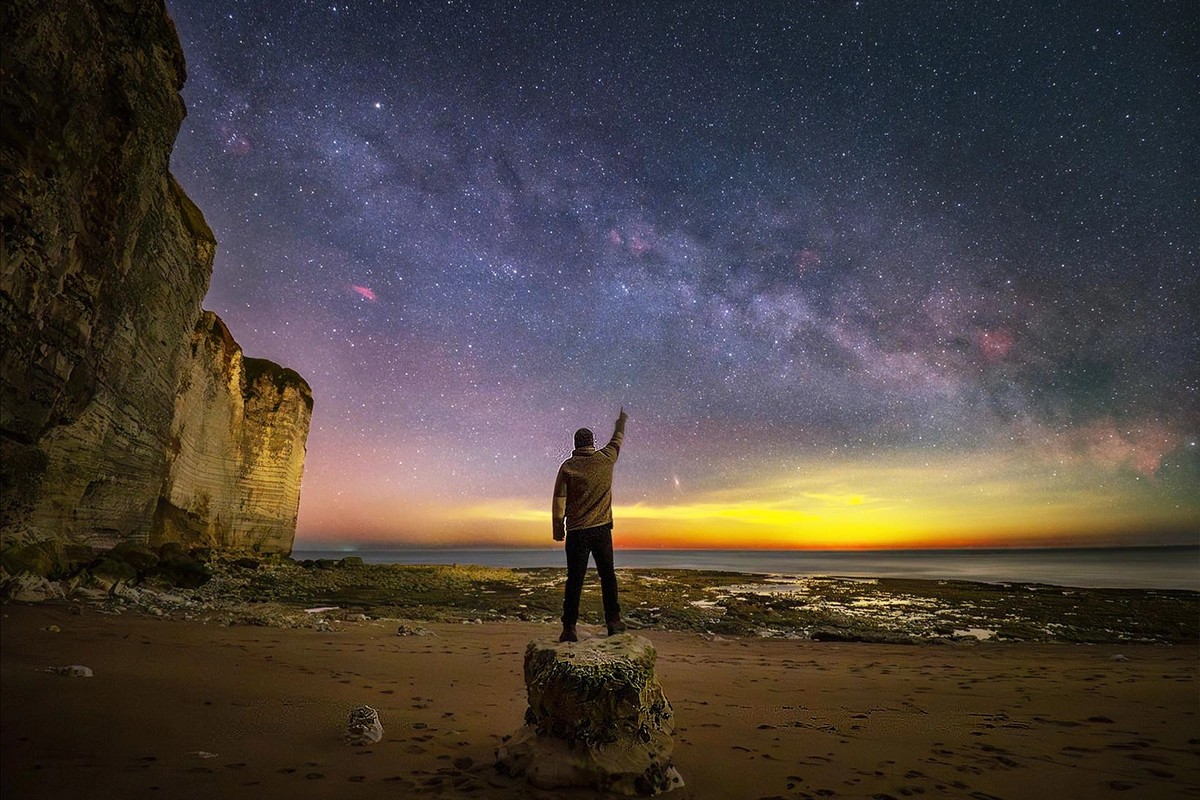
Faced with this uninvited glow, Tcherkasski transformed the surprise into creative inspiration. He stepped into the frame, holding a flickering lantern high above his head, portraying himself as a solitary traveler approaching the castle’s entrance. This meticulously planned photographic piece is what he calls “Astroscapes.” It’s a unique art form that combines elements such as starry skies, architecture, human silhouettes, and even classic American muscle cars, all woven together to narrate captivating stories against the backdrop of the night sky.
Reflecting on nearly two decades of his photographic journey during an interview, Tcherkasski remarked, “Initially, it was simply an experiment, which gradually evolved into a thoughtful, skill-based photographic art. Looking back, I believe the greatest shift has been from merely taking pictures to consciously creating images.”
He approaches these works with the perspective of a director, even though achieving certain special effects requires stringent technical considerations. To eliminate digital noise in night-time photography, Tcherkasski stabilizes his camera on a solid tripod and layers dozens of rapid-fire images of the sky—each with the same exposure settings—over a single long-exposure landscape shot. This technique helps him tease out details invisible to the naked eye from the darkness. Technically a composite method, it represents a single, authentic scene rather than a patchwork.
Tcherkasski works professionally as a manager in a Geographic Information Systems (GIS) department, where he handles ultra-high-precision satellite map data, making him particularly adept at overcoming various spatial positioning challenges.
Capturing buildings and structures on Earth as foreground subjects while ensuring that the Milky Way is perfectly positioned in the backdrop demands precise calculations, often requiring weeks of beforehand planning. Tools like the PlanIt Pro photography tracking app, or simply studying terrain and surroundings via Google Street View, are among his strategies.
“You can’t just show up at a picturesque location and expect the galaxy to appear in the perfect spot,” he explained. “The position of the galaxy must align precisely with the foreground elements.”
However, controlling light pollution is no easy feat. To chase the darkest night skies, Tcherkasski traveled all the way to the Roque de los Muchachos Observatory on La Palma in the Canary Islands, a renowned astronomical research center known not just for its ink-black skies, but also for its colossal optical telescope, which provides a striking foreground for his photography—almost reminiscent of scenes from a science fiction movie.
After matching the observatory’s position to that of celestial bodies, the photographer ascended to the mountaintop telescope situated 2,400 meters above sea level, surrounded by extraordinary rock formations. Everything seemed in perfect harmony—the weather forecast, moon phase, and wind speed all indicated the potential for an epic photograph.
Yet, one variable caught Tcherkasski by surprise.
“Mosquitoes,” he recounted. “Thousands of mosquitoes relentlessly attacked me.”
From a photographic perspective, his composition was undeniably successful. Carefully planned in advance, he precisely captured the Milky Way at his anticipated location. Ultimately, the scene he presented “was almost identical to what I had imagined.” The trade-off, however, was spending the following days scratching incessantly, ultimately needing to visit a local pharmacy to acquire antihistamine cream.
Tcherkasski’s astrophotography does not entirely shun artificial light sources; quite the contrary. Near Lake Diemelsee in Germany, the soft red glow from brake lights and the beam projected by a 1968 Ford Mustang’s headlights are crucial elements that help to frame this classic car under the vast starry sky. The challenge lies in managing the brightness of the headlights, which are often too intense. Capturing the gleaming details of vintage chrome strips against a pitch-black night typically requires more delicate lighting methods.
In response, Tcherkasski and a colleague, who had personally restored the car, implemented a rather improvised, low-tech solution. Tcherkasski operated the camera while his friend lay on the front seat, manually turning the headlights on for just one-tenth of a second during the long exposure.
“We originally planned to use the car’s own headlights to illuminate the scene, but the light was simply too bright to leave on continuously during the long exposure,” he explained. “It may sound a bit crazy, but this technique really worked. We managed to illuminate the car and the road without over-exposing the foreground.”
For Tcherkasski, these late-night photographic endeavors offer a perfect counterbalance to his highly digitized daily work life. “When I head out at night with my camera, it’s a completely different experience,” he shared. “I’m outdoors and must slow down.”
Now, having wrapped up his summer vacation with family on La Palma, Tcherkasski is back to his everyday routine, yet the exploration for dark skies continues. Regarding his next journey, he is contemplating a visit to France to explore its newly implemented statutory night-time curfews aimed at curtailing light pollution.
France is widely recognized as a global leader in reducing light pollution, albeit not solely for the purpose of preserving historical buildings’ night-time aesthetics, but rather to significantly lower energy costs. The country’s excellent conditions for capturing the galaxy are merely an unintended bonus.
Before embarking on his next adventure, any challenges posed by castles, vehicles, or artificial light sources are exactly where Tcherkasski excels.
“In reality, I don’t follow a fixed formula,” he said. “Sometimes I start with the landscape, sometimes with the sky, occasionally with a person, and sometimes I focus on objects like classic cars. The key is to have a concept first, and then find a way to realize that idea under the night sky.”