
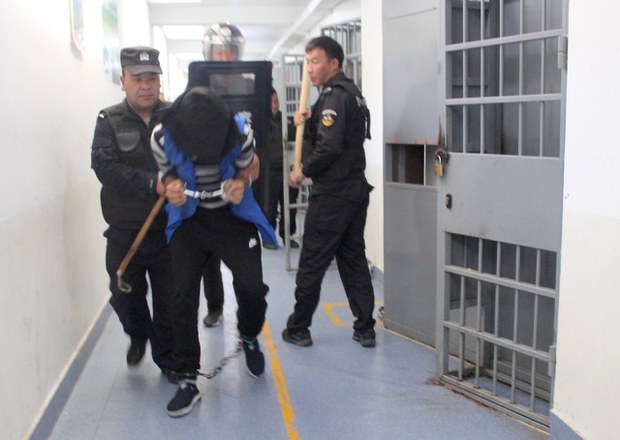
A senior official in Thailand announced on Wednesday that the Chinese Communist Party is requesting the repatriation of five Uyghurs, claiming that they are subjects of arrest warrants. These five individuals have been detained in Thailand since fleeing China more than a decade ago.
Human rights organizations around the globe have issued warnings, indicating that these Uyghurs could face torture and other forms of persecution if returned to China.
According to reports from Thai Public Broadcasting Service (TPBS), the Secretary-General of Thailand’s National Security Council, Chaipruak Doungprapat, informed reporters that the fate of these Uyghurs, who have been held in detention since 2014, will ultimately be determined by the courts. They have the right to hire lawyers to contest the extradition request made by Beijing.
These five individuals are part of a group of more than 300 Uyghurs who fled China in 2014 and were subsequently apprehended by Thai authorities near the Malaysian border.
In 2015, the Thai government deported over 170 individuals to Turkey, most of whom were women and children. Subsequently, nearly 100 remaining Uyghurs were sent back to China, with another group facing deportation in 2025. Disturbingly, it has been reported that at least five Uyghurs died while in detention in Thailand.
In China’s far western Xinjiang region, Uyghurs and other Muslim minority groups have faced large-scale detentions. Survivors have recounted experiences of indoctrination, forced labor, and various forms of abuse during their imprisonment.
The Chinese government has linked its crackdown on these communities to counter-terrorism efforts; however, the United States and other Western democracies have classified these actions as “genocide.”
Chaipruak Doungprapat clarified that the case of the five Uyghurs differs from that of 40 Uyghurs who were deported to China last year at Beijing’s request. That repatriation drew international condemnation and led to sanctions from the U.S.
He noted that these five individuals were sentenced in Thailand for attempting to flee detention. Three of them still have a year left of their sentence, while the other two completed their terms last month.
Chaipruak emphasized that if Beijing wishes to take back the two individuals who have served their sentences, it must adhere to formal extradition procedures.
He stated that should the courts rule against the Uyghurs, they would be handed over to China under the extradition treaty. Conversely, if they prevail in court, they may settle in a third country.
When asked about Beijing’s extradition request on November 4, a spokesperson from the Chinese Foreign Ministry, Mao Ning, avoided answering the question directly.
She merely stated that Beijing’s cooperation with Bangkok in combating cross-border crime, including illegal immigration, aligns with the laws of both countries as well as international law and norms.
Former Thai parliament member Kannavee Suebsang has expressed doubt regarding Beijing’s claims about arrest warrants being issued for the Uyghurs. He pointed out that one of the detainees was only 15 years old when he fled China in 2014 and was subsequently detained by Thai authorities.
Earlier this month, Suebsang made public a letter written in July 2022 by a detained Uyghur, who expressed deep fears about returning to China. The letter indicated that if he and his parents were sent back, they could face the death penalty.
The Uyghur man wrote in English, “Uyghurs have no human rights; the treatment we receive is worse than that of animals.”
International human rights organizations have urged the Thai government not to deport the Uyghurs to China, warning of the torture and abuse they would likely encounter upon return.
Agnes Callamard, the Secretary-General of Amnesty International, commented in a statement on November 4, saying, “Thailand should not send anyone back to places where they may face torture and other serious human rights violations. No amount of diplomatic assurances from China (the Communist Party) can absolve Thailand of this obligation.”
She added, “After being detained for over a decade, these men must be released and given the opportunity to rebuild their lives in a safe and free environment.”
Elaine Pearson, the Asia Director for Human Rights Watch, urged Thailand to protect the Uyghurs from oppression rather than “send them back into danger.”
Pearson stated in a November 4 release, “Previous Thai governments have allowed Uyghurs to be held for years in inhumane detention conditions, then complied with Beijing’s requests to send them back to China, where they face persecution and subsequent disappearance.”