
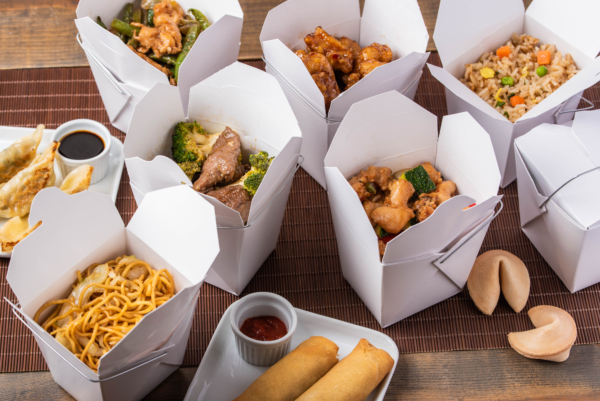
The iconic small white box, made of a single piece of folded cardboard into a trapezoid shape, is a familiar sight for many, often adorned with a metal handle and a red Chinese pagoda motif on the side. Within this box lies the delicious dishes from Chinese restaurants.
This box is commonly used for takeout in American Chinese restaurants, symbolizing a connection to Chinese cuisine for many. However, this small paper box is rarely seen in China or Taiwan.
According to a report by the Associated Press on October 16, this type of Chinese takeout box is actually a product with distinct “American characteristics.” It combines clever design, the transformation of immigrant culture into local daily dining habits, and people’s pursuit of convenience — such as enjoying great food comfortably at home in pajamas.
By the most optimistic estimates, there are more Chinese restaurants in America than post offices, leading to the ubiquitous presence of these Chinese takeout boxes. It has not only become a part of popular culture, frequently appearing in movies or TV series, but has also been featured in the New York Food Museum.
The design of this essentially a “paper bucket” can be traced back to 1894. At that time, inventor Frederick Weeks Wilcox obtained a patent for a “novel and practical improvement” for an “oyster pail.” Through specific folding methods, a single material sheet could maintain structural integrity, effectively prevent leaks, and come with a lid.
So, how did the food inside these boxes come about?
In the mid-19th century, Chinese immigrants began arriving in America, participating in the Gold Rush and engaging in railroad construction. Their settlements were known as “Chinatowns,” initially appearing in places like San Francisco and later spreading across the country. Various restaurants emerged in these communities, laying the foundation for “Americanized Chinese cuisine.”
Michelle King, a Chinese history professor at the University of North Carolina at Chapel Hill, told the Associated Press that after World War II, there was an “explosive growth” in the number of Chinese restaurants, with an increasingly diverse range of dishes beyond just “chop suey” or “chow mein.” Interest and demand for Chinese food surged.
She emphasized that it was crucial that the public began associating Chinese food with affordability, ubiquity, and convenience. Additionally, restaurant operators aimed to portray an “approachable” image, with takeout services playing a significant role.
“Whether you need to bring food home, or prepare for a dinner party — we’ve got you covered, right?” Professor King said.
At some point in the 1970s, a packaging company then known as “Fold-Pak” added the pagoda motif to these takeout boxes, sometimes with additional text on the boxes.
Subsequently, these takeout boxes were lined with grease and leak-resistant coatings, the metal wire handles were eliminated to facilitate microwave heating, and eco-friendly cardboard was used.
“It has, to a certain extent, become a symbol of American Chinese restaurants, much like how pizza boxes are to Italian cuisine,” Professor King remarked.
Today, takeout boxes come in various shapes, and the variety of dishes for takeout continues to expand, with a wide array of flavors that can be packed into these containers derived from “oyster pails.”
Nevertheless, it remains a symbol — quite literally. Take a look at the “takeout” emoji on your phone; you might see a familiar white box.