
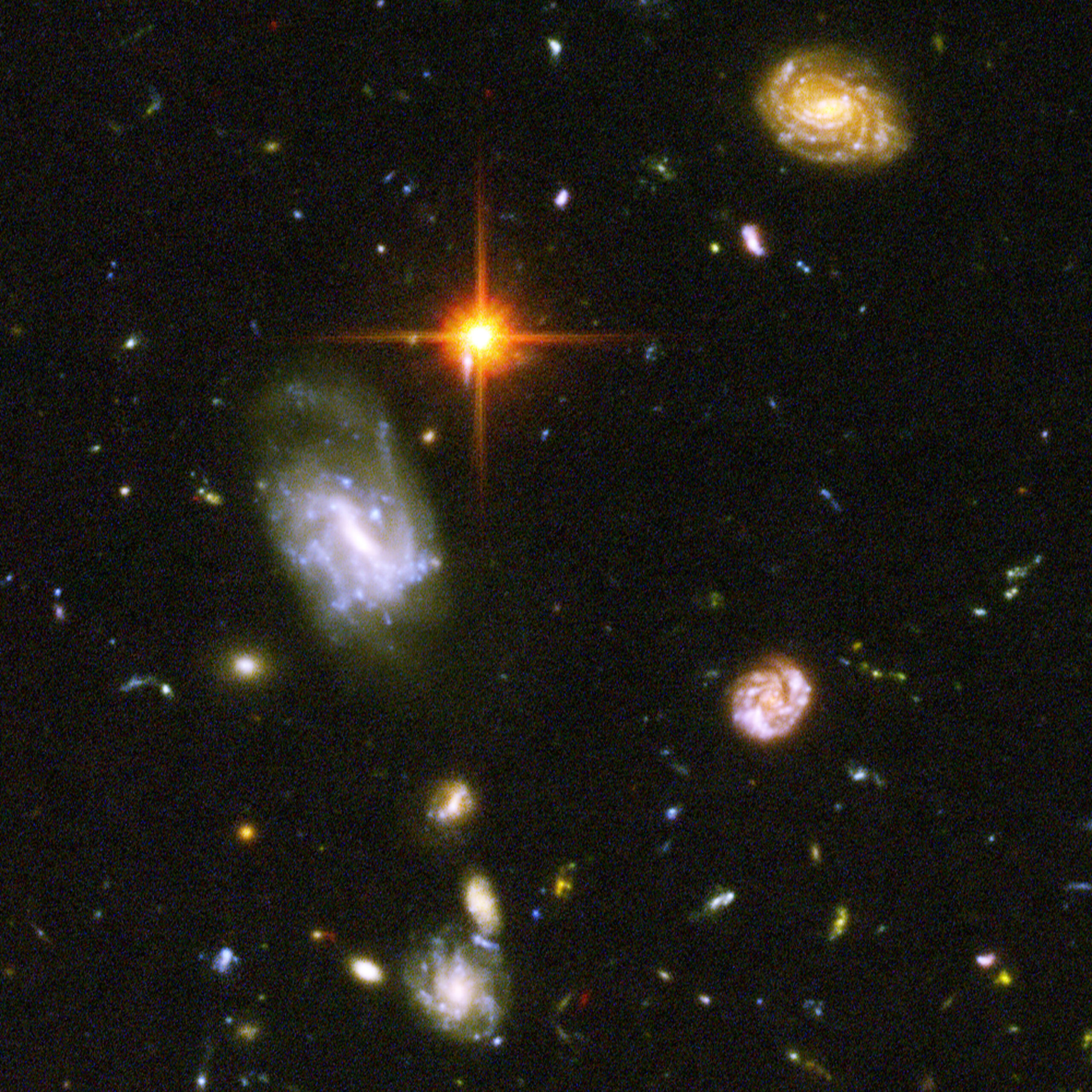
In the seemingly empty expanse of deep space, a mysterious signal has quietly emerged, leaving scientists both shocked and puzzled.
Recently, astrophysicist Mason S. Huberty and his team at the University of Minnesota published their latest research in the prestigious journal “The Astrophysical Journal”, announcing a special signal detected by the James Webb Space Telescope (JWST) in one of the most extensively studied regions of the sky, known as the “Hubble Ultra Deep Field” (HUDF) in the Fornax constellation in the southern hemisphere.
The HUDF has garnered attention and coverage from various scientific media outlets such as ScienceAlert, where the Hubble Space Telescope spent over 270 hours gazing into the depths of space, capturing ancient galaxies extending billions of light-years away. With the launch of the Webb telescope, its powerful infrared observation capabilities once again focused on this region.
Huberty’s team adopted an innovative observation strategy called Multi-Object Coronagraph Spectroscopy with Slitless Spectroscopy (MOCSS). Unlike the traditional method of “locking onto a target and then observing the spectrum”, the research team opened nearly all of the microshutter arrays of the Near Infrared Spectrometer (NIRSpec) of the Webb telescope, only blocking known foreground objects, to conduct a “blind search” in the vast expanse of space to look for overlooked faint signals.
Foreground objects refer to celestial bodies that are closer to the observer and located in front of the main observation target (usually distant background galaxies, nebulae, or deep space objects) in astronomical observations or astrophotography.
This new technology successfully matched six signals that coincide with known ancient galaxies, but the 7th detection result has left scientists astonished.
Data showed a strong emission line at 1.6 microns in the near-infrared band. What baffled researchers was that the signal appeared consistently in two independent observations 88 days apart (in August and November of 2023), from two different viewing angles, and in four sets of data stacking, ruling out common cosmic ray interference or software errors.
Furthermore, neither the deep images from Hubble over the years nor the previous JADES survey data from the Webb telescope revealed any corresponding celestial bodies or galaxies at the precise coordinates of the signal.
In spectroscopy, the release of energy from atoms or molecules generates specific emission lines. Typically, a celestial body is accompanied by multiple emission lines of different wavelengths simultaneously. However, the signal detected this time not only “appeared alone” but also had an extremely high brightness, far exceeding the reasonable range expected for normal celestial bodies, with no matching object found in the databases of both Hubble and Webb.
Setting aside sci-fi speculations like “extraterrestrial signals”, scientists have proposed four possible explanations from the perspective of astrophysics, each facing significant contradictions:
Early Universe Galaxies:
If these are galaxies formed in the early stages of the universe after the Big Bang, photons at this wavelength would have difficulty penetrating the neutral hydrogen fog that filled the universe at that time, and if bright enough to be captured by Webb, they could not have been completely invisible during the 2022 JADES observations.
Recently Evolved Galaxies:
If they were conventional galaxies, they would necessarily be accompanied by emission lines of other wavelengths, yet no such data was found in the databases.
Supernova Outbursts:
Transient outbursts can explain “why there was no observation before and suddenly it appeared now”, but the spectral structure produced by supernovae should be more complex and not match the characteristics of a single isolated spectral line.
Tidal Disruption Events of Black Holes:
When a black hole tears and consumes a star, it could indeed release a strong single emission line without an apparent host galaxy. However, the available feature data is not enough to prove the occurrence of such extreme events.
The research team emphasized in their paper that this celestial body is extremely unusual, possibly representing a brand new phenomenon under extreme physical conditions.
“This is not about what the Webb telescope saw, but about it seeing light that shouldn’t exist in a place of ‘nothingness'”, scientists are currently applying for deeper and wider wavelength follow-up spectroscopic observations of the area. Only by capturing more details of these faint spectral lines can the redshift and distance of this signal be accurately calculated, unraveling this mysterious enigma from deep space.