
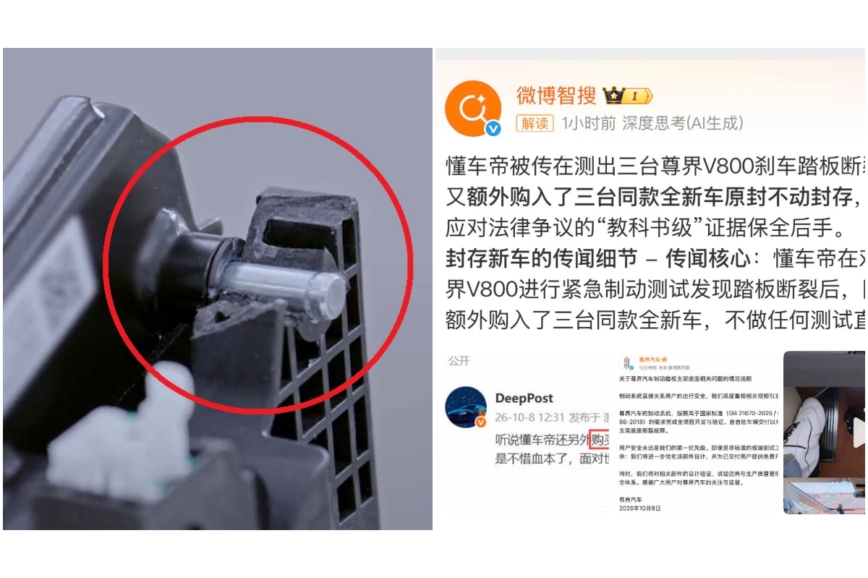
Recently, the luxury car brand Zunjie, jointly created by Huawei and Jianghuai Motors, has been caught in a whirlpool of public opinion due to the issue of the brake pedal bracket fracture in the V800 model. On October 15, the Chinese Communist Party officially announced the establishment of a joint investigation team to conduct inspections, further escalating the situation.
The Ministry of Industry and Information Technology of the CCP released a statement on its official WeChat account “Gongxin Weibao” on the evening of October 15, stating that in response to the online reports of the “Zunjie V800 car brake pedal bracket fracture issue,” the Ministry of Industry and Information Technology, the Central Cyberspace Administration, and the State Administration for Market Regulation have attached great importance to the matter. Building on the preliminary investigation, they have set up a joint investigation team to carry out inspections. Any relevant information will be disclosed promptly.
Zunjie promptly issued a statement in response, stating that they will cooperate with the investigation team, supporting the healthy development of the new energy automobile industry.
Prior to this, on October 8, a test video released by the automotive information and transaction service platform “Dongchedi,” incubated by ByteDance, showed that during emergency braking tests at speeds of up to 100 kilometers per hour with three brand-new Zunjie V800 vehicles on a closed track, the brake pedal brackets physically fractured after multiple intense brake applications. This resulted in a complete failure of the foot brake system on the vehicles, only relying on the emergency brake in P gear.
Subsequently, both Huawei and Jianghuai Motors found themselves embroiled in public scrutiny.
On that same evening, Zunjie Automobile released a statement explaining that while not formally acknowledging any quality or design issues with their products, they would optimize the relevant component designs and provide free upgrades to customers who have already received deliveries. Additionally, they would systematically review and reinforce the design verification, testing boundaries, and production quality management of the related components.
On October 10, various departments jointly issued a notification, emphasizing the need to enhance innovation in automotive product design and R&D testing verification management. An article published by the party’s official newspaper, “People’s Daily,” on the 11th analyzed the new regulations as a rejection of “instant cars,” emphasizing that brake pedal brackets in automobiles should never experience “fractures” while driving.
On October 13, Zunjie released a third-party static testing report, affirming that the V800 brake pedal meets industry standards. Additionally, they committed to providing free brake pedal upgrades for owners in November.
Subsequently, Dongchedi’s automotive safety content manager, Dongmen Jiannan, who participated in the testing, raised doubts on his Weibo account “Understanding Cars Big Corgi Dongmen,” questioning whether static loading could reflect the momentary dynamic impact during emergency braking of actual vehicles.
He pointed out that the testing involved a slow loading rate of 20 millimeters per minute, which differs from the force exerted on the brake pedal brackets during high-speed emergency braking scenarios. Particularly, the material of the pedal bracket, polypropylene added with 40% glass fiber (PP+GF40), may exhibit variations in performance under static and dynamic loads.
He suggested that companies with testing facilities, vehicles, equipment, and personnel could randomly select production cars and conduct continuous emergency braking tests at speeds of 100 kilometers per hour to verify real-world performance.
Dongmen Jiannan questioned, “There are no sample photos, no videos, no before-and-after comparisons of the samples, and we don’t even know if these components are from current production cars. We know nothing about the thickness of the brake pedal bracket plate or the material it is made of, and yet we are told everything is fine and there is no need for upgrades.”
Furthermore, staff at the testing center of the China Automotive Engineering Research Institute, which conducted the tests, indicated that they only tested the sample vehicles provided by the company and could not guarantee whether the report circulating publicly had been tampered with. According to the Securities Times, the testing was commissioned by Anhui Jianghuai Automobile Group Co., Ltd.