
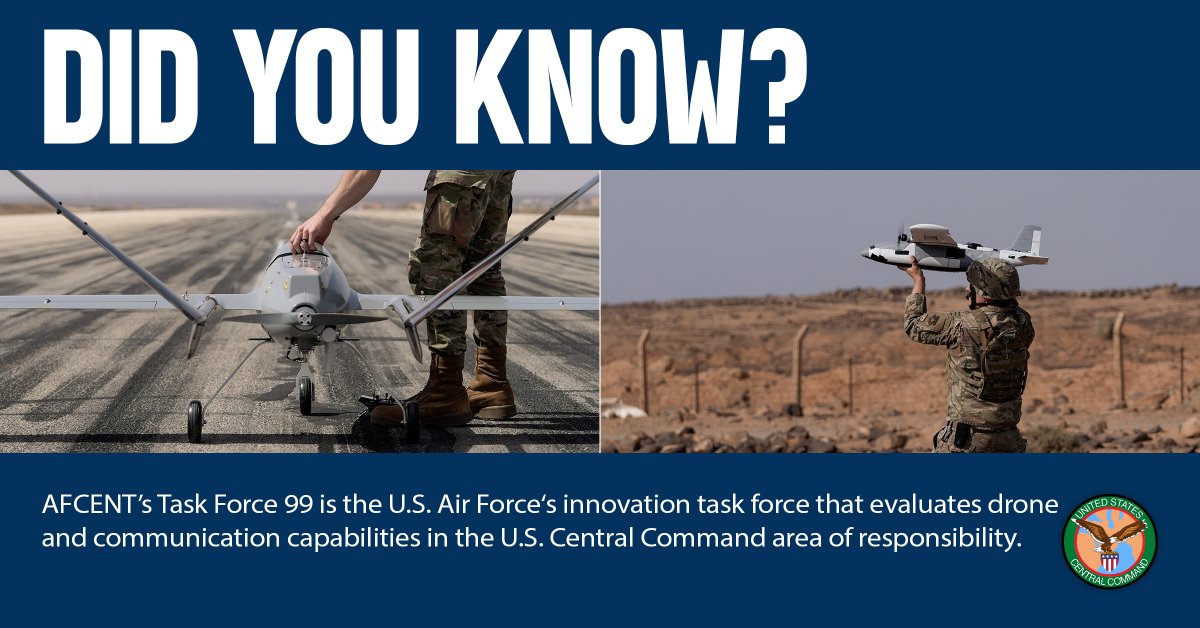
In modern warfare, drones play an increasingly important role due to their relatively low cost and the lethality they bring. The US Central Command (CENTCOM) announced on Wednesday (October 14) that new drones and communication capabilities are being introduced and tested for the Middle East forces to enhance their combat effectiveness.
CENTCOM revealed on social media platform X that “the 99th Task Force under the US Air Force Central Command is introducing new drones and communication capabilities for combat personnel in the Middle East. As a pioneering experimental platform, this task force is responsible for testing innovative combat concepts to improve the forces’ combat effectiveness in real-world environments.”
The significant roles drones played in conflicts like the Russo-Ukrainian War and the Iran War have altered perceptions of modern warfare, prompting the US to prioritize strengthening its own drone capabilities. The Pentagon stated on its official website that the War Department is fully leveraging the US dominance in the field of drones by: bolstering the US drone manufacturing base, utilizing the intellect of combat personnel, equipping combat units with low-cost attack drones, and breaking the bureaucratic culture of risk aversion in drone procurement and training through training senior officers.
The Pentagon also mentioned that the 401st Joint Interagency Task Force is taking a leading role in coordinating anti-drone operations and advancing joint capabilities for rapid deployment across various departments within the War Department.
The US military is not only focusing on drone deployments in the Middle East but also expanding its anti-drone capabilities in Europe. As per information released on the US Army website, the 2nd Cavalry Regiment (2CR) is advancing Project Flytrap, aiming to extend anti-drone and electronic warfare capabilities to company-level units. The project is transitioning from small unit field testing to tactical application integrated with combat objectives to enhance the forces’ mobility and assault capabilities in the drone-intensive and high electronic interference battlefield environment on the eastern flank of Europe.
This joint program, conducted in collaboration with the UK military, is dedicated to developing and utilizing mobile counter-unmanned aerial system (C-UAS) and electronic warfare capabilities. Unlike other joint strategic plans, Project Flytrap focuses on brigade and company-level mobile combat units, equipping frontline operational units with relevant capabilities to conduct offensive mobility in environments characterized by severe electronic interference and intense surveillance.