
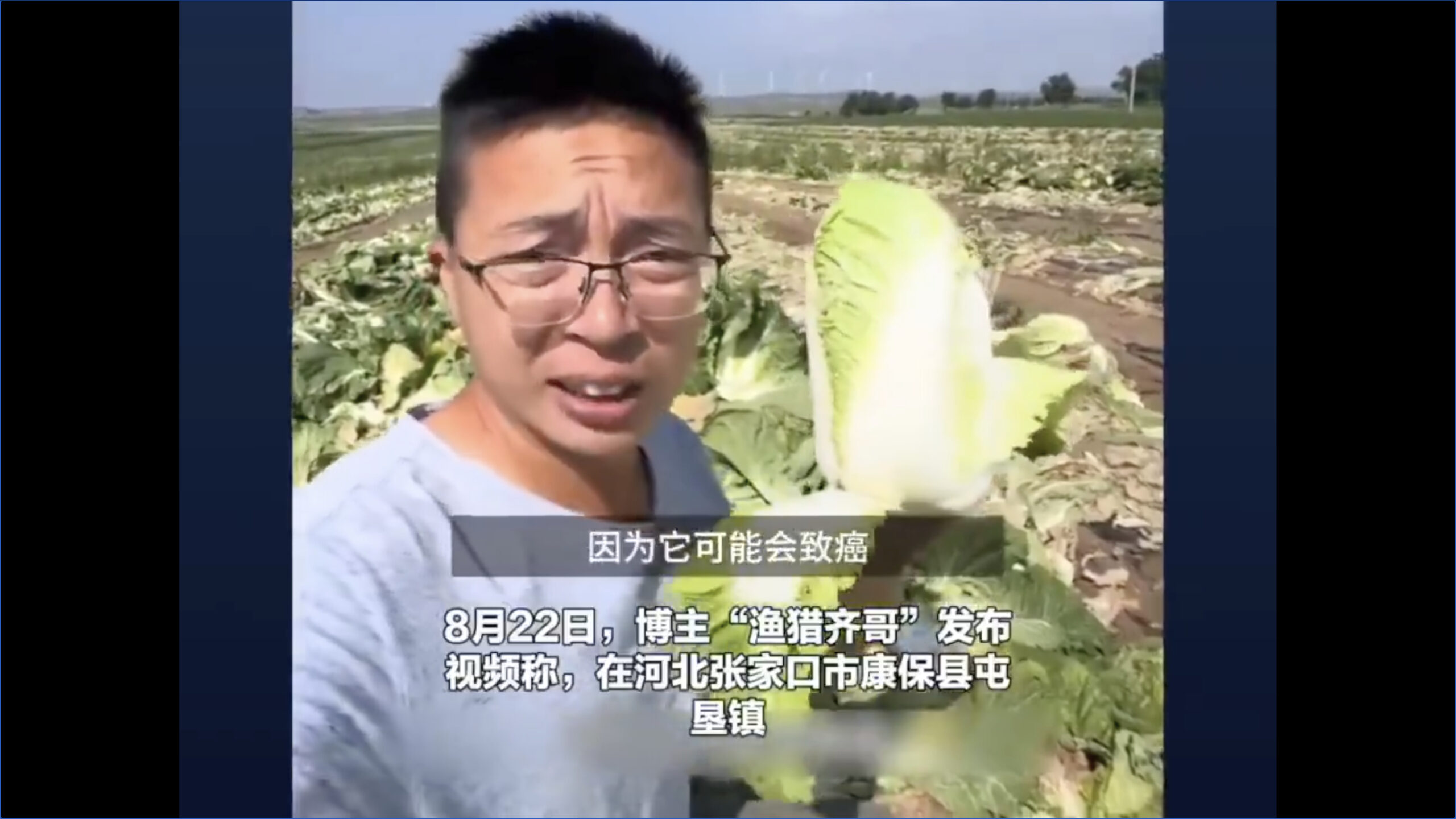
In recent news from Hebei Province, it has been exposed that some vegetable vendors were dipping Chinese cabbage in formaldehyde solution for preservation, sparking nationwide and even international food safety concerns in countries like Japan, South Korea, and Taiwan. Official responses swiftly moved to “put out the fire and cool down,” with many regions reporting that local agricultural products passed inspections following the incident. Analysts pointed out that the impact of the event not only affects the careers of local officials, but the Chinese Communist Party is also concerned about its own positive image being affected.
The practice of dipping Chinese cabbage in formaldehyde solution before loading it onto trucks was recently exposed in Kangbao County, Zhangjiakou City, Hebei Province, causing nationwide food safety worries. Formaldehyde, an industrial chemical, has long been classified as a carcinogen by the World Health Organization.
The incident originated from a video uploaded by a blogger on August 22. The video showed workers in Tunken Town, Kangbao County randomly inspecting several trucks carrying Chinese cabbage, and found workers dipping the roots of the cabbage in a liquid for preservation. It was mentioned that these cabbages were being transported to Suqian, Jiangsu Province, and after dipping, they could be preserved for two to three days.
After the video was exposed, the local authorities in Kangbao County responded the same day, stating that after initial verification, the situation shown in the video was true and was an illegal act carried out by the purchasing merchants for preservation during transportation.
As the public opinion continued to ferment, the controversy quickly crossed borders, affecting markets in neighboring areas.
Due to the large volume of Chinese cabbage exports, the South Korea Food and Drug Safety Agency has initiated a third-level customs inspection for the upcoming kimchi season; Japan’s Ministry of Agriculture, Forestry, and Fisheries and Ministry of Health, Labour and Welfare have also launched cross-departmental checks. Regarding Taiwan, the Food and Drug Administration stated that Chinese fresh cabbage is not allowed to be imported items, and there have been no related import inspection records this year.
Faced with the chain reaction at home and abroad, the Chinese authorities immediately launched an intensive response to try to “cool down” the public opinion.
In addition to official reports, merchants who have long been in the frontline of circulation provided another perspective.
Mr. Zhou, a merchant in Tianjin, revealed in an interview with Epoch Times that similar phenomena have been around for years. He mentioned that the use of unknown preservatives during the long-distance transportation of northern vegetables has been a common practice. He recalled witnessing similar operations over a decade ago and highlighted the lack of awareness among consumers regarding the harm of formaldehyde in vegetable preservation.
Regarding how consumers can determine if vegetables have been treated, Mr. Zhou mentioned that not all vegetables can be distinguished based on appearance alone. Some may emit odors while others require professional testing for verification.
Mr. Zhou also listed some winter vegetables that consumers should be cautious about when purchasing, emphasizing the need to be alert to noticeable pungent odors upon unpacking them.
He warned that even winter vegetables sold locally in the north may not be free of preservation issues.
In addition to “formaldehyde cabbage,” food safety issues have also emerged in the barbecue industry.
Mr. Zheng, a merchant in Harbin City, Heilongjiang Province, revealed during an interview with Epoch Times the use of food additives in the barbecue industry. He expressed concern about the safety of using these additives and advised consumers to be cautious and consider making their own food if they enjoy barbecue.
Examining the systemic factors behind the food safety controversy, a professor from a renowned university’s food science institute in China, speaking anonymously to Epoch Times, highlighted local interests, regulatory enforcement, corporate integrity, and food safety systems as multiple layers of the issue.
The professor pointed out the complex relationship between local interests, regulation execution, and food production inputs, suggesting that local protections and interests play a significant role in shaping behaviors in the agricultural sector.
In a larger political-economic context, analysts like Mr. Tang see China’s food safety issues as deeply rooted in the Communist Party’s prioritization of GDP growth over public health concerns, leading to a systemic failure in regulatory enforcement and governance.
Mr. Tang pointed out the historical recurrence of food safety scandals in China and predicted that the authorities’ handling of the current incident might follow a pattern of downplaying and containment to protect the image of local officials and the Chinese Communist Party.
Moreover, the event’s potential international repercussions were also mentioned by Mr. Tang, emphasizing the impact of continuous food safety incidents on consumer trust in Chinese agricultural products in both domestic and international markets.
In conclusion, the accumulation of such examples may eventually lead to a broader rejection of Chinese products by the international community, potentially undermining China’s economic standing.
In light of these insights, it becomes evident that authentic and lasting change in China’s food safety landscape requires a comprehensive overhaul of regulatory structures and a fundamental shift towards prioritizing public health over immediate economic interests.