
The U.S. Air Force is advancing the expansion and normalization of operations at four airports in the Northern Mariana Islands, marking the implementation of the “Agile Combat” concept in the Second Island Chain. This initiative aims to mitigate the risk posed by China’s long-range missiles to U.S. military bases, while also enhancing the operational capability and survivability of U.S. forces in the Pacific theater.
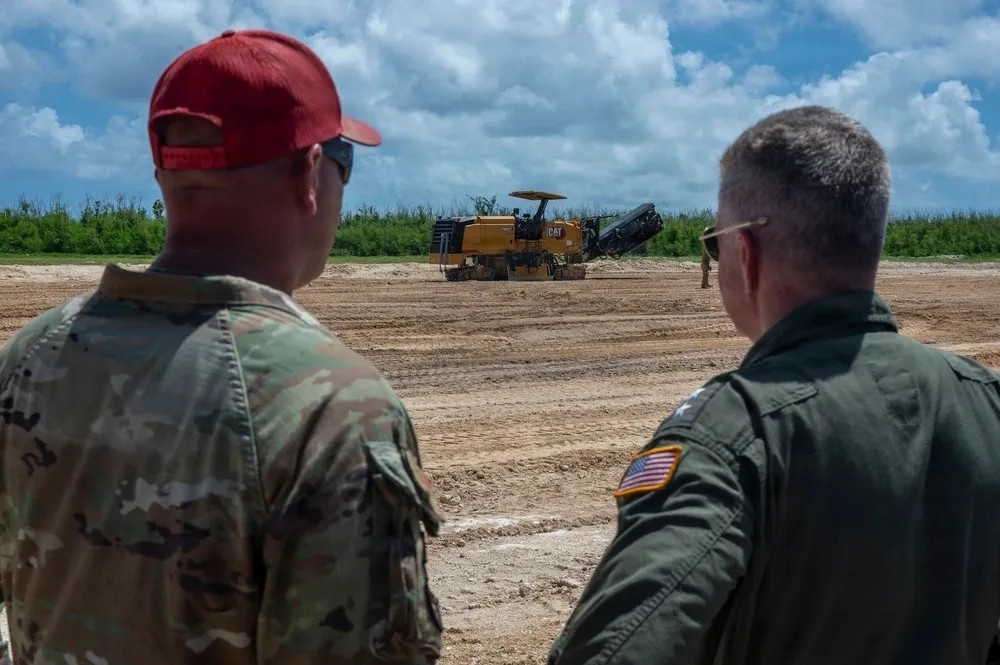
On October 28, 2026, the U.S. Air Force issued a notice in the Federal Register announcing plans to strengthen aerial operational training capabilities in the Northern Mariana Islands. The plan involves utilizing four airports on Saipan, Tinian, and Rota to conduct over 6,000 flight training missions annually. Additionally, the air force has initiated an environmental impact assessment process to evaluate the potential effects of aircraft operations, fuel supply, temporary deployments, and related training on the local social, economic, and natural environments. Concurrently, renovation work at Tinian North Airport has commenced.
This initiative supports the U.S. Air Force’s Agile Combat Employment (ACE) concept, which enhances resilience in maintaining combat capabilities during attacks or when primary bases face operational constraints through dispersed deployments, dynamic scheduling, and logistical support across multiple airfields.
The environmental impact assessment encompasses the frequency and duration of large, medium, and small joint military exercises held annually. It presents two progressive options: the first proposal allows for each airport to manage 1,200 annual takeoffs and landings of fixed-wing aircraft and 320 for rotary-wing aircraft, totaling approximately 6,080 annual operations across the four airports. The second proposal increases the annual takeoff and landing cap to 1,400 fixed-wing aircraft and 384 rotary-wing aircraft per airport, resulting in a total of around 7,100 annual operations.
To support this high-frequency flight training, the U.S. military plans to equip each airport with a fuel reserve of 550,000 gallons, deploy 1,000 operational and maintenance personnel, and construct essential infrastructure for expeditionary deployments. Training will also involve countermeasures such as flares and heat munitions.
Public consultations will be held by the U.S. Air Force at Saipan, Tinian, and Rota. A draft report for the environmental impact assessment is expected to be released in fall 2027, with a final version anticipated by mid-2028.
Tinian North Airport was historically a central base for U.S. B-29 bombers during World War II, targeted at the Japanese mainland, but was abandoned after the war.
In December 2023, Kenneth Wilsbach, then the commander of U.S. Pacific Air Forces, confirmed that U.S. engineering units had returned to Tinian North Airport. They are rehabilitating over 20 million square feet of runways and ramp space while also upgrading port facilities, roads, pipelines, and municipality utilities on Tinian. The official initiation of the environmental assessment process indicates a shift towards military training and operational deployments.
Following the end of the Cold War, the U.S. military, aiming to minimize deployment costs, concentrated its air strike capabilities in the Western Pacific in a few large hub bases, notably at Kadena Air Base in Okinawa on the First Island Chain and Andersen Air Force Base in Guam on the Second Island Chain.
However, with the Chinese military’s concerted efforts over the past two decades to build a global arsenal of conventional ballistic and cruise missiles, this “pancake” style of concentrated deployment has revealed vulnerabilities to long-range precision strikes.
The Department of Defense’s October 19, 2023, “Military Power of China” report indicates that China’s H-6K bombers can carry multiple long-range air-launched cruise missiles capable of targeting the Second Island Chain from bases in mainland China. The DF-21 medium-range ballistic missile and the DF-26 medium to long-range ballistic missile, which has a range of 3,000 to 4,000 kilometers, provide capabilities for precise long-range strikes against critical military targets in the Western Pacific. These land-based and air-launched weapons pose significant threats to U.S. bases and other military facilities within the First and Second Island Chains from multiple directions.
A report released by the Stimson Center on December 12, 2024, simulated multiple attacks by China’s rocket forces on U.S. air bases in Japan, Guam, and other regions in the Pacific. The study found that such missile attacks could impede the operations of fighter jets at U.S. bases in Japan for approximately 12 days, and hinder operations for refueling and other large aircraft for about 33 days. Furthermore, operations at Andersen Air Force Base could be significantly disrupted for at least three days in the initial phase of a conflict.
A January 2025 report by the Hudson Institute warned that the construction of protective facilities at U.S. bases in the Western Pacific has lagged behind. While China continues to expand its hangars, runways, and other airfield infrastructure, the U.S. military has not invested equivalent resources over the long term.
The report concluded that in the event of a conflict in the Taiwan Strait, U.S. aircraft could suffer ground losses, and without reinforced hangars, dispersed deployment, and other defensive measures, even advanced fighter jets and bombers could face severe degradation in the early stages of engagement.
It is in light of these formidable threats that the expansion of the four airports in the Northern Mariana Islands emerges as a crucial step for the U.S. Air Force to implement the Agile Combat directive and mitigate strategic risks. The essence of the Agile Combat concept lies in transforming the traditional reliance on major hubs to a system where airpower is distributed among multi-skilled teams operating in an elastic network of a “Main Operating Base” (MOB) and various “Forward Operating Locations” (FOL) for flexible operations.
The three islands of Saipan, Tinian, and Rota are located within a fan-shaped maritime area less than 100 nautical miles north of Andersen Air Force Base in Guam, with a distance of only a few dozen nautical miles between them. This unique spatial configuration allows U.S. forces to deploy their operations in a dispersed manner effectively. On one hand, the proximity to Andersen Air Force Base allows for short-distance logistical support, including heavy equipment, fuel, and munitions; on the other hand, the airports encompass a diverse range of facilities, from modern commercial airports with complete amenities, such as Saipan International Airport, Tinian International Airport, and Rota International Airport, to expeditionary forward bases like Tinian North Airport.
These airports, along with the base in Guam, can collectively form a decentralized network consisting of at least six large airports with over ten long runways.
In the context of potential high-intensity conflict with China, the Northern Mariana Islands’ airport cluster holds critical strategic importance. Firstly, they serve to distribute the strike capabilities of China’s long-range weapons. Research by RAND Corporation on the survival rates of Pacific air bases suggests that dispersing aircraft across multiple operable bases with support capabilities can diminish the effectiveness of China’s missile strikes, compelling the offensive force to expend more firepower to achieve comparable operational results.
Previously, the Chinese rocket forces could direct a limited number of medium-range ballistic missiles to concentrate on Andersen Air Force Base, directly threatening U.S. air combat capabilities in the Second Island Chain. However, the expansion of the Northern Mariana Islands airport group increases the number of runways capable of supporting various military aircraft, which will help preserve U.S. air power and sustain mission capabilities during attacks on key bases while complicating the challenge and ammunition consumption for China in striking U.S. bases within the Second Island Chain.
Furthermore, the four airports in the Northern Mariana Islands can provide shelter and forward support bases for U.S. refueling and transport fleets, enabling swift combat support utilizing pre-positioned fuel and munitions, while maintaining uninterrupted operational capability during high-intensity engagements. These capabilities hold vital tactical importance across the vast Western Pacific theater.
Additionally, the Northern Mariana Islands airport group augments U.S. operational independence, reducing reliance on allied base access while reinforcing strategic depth in the Second Island Chain. Although the U.S. has established multiple rotational bases in the Philippines through the Enhanced Defense Cooperation Agreement (EDCA) and is actively advancing expansions in northern Australian base clusters, there remains inherent political uncertainty tied to sovereign access.
By contrast, the Northern Mariana Islands, as a U.S. territory, allow for immediate tactical responses without the need for foreign governmental approval in the event of an unforeseen conflict.
The potential of the Northern Mariana Islands airport group hinges on whether the U.S. military can effectively translate these dispersed runways into a sustained aerial combat capability. Especially in high-intensity conflicts, maintaining the efficient operation of these airports while ensuring the survivability of aircraft, ground personnel, and supply facilities will directly impact the practical efficacy of this initiative.
The reconstruction and military planning of the Northern Mariana Islands’ airport group illustrate how the U.S. Air Force is elevating the strategic significance of island airfields in the Western Pacific. The Second Island Chain is transforming from a traditional supportive rear area into an effective forward support network for U.S. forces that emphasize decentralized deployment and operational sustainability.