
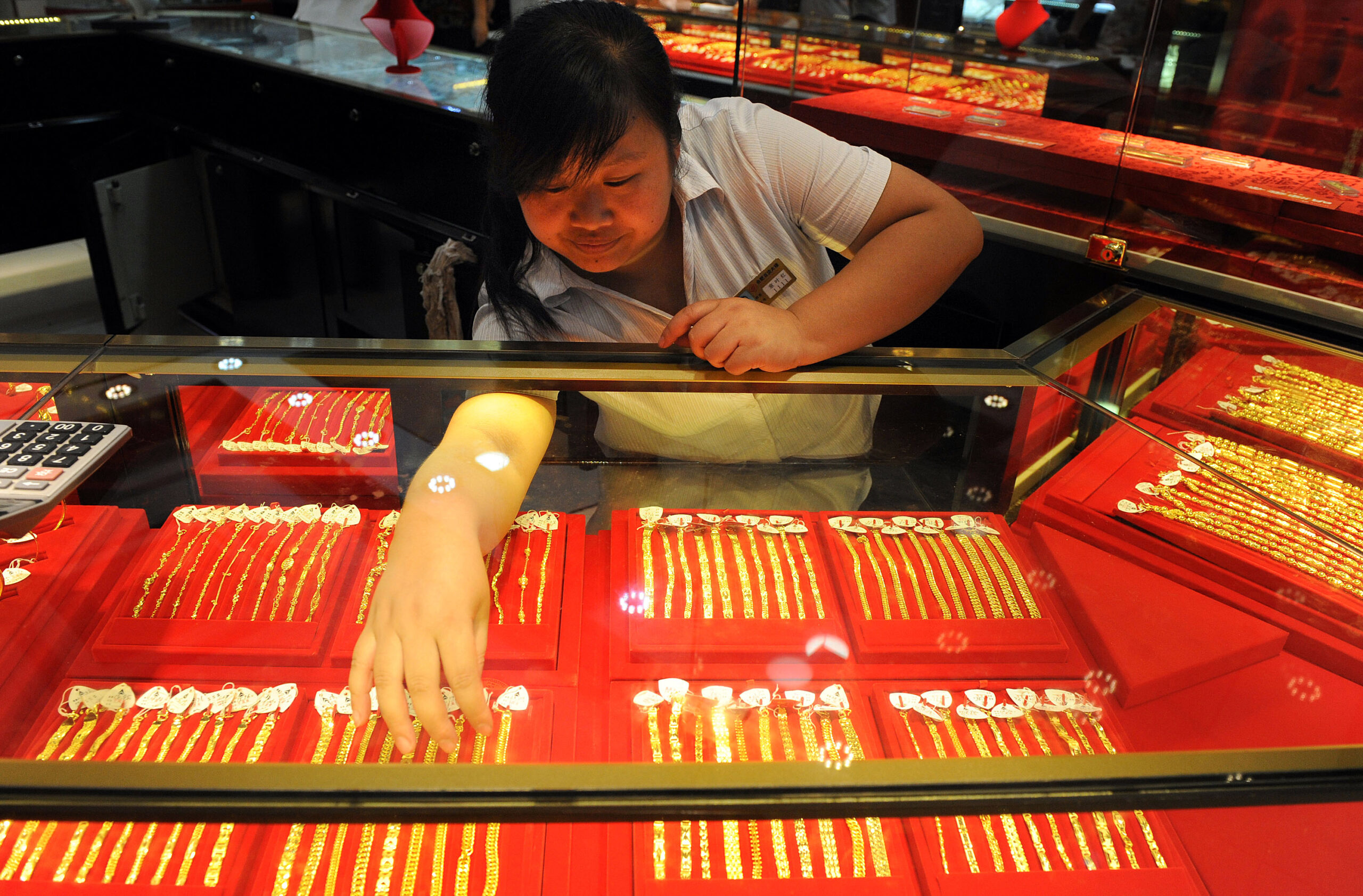
Recently, gold prices have experienced significant fluctuations, leading to a noticeable change in consumer behavior in China. While some gold buyers who previously queued to purchase gold have adopted a more cautious stance, there are also reports of other regions bustling with customers eager to make purchases.
In Zhengzhou, Henan province, a local jewelry store has seen a sharp decline in customer footfall compared to the bustling environment witnessed just a short while ago. The store manager, Luo Yue, reminisced about the fervent business days when customers lined up even for elevator access, with staff members juggling multiple groups of clients at once. Today, the scene is starkly different, with the store appearing nearly deserted, in some instances having more sales associates than customers.
Manager Luo explained that this sudden drop in visitor numbers can be attributed to the recent volatility in gold prices. Many consumers are now holding back, hoping for further reductions in prices before making any purchases. Additionally, some consumers who had an urgent need for gold already made their purchases when prices significantly fell.
Luo further highlighted that just a week ago, gold prices surged to around 910 yuan per gram but quickly dropped back to a low of 891 yuan per gram. Such intense fluctuations in price are influencing the purchasing patterns of consumers.
Gold price volatility is reshaping how and when consumers decide to buy. At the end of October, international gold prices dipped to approximately $3,870 per ounce, which caused domestic gold jewelry prices to drop by over 500 yuan from their peak earlier in the year. Despite this drop, a sustained surge in purchases has not materialized.
Interestingly, while some regions are experiencing a slowdown, others show a contrasting trend. On November 1, a visit by a financial news outlet to jewelry markets in Shijiazhuang revealed that several gold stores were buzzing with activity, with customer traffic increasing by 20% to 30% in some locations. Consumers were seizing the opportunity to buy gold bracelets as prices fell, while others were preparing to purchase gold jewelry for weddings.
In Shanghai, on November 8 at the Zijingcheng Jewelry Trading Center, some merchants reported that popular items were running out of stock and certain sizes were sold out, indicating that consumer interest was still strong, bolstered by promotional consumer vouchers that attracted those who were previously hesitant.
Despite the regional differences in consumer behavior concerning gold purchases, data reveals a broader downward trend in the overall demand for gold jewelry in China. According to a report released by the World Gold Council (WGC) on November 3, gold jewelry consumption in mainland China totaled 65.7 tons in the third quarter, marking a 22% decline year-on-year. While this figure reflects a 30% recovery from the second quarter, it remains the lowest level for that period since 2006.
The report highlights several factors contributing to the decline in consumer purchasing power and confidence, including high gold prices, sluggish economic growth, and a persistently weak real estate market.
In contrast to the weakening demand for jewelry, investment in gold has shown signs of resilience. The same WGC report noted that demand for gold bars and coins reached 78.9 tons in the third quarter, reflecting a 7% increase compared to the previous year. This suggests that while some consumers are still looking to invest in gold, their motives for purchasing jewelry and investment-grade gold bars have diverged.
On the retail side, merchants are also facing challenges. A survey conducted by the World Gold Council in October revealed that 45% of jewelry retailers plan to further cut back on their gold inventory due to the high prices, decreased sales volume, and rising financing costs. Additionally, over 40% of retailers intend to introduce more products weighing less than 5 grams in response to tightened consumer budgets.