
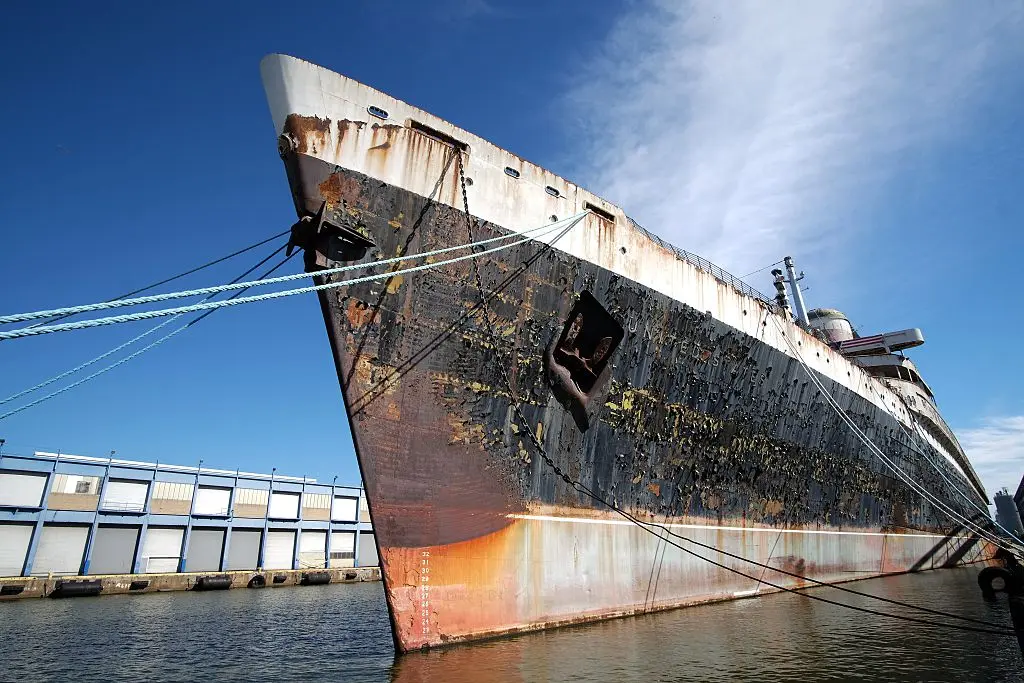
On November 11, a significant milestone was achieved when the SS United States, the largest and fastest ocean liner ever built in American history, was successfully scuttled approximately 22 nautical miles southwest of Destin, Florida, in the Gulf of Mexico. With this operation, the SS United States officially transitioned into the world’s largest artificial reef.
According to information released by the SS United States Conservancy, the vessel was towed out to sea for its final journey, escorted by dozens of tugboats and yachts. Prior to the scuttling process, workers had strategically cut multiple holes in the ship’s hull and deck to ensure that it would sink smoothly and evenly, without the use of explosives.
Around 2 PM Eastern Time, workers began preparations for the scuttling operation. Using fireboats, they pumped water into the ship through hoses. By 5 PM, staff opened two valves to let seawater flow into the vessel via its original intake pipes.
By approximately 6 PM, the water inflow was fully underway, with seawater continuously flooding the ship’s compartments, setting the stage for its final descent. Later, around 10 PM, this legendary cruise liner sank upright into the ocean, settling at a depth of about 180 feet (approximately 55 meters). It will now serve a dual purpose as both a diving attraction and a crucial component of the local marine ecosystem.
The original scuttling date was scheduled for November 12 but was moved up due to anticipated high winds. Nick Tomecek, a public information officer for Okaloosa County, conveyed to a FOX Weather correspondent that operations could only proceed safely with continuous wind speeds below 27 kilometers per hour and wave heights under one meter. The concern was that strong winds could cause the vessel to drift from its designated sinking location.
The SS United States entered service in 1952 and was formally retired in 1969. Since 1996, it had been moored in Philadelphia and faced potential scrapping for scrap metal. Fortunately, in 2024, it was purchased by Okaloosa County for around $1 million.
In February 2025, the vessel was towed to Mobile, Alabama, for a thorough cleaning and refurbishment. Workers removed hazardous materials such as residual fuel, wiring, glass, pipes, and various non-metallic items to prepare for its transformation into an artificial reef. The total cost for the refurbishment and cleaning process was about $13 million.
Tomecek noted that certain areas of the northern Gulf lacked natural coral reefs, and with the transformation of the SS United States into an artificial reef, it is expected to become a haven for fish and marine life. This development is also anticipated to attract numerous tourists and fishermen to the area.
“When we learned that the SS United States might be sent to a scrap yard, we decided to purchase it and convert it into the world’s largest artificial reef,” Tomecek remarked.
The SS United States was a joint development between United States Lines and the U.S. government, crafted to blend the features of a luxury passenger liner and a military troop transport. It could carry 14,000 soldiers across nearly 10,000 miles (about 16,000 kilometers) without needing to refuel.
According to the conservancy, during sea trials, the vessel achieved a speed of 44 miles per hour (approximately 70 kilometers per hour), and it still holds the record for the fastest transatlantic crossing by an ocean liner, completing the journey in just about 3 days and 11 hours. Throughout its service, it transported over one million passengers.
Warren Jones, a current board member of the conservancy, shared his memorable experience from a journey sailing from New York to France. “The ship raced along at an incredible speed; you could hear the roar of the engines and feel a powerful vibration. The image of the vessel passing the Statue of Liberty is one I will never forget,” he reflected.
In a phone interview with Reuters on Wednesday evening, Jones indicated that some diving enthusiasts were eager to explore the wreck site as early as Thursday morning. The SS United States will join a large underwater landscape composed of wrecks and concrete structures, creating more than 500 dive sites within the Destin-Fort Walton Beach Artificial Reefs area, renowned for its diving opportunities.