
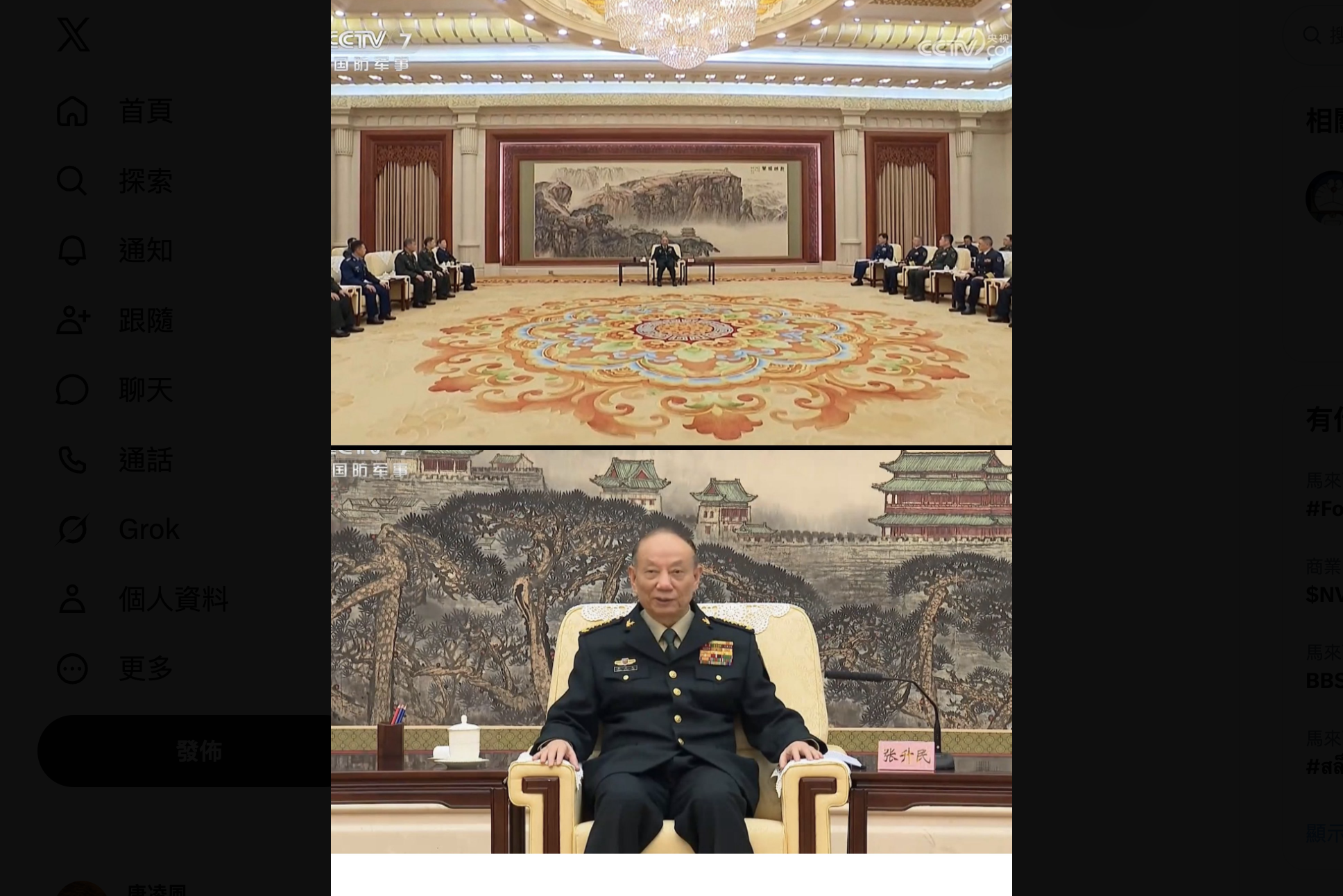
On November 9th, Zhang Shengmin, who has recently been elevated to a member of the Political Bureau and serves as the Vice Chairman of the Central Military Commission (CMC), conducted a report in Beijing that outlined the key messages from the 20th National Congress’s Fifth Plenary Session of the Communist Party. In this address, he emphasized the need for the entire military to heed the leadership of Xi Jinping. State media coverage depicted Zhang in a commanding position, which attracted attention for its symbolic implications; observers have interpreted this as a potentially precarious situation for him.
According to reports from state news agency Xinhua, the first briefing on the “spirit of the 20th National Congress’s Fifth Plenary Session” for the entire military took place in Beijing. During this session, Zhang Shengmin interacted with members of the briefing team.
At 68 years old, Zhang’s promotion to the Political Bureau during the Fifth Plenary Session is generally regarded as paving the way for his re-election at next year’s 21st National Congress of the Communist Party of China.
In his remarks, Zhang praised Xi Jinping as the “navigator and helmsman,” insisting that “the entire military must implement the responsibility system of the Chairman of the Military Commission and resolutely listen to the commands of the Party Central Committee, the Central Military Commission, and Chairman Xi.”
Visuals broadcast by state-run CCTV highlighted Zhang seated alone at the center of the hall with a grand landscape painting behind him, flanked by military leaders on either side.
Footage and images of Zhang’s lecture sparked significant debate on social media platforms. Some users expressed concerns, questioning if the display was perhaps overstated.
Several analysts shared their views on this display of power.
One comment stated, “After a series of purges, Zhang Shengmin sitting in this prominent position gives off a feeling of triumph.”
Another observer remarked, “Zhang Shengmin’s seating posture appears rather dangerous.”
Some netizens suggested that Zhang’s placement could surpass figures like Ye Jianying from previous years. Given the meeting’s themes, the setup for this briefing seemed inappropriate. Many recognized this as a misstep in venue preparation by Zhang’s office, although some speculated that others might have deliberately elevated Zhang’s status to invite criticism, a move that surely wasn’t initiated by him personally. It’s widely acknowledged that such arrangements resembling Xi’s personal style could provoke accusations of overstepping.
The 20th National Congress’s Fifth Plenary Session concluded on October 29th in Beijing, during which Zhang Shengmin was elected as a member of the Political Bureau of the Central Committee.
In insights shared earlier, Chinese-American writer and political commentator Chen Pokong indicated that Zhang’s increasingly prominent position could entail higher political risks. “Rather than viewing Zhang Shengmin’s advancement as a promotion, it might be more accurate to see it as entering a high-risk environment.”
Chen suggested that if Zhang attempts to assert independence, it could arouse suspicion from Xi Jinping. Conversely, if he chooses to proceed with caution, he may find it challenging to make substantial impacts on military decisions.
Notably, among the seven leaders designated to the CMC during the 20th Congress’s First Plenary Session in 2022, several, including He Weidong and Miao Hua, have since fallen from grace. Currently, only Xi and Zhang remain.
Expert on Chinese affairs, Wang He, commented that Zhang’s ascent to the Political Bureau is a significant strategy by Xi for consolidating military power and stabilizing morale in anticipation of securing his position during the upcoming 21st National Congress.
Wang observed that since January 2026, Xi has not inspected the military at any local level, which is an unprecedented situation that emphasizes the gravity of Zhang Youxia’s downfall. While Xi might have managed to stall the CMC, he couldn’t ignore the necessity of having an operator within the military. Given the alternatives, Zhang Shengmin was likely the only choice, even if it may lead to complications.
In light of Zhang Shengmin’s distinct singular recognition during military meetings, independent analyst Cai Shenkun remarked on social media that while many predict Zhang will certainly retain his position as First Vice Chairman of the Military Commission for the coming year, he believes significant uncertainties remain. He suggested that if Zhang continues in office, the military’s risk levels could surpass anything seen before, especially considering Xi’s tendency toward suspicion—heightened further in his later years. Zhang’s rise has been marked by the purging of military leaders, and thus, Xi’s trust in him might be quite limited.
Cai assessed that Zhang’s main task likely involves selecting party representatives for the 21st Congress from the military and reviewing candidates for Central Committee positions, after which he might step down. Should he attempt to further embed himself into the 21st Congress, his fate could mirror that of Zhang Youxia.