
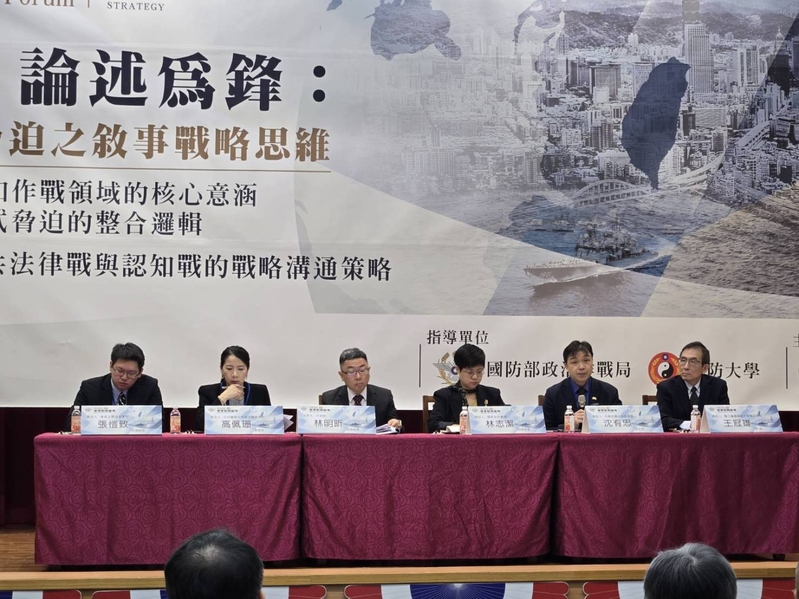
On November 11, a high-ranking government official from Taiwan attended a military news forum to discuss the ongoing threats posed by the Chinese Communist Party (CCP). The Deputy Minister of the Mainland Affairs Council emphasized the multilayered coercive tactics employed by the CCP against Taiwan, which include cognitive warfare and gray zone tactics. He expressed concerns that under Xi Jinping’s extended leadership following the 20th National Congress, these coercive measures would only intensify.
During his participation in the 2026 Military News Forum organized by the National Defense University, the Deputy Minister pointed out that the CCP actively disseminates misinformation through social media platforms. This includes narratives that question U.S. intentions and military presence, aimed at manipulating public opinion and dividing Taiwanese society.
Furthermore, he highlighted the CCP’s strategic use of platforms like TikTok and Xiaohongshu to normalize and trivialize political issues, creating an illusion of a prosperous life in China while portraying Taiwan’s development as lagging. Such tactics reflect a trend towards more professional, organized, and targeted messaging.
The Deputy Minister elaborated on the CCP’s recent cognitive warfare initiatives, which not only involve the spread of false information but also the exploitation of real events to forward politically motivated narratives. Examples include the misrepresentation of the 80th anniversary of post-war international order, the UN Resolution 2758, and commemoration dates like the October 25 Restoration Day and the November 12 birthday of Sun Yat-sen. These narratives aim to foster the perception that Taiwan belongs to the CCP, thus promoting the “One China Principle.”
On the legal front, he pointed out the CCP’s attempts to create a legal framework that distorts international decisions like the aforementioned UN resolution to mislead Taiwan’s legal status. Their strategy involves establishing laws that make “unification” a legal obligation rather than merely a political slogan.
In recent years, the CCP has taken steps to construct a legal system opposing independence, such as the “22 Punitive Measures against Independence” announced in 2024. This legislation serves their agenda of jurisdiction over Taiwan and is claimed to provide a legal basis for cross-border suppression.
Additionally, the official remarked on the CCP’s claims of conducting gray zone operations around the Taiwan Strait under the guise of legality. These operations, which have included regular patrols and law enforcement, represent a gradual escalation that seeks to establish a “new normal.” This evolution, he argued, is aimed at achieving a scenario of “governing without unifying” Taiwan.
He stressed that the CCP’s ultimate goal with its multifaceted coercion is to deny the sovereignty of the Republic of China, internalize the cross-strait conflict, and sever Taiwan’s international presence while forcing its people to accept the CCP’s narratives surrounding “One China” and unity.
The Deputy Minister reaffirmed the government’s unwavering stance against accepting any political framework or legal definitions imposed unilaterally by the CCP. He emphasized that the government will not allow the CCP to redefine cross-strait relations as domestic issues to undermine Taiwan’s sovereignty.
He called upon the public to be vigilant in the face of the CCP’s cross-border suppression and the uncertainties surrounding entry and exit checks to China and Hong Kong. Individuals planning to travel to these regions should carefully assess the risks involved.
Looking ahead, he noted that the CCP is expected to convene the 21st National Congress next year, during which it is likely to intensify its pressure and united front tactics against Taiwan. This impending situation heralds more complex and severe challenges for Taiwan.
In summary, the Deputy Minister asserted that in light of the CCP’s combined military intimidation, political infiltration, and cognitive warfare, the government will continue to strengthen the overall resilience of Taiwan’s defense. It aims to enhance legal frameworks and response mechanisms against foreign infiltration and cognitive operations. The ultimate goal is to prevent authoritarian influence from interfering in Taiwan’s democratic processes while steadfastly defending national sovereignty and the freedoms that define Taiwan’s democratic way of life.