
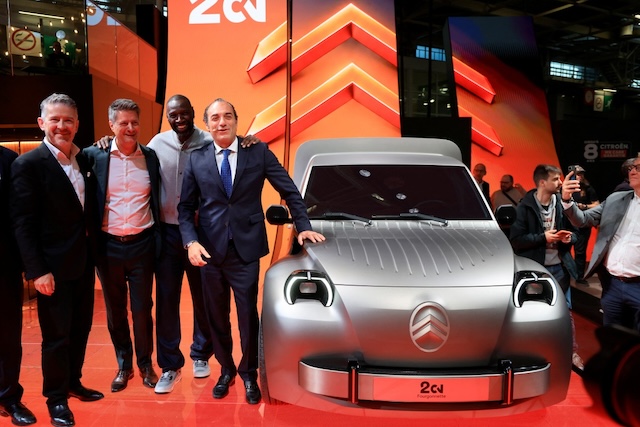
As Chinese automotive brands accelerate their expansion into the European market, traditional European car manufacturers are seeking new competitive strategies. At the 91st Paris Motor Show held from October 12th to 18th, European carmakers are introducing electric versions of classic car models, hoping to leverage their brand history, design characteristics, and cost control to establish a competitive edge against Chinese car companies and attract consumers.
According to a report by the Financial Times on October 12th, French carmaker Citroën, a subsidiary of Stellantis, plans to launch an electric version of the classic 2CV in 2028 with a target price of around 15,000 euros. Volkswagen is introducing the ID.Polo electric hatchback with a price tag of about 25,000 euros, drawing inspiration from the design of their classic model, the Golf.
Previously, Renault’s electric versions of the R5 and Twingo successfully stirred consumers’ emotions and brand identity by leveraging their classic image.
A report by Reuters on October 13th highlighted that Renault’s electric version of the R5 became the best-selling midsize electric vehicle in Europe in the first half of this year, driving a 9% revenue growth for the Renault Group.
Industry experts believe that compared to Chinese brands, which have entered the European market for a shorter period, the historical heritage and brand culture of European car manufacturers could be a crucial advantage in attracting consumers.
At the same time, Reuters reported that the classic car strategy is not a one-size-fits-all solution. Volkswagen’s Chief Designer, Andreas Mindt, emphasized that car manufacturers cannot rely solely on brand heritage; they still need to excel in key technologies such as fast charging and autonomous driving.
The presence of Chinese automotive brands at the Paris Motor Show was significantly strengthened. According to Reuters, this year’s show featured 20 Chinese automotive brands, accounting for about one-third of the total number of car brands exhibited, which is double the amount compared to 2024.
Apart from brands like BYD, emerging brands like NIO and WM Motor are actively seeking opportunities in the European market and gradually expanding their product focus to include high-end models.
Global consulting firm AlixPartners estimates that the market share of Chinese brands in European car sales is expected to rise from approximately 12% to 16% by 2030.
Chinese car companies primarily gain a competitive advantage through price differences. AlixPartners pointed out that the production cost of Chinese brand electric vehicles is around $20,000, while similar models in Europe require about $31,000, mainly due to differences in battery and material costs.
Simultaneously, the European automotive industry is facing challenges such as weak demand, low factory capacity utilization, plant closures, and job cuts. In response to competition from Chinese brands, European car manufacturers are not only electrifying classic car models but also actively adjusting supply chains, reducing manufacturing costs, and shortening the development cycle for new vehicles.
Top executives from Volkswagen and Renault are urging the European Union to expedite the establishment of “European Manufacturing” regulations to support local production, strengthen supply chains, and enhance industry competitiveness.
Volkswagen’s CEO, Oliver Blume, recently stated that France and Germany should enhance cooperation to collectively boost the competitiveness of the European automotive industry and address the challenges posed by the Chinese automotive industry.
In addition to price competition, concerns about the copying issues of Chinese automotive companies were once again raised at this year’s Paris Motor Show.
Czech automotive journalist Michal Dokoupil discussed the large Chinese “luxurious” SUVs at the Paris Motor Show on the social media platform X, pointing out that the competition presented by Chinese car companies no longer solely revolves around replicating Western designs but also features highly similar branding between companies.
He noted that approximately 7 car models had “completely identical” interiors, with software systems, dashboards, central consoles, seat configurations, roof screens, and in-car refrigerators being “eerily similar.”
Dokoupil criticized that while some Chinese car models boast advanced technological features, they lack distinct personality and originality. He believes that this phenomenon is not limited to high-end SUVs but can also be observed in other levels of Chinese automotive models.