
Hello, audience! Welcome to watch “Century Truths”.
The combination of Xi Jinping and Wang Qishan, was once known as the “Xi-Wang system”, with Wang Qishan playing a crucial role in helping Xi Jinping seize the highest power.
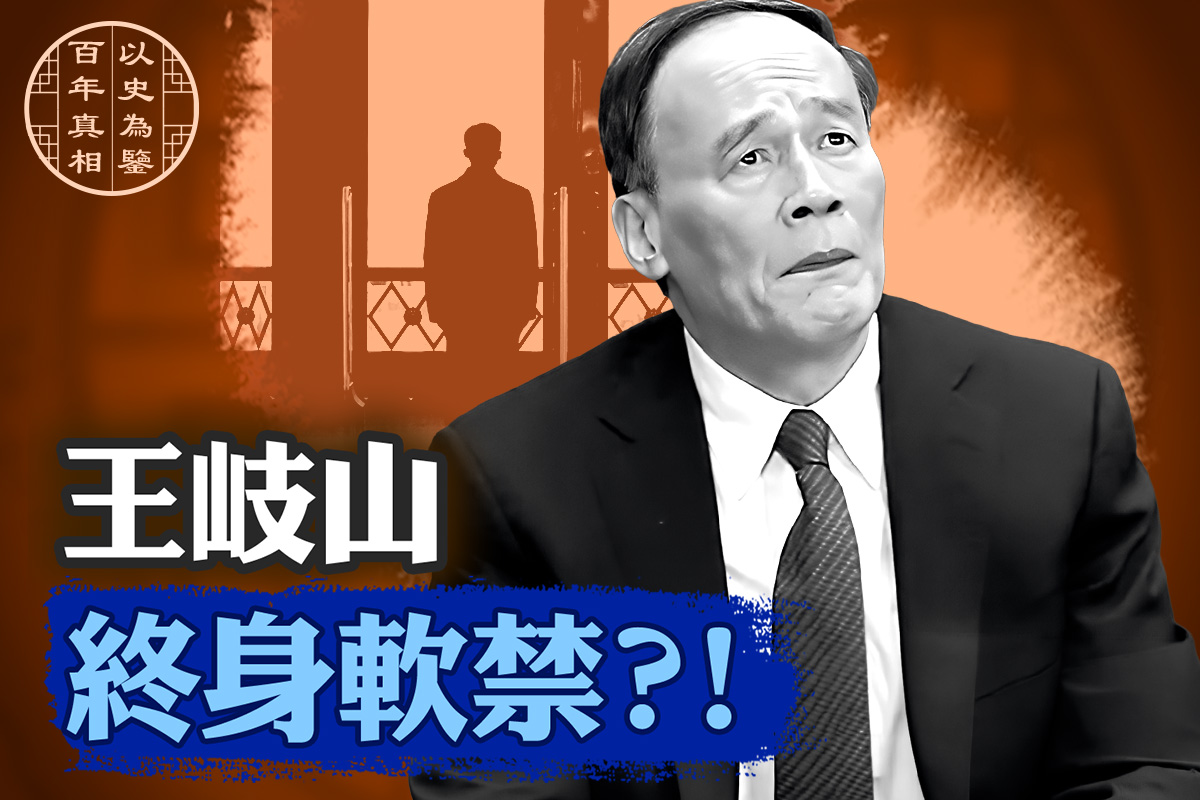
However, after October 2023, Wang Qishan completely vanished from official media. In June 2026, the US magazine “The Diplomat” revealed that he had actually been under house arrest in Beijing.
This news was not entirely surprising as unfavorable news about Wang Qishan had been circulating in recent years. His close associates fell one after another, from the financial system to the inspection system, from the old guard to his former allies, his “Fab Five”, have almost all been eliminated.
At the same time, rumors of a rift between Xi and Wang began to spread, with the insider details of their falling out circulating online.
From former political allies to present-day political adversaries, the dramatic reversal of the relationship between Xi Jinping and Wang Qishan is truly worth discussing. Today, let’s start from the story of Xi Jinping and Wang Qishan, and see how power can tear apart allies.
Xi Jinping and Wang Qishan have known each other since youth. Many people know that Xi is a second-generation Communist Party leader, with his father, Xi Zhongxun, holding high positions within the CCP. Although Wang Qishan is not from a Party background, his father-in-law Yao Yilin was a former member of the CCP Politburo Standing Committee and Vice Premier of the State Council.
In their youth, both Xi Jinping and Wang Qishan were sent to Shaanbei as educated youth. Xi Jinping once revealed to Zhang Siming, the head of the Yanchuan County Revolutionary Committee, that during his early days in Yanchuan, he once returned from Beijing and stayed at Wang Qishan’s place in Fengzhuang due to the distant travel, sharing a bed and blanket. This shows that Xi and Wang had a good relationship from a young age.
Time passed, and we arrived at 2012 when the CCP held the 18th National Congress, and Xi Jinping became the General Secretary of the Communist Party of China. At that time, the former CCP leader Jiang Zemin still held significant influence, and in order for Xi to solidify his position, he needed someone to help him purge the Jiang faction. Thus, he chose Wang Qishan.
At the end of 2012, Wang Qishan was appointed as the Secretary of the Central Commission for Discipline Inspection. A few months later, a nationwide anti-corruption storm began. “Taking down tigers” quickly became the most chilling phrase in the CCP officials’ circles, with a large number of ministerial-level officials, military generals, and state-owned enterprise executives being taken down.
Wang Qishan became the sharp blade in this political purge. A saying circulated in the official circles at the time: “Better to see Yama than to see Lao Wang.” This phrase reflected Wang Qishan’s influence and power during that period.
During those years, the top CCP echelon was referred to as the “Xi-Wang system.” Xi was responsible for strategic direction while Wang was in charge of the clean-up operations. One set the strategy, the other handled the battleground. Their collaboration quickly established Xi Jinping as the true core of power.
However, once Xi consolidated his position, a question emerged: Was Wang Qishan a friend or a threat as his power grew?
Before the 19th National Congress of the CCP in 2017, there were widespread speculations that Wang Qishan would break tradition and remain as a member of the Politburo Standing Committee. However, the opposite happened as he left the Central Commission for Discipline Inspection and was appointed as the Vice President of the country. The once mighty “tiger hunter” started to gradually fade from the core.
The relationship between Xi and Wang took a turn, reportedly due to a shift in Xi’s mindset and another reason.
While studying in the US, commentator Cai Shenkun revealed that Xi Jinping had consulted Wang Qishan on future arrangements. Wang indicated that he did not plan to continue serving after the 20th Congress and advised Xi not to seek reelection. However, Xi paid no heed. Wang’s advice ultimately led to Xi purging those around Wang.
From April 2022 to June 2026, key former associates of Wang Qishan were investigated, with the five major associates known as Wang Qishan’s “Fab Five” – Dong Hong, Tian Huiyu, Fan Yifei, Zhou Liang, and Li Xiaohong – all being taken down.
The Diplomat magazine’s June 2026 report also suggested that Beijing’s cleansing of Wang Qishan’s associates was likely to ensure Xi Jinping’s fourth term at the 21st Congress in 2027 without interference from Wang Qishan and other party elders.
The once vaunted “Xi-Wang system” had been swept into history. In the realm of power, sharing hardships is often easy, but sharing dominion over the world is the most difficult.
If Wang Qishan’s reversal in relation to Xi Jinping was partly due to suspicions of him posing a threat, the next individual, who does not pose any threat to Xi, is Hu Jintao.
From 2002 to 2012, Hu Jintao served as General Secretary of the Communist Party of China for ten years, also holding positions as the President and Chairman of the Central Military Commission. However, he never attained the authoritative status of “Mao core” or “Deng core”. The real wielders of power during that period remained behind the scenes – Jiang Zemin and Zeng Qinghong.
When the 18th National Congress of the CCP was held in the fall of 2012, Hu Jintao made a surprising decision – he simultaneously handed over the roles of General Secretary of the Central Committee and Chairman of the Central Military Commission to Xi Jinping. This was not a common occurrence in CCP history.
Many analysts believed that Hu Jintao aimed to avoid dual power centers, allowing the new leader to genuinely take control. He paved a relatively seamless path for Xi Jinping’s succession.
In the following years, when Xi Jinping encountered significant resistance while purging officials aligned with Jiang, Hu Jintao consistently supported Xi at critical junctures.
What did Hu Jintao’s support for Xi Jinping earn him?
On October 22, 2022, the CCP held the closing ceremony of the 20th Congress at the Great Hall of the People, attracting global media attention. Just as the meeting was about to conclude, amidst his retirement for a decade, 80-year-old Hu Jintao was suddenly helped to his feet by staff. Hu Jintao tried to stay at the scene, wanting to say something, and it was noticed that he touched some documents on the table. Subsequently, before the cameras, Hu Jintao was forcefully escorted out of the venue.
Xi’s aggressive and ruthless treatment of Hu was instantly spread worldwide.
If Hu Jintao illustrated the handover of power post-Comrade era, the next individual touched upon a sensitive red line – assessing the highest authority. This individual is Liu Yazhou.
Liu Yazhou is a second-generation Communist leader, an Air Force general who served as the political commissar of the National Defense University for over seven years. He is also the son-in-law of former CCP National Chairman Li Xiannian. In other words, Liu has both a red background and military credentials along with extensive connections.
Liu Yazhou is not your typical military official. He has written numerous articles, expressed strategic viewpoints, and within the second-generation circle, he is known as the “Scholar General” for his intellectual acumen.
Liu Yazhou had also been a visiting scholar in the US, gaining exposure to Western political, military, and academic systems. Such qualities make him influential within the system. However, individuals like him are often not easily silenced.
In early 2017, Liu Yazhou retired and should have entered a retirement mode. However, by the end of 2021, rumors surfaced overseas: Liu Yazhou ran into trouble.
In 2023, the CCP’s “Red Culture Network” released an article titled “Who is Liu Yazhou sacrificing himself for?”, directly denouncing Liu Yazhou as “a typical ambitious conspirator”.
Those familiar with CCP political jargon know that this is no ordinary criticism. Past individuals labeled as such were mostly deemed involved in power struggles for the highest position, such as Zhou Yongkang, Bo Xilai, Ling Jihua, and Sun Zhengcai.
In 2024, overseas scholar Wang Juntao revealed that through Liu Yazhou’s relatives, he had confirmed that Liu had been sentenced to life imprisonment, ostensibly on charges of corruption.
Being targeted after retirement for nearly five years, and facing such intense measures, led many to speculate: Liu Yazhou’s troubles likely went beyond just economic matters.
Some say Liu Yazhou opposed the reunification of Taiwan through force. Others say he privately had a low opinion of Xi Jinping’s capabilities, offending him.
These claims are challenging to independently verify. But one detail worth noting: in a highly centralized system, whether a person truly constitutes a threat sometimes does not depend on what they did but on whether they have the capacity to establish an alternative influence.
Liu Yazhou had the qualifications, the reputation, and his own judgment. And when power becomes increasingly concentrated, even differing opinions themselves may be seen as risks.
The next story points to the most core and sensitive aspect of China’s power structure – military authority. The protagonist of this story is Zhang Yuxia.
Zhang Yuxia’s background is unique. He is a second-generation Communist, his father Zhang Zongsun was a founding general of the CCP, and had long worked alongside Xi Jinping’s father Xi Zhongxun as old comrades. The Zhang family and the Xi family had decades-long friendships.
Zhang Yuxia’s own military career is also extraordinary. Rising through the ranks from grassroots, serving for nearly sixty years, with combat experience, he held high prestige within the military system.
During the 19th Congress, Zhang Yuxia entered the Central Military Commission. By the time of the 20th Congress, he further ascended to become the first Vice Chairman of the Central Military Commission. Many believed that Zhang Yuxia was one of the most important and trusted military figures of Xi Jinping; he played a significant role in Xi’s achieving his “three terms”.
One would think such a person would be the safest. However, on January 24, 2026, the 76-year-old Zhang Yuxia was suddenly announced to have fallen from grace. The next day, Xi Jinping used his pen to publish an editorial in the military newspaper, accusing Zhang of five major offenses, the most severe being “seriously trampling on and destroying the Chairman responsibility system of the Central Military Commission”.
This was a serious political denunciation, equivalent to politically “killing” Zhang Yuxia. However, the outside world still did not know what Zhang had done, as the Xi authorities did not disclose a single word about it.
A military figure who had accompanied Xi Jinping for many years and was most trusted by him, ultimately met this fate.
Today, we discussed four individuals.
Wang Qishan, who once fought on the front lines for Xi Jinping; Hu Jintao, who handed over the highest power to Xi; Liu Yazhou, coming from a red family with military influence; Zhang Yuxia, considered one of Xi’s core military associates.
In the end, they all met similar fates – suspected by Xi Jinping and even ruptured by him.
Power was originally meant to integrate resources and establish order. But as power becomes increasingly centralized, it may transform into a tool for destroying resources and order.
History repeatedly proves: the most dangerous moment for a regime is not necessarily when facing external enemies, but when internal distrust among its own ranks emerges.
Alright, that’s it for today’s “Century Truths”. If you enjoyed our program, feel free to subscribe, like, and share. See you in the next episode.