
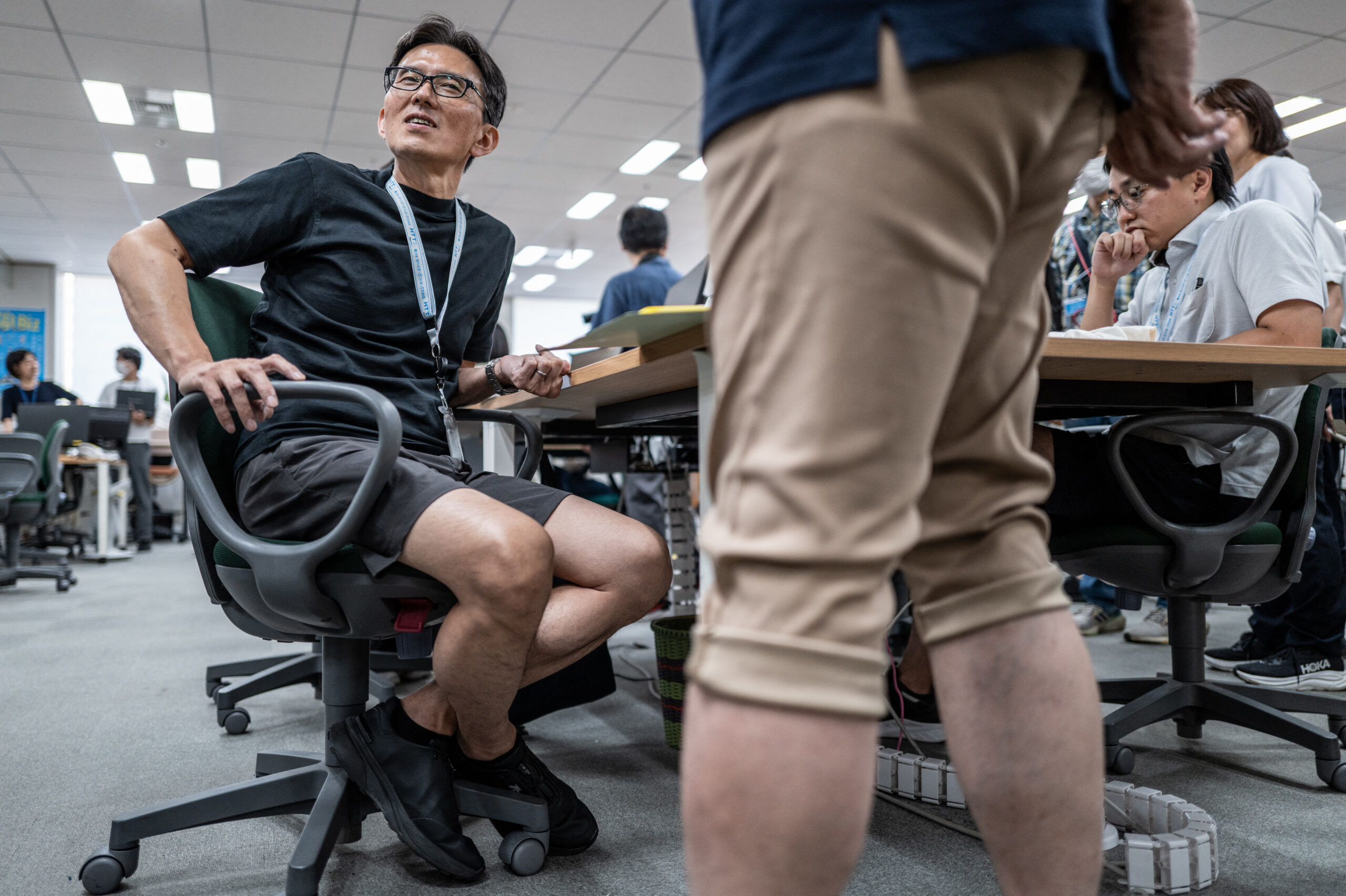
Continuing high temperatures are not only affecting people’s daily lives, but are also starting to change the workplace attire of some office workers. This year, the Tokyo Metropolitan Government in Japan has further encouraged employees to dress in lighter clothing, including shorts, T-shirts, and sneakers, building upon the “Cool Business” initiative promoted by the Japanese Ministry of the Environment in 2005.
“Cool Business” is an energy-saving initiative promoted by the Japanese Ministry of the Environment since 2005, encouraging people to wear light clothing to work in the summer to reduce dependence on air conditioning and energy consumption. With a heatwave sweeping across Europe, some companies, employees, and retailers are beginning to relax or adjust summer workplace dress codes.
According to Reuters, several major retailers in the UK have reported strong sales of linen shorts and suits, with men opting for more breathable fabrics suitable for Mediterranean climates in high temperatures.
Martha Hibberd, a men’s wear buyer at John Lewis department store, noted that the line between commuter style and vacation wear is becoming increasingly blurred. Meanwhile, Marks & Spencer reported a 183% increase in sales of linen trousers for men from June to July compared to the same period last year.
European fashion retail giant H&M announced plans to introduce more lightweight clothing styles and postpone the launch of their autumn collection. Andreas Lowenstam, head of menswear design at H&M, commented that “when it comes to climate change, it seems we can’t turn back.”
In addition, Hugo Boss has expanded its selection of tailored shorts, including a cotton pair priced at 229 euros in their Boss by Beckham collection, a collaboration with football star David Beckham.
Reporters from Reuters observed people wearing shorts to work in commercial districts such as London’s Canary Wharf and Frankfurt, Germany. However, some companies still have restrictions on the style or occasions for wearing shorts.
Vidar Korsberg Dalsbo, a spokesperson for Norway’s largest bank DNB, told Reuters that employees are allowed to wear shorts and skirts to work, but specified that it should be “formal attire with a certain length, not ballet skirts or 1970s style football shorts.”
In a June email to employees, Gianfranco Lot, Swiss Re’s head of the Swiss region, suggested that staff drink more water, take breaks when needed, and even mentioned swimming in Lake Zurich across the office. The email also reminded employees that “shorts are only suitable for weekends.”
Aside from existing company regulations, some trade unions and employees are also requesting relaxed summer dress codes. IG Metall and Verdi service industry union in Germany both stated that companies should relax or abolish dress codes during hot weather or heatwaves.
Moriz Tiedemann, an occupational health expert at IG Metall, commented, “As summers get hotter and heatwaves become more frequent, the burden on workers is visibly increasing.”
Some individual employees have taken matters into their own hands. A bus driver in Warsaw, Poland, named Darek, expressed dissatisfaction with the polyester long pants in his standard uniform, and protested by wearing a skirt to work this month. Darek mentioned that “these fabrics make us sweat excessively and feel overheated.”
One of his colleagues initiated a petition calling for the Warsaw Capital Transport Authority ZTM to allow drivers to wear shorts to work in high temperatures. The petition has gathered over 400 signatures to date.