
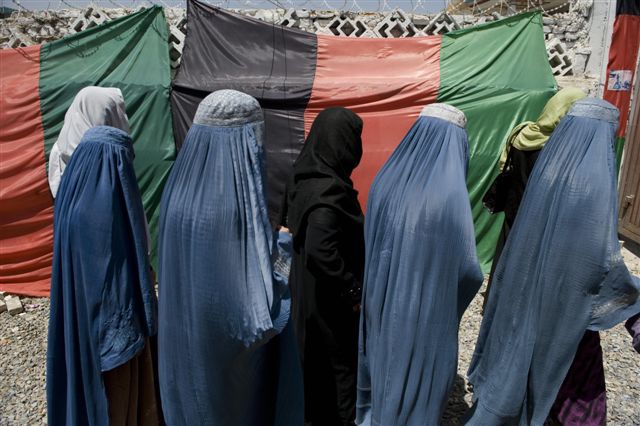
On August 19, Portuguese President António José Seguro signed a law that prohibits covering the face in public places, making the country the latest in Europe to implement a “face-covering ban.” According to reports by Reuters on Friday, the new law, dubbed the “Robe Law” by the Portuguese media, primarily targets the burqa and niqab worn by Muslim women, which fully or largely cover the body and face.
The burqa is a loose, usually black or blue, full-length outer garment that completely covers women from shoulder to toe. The burqa and niqab are traditional clothing worn by women in Arab and some Islamic countries. The Taliban regime in Afghanistan ordered on May 7, 2022, that Afghan women must wear burqas in public places.
Under the new law, Portuguese citizens are prohibited from wearing clothing intended to cover the face and make identification impossible in public places. Additionally, no one can compel others to cover their faces based on gender, religion, age, or background. Violators could face fines ranging from 150 euros to 3,000 euros.
At the same time, the ban includes several exemptions, such as situations where face-covering is necessary for health, occupation, artistic performances, or weather-related reasons. Furthermore, places of worship, diplomatic and consular offices, as well as inside airplanes, are not subject to these restrictions.
The Portuguese Parliament passed this bill in July this year. During the vote, right-wing and far-right parties supported the bill, while left-wing parties opposed it.
Seguro, when signing the law, emphasized that showing one’s face is an important foundation for social trust, as facial recognition plays a crucial role in identifying people and facilitating communication with each other.
The Presidential Palace of Portugal also stated that this decision involves factors such as social integration, gender equality, and public safety. Requiring only women to fully cover their faces might create disparities not in line with the principles of gender equality and equal dignity.
This law has sparked debates in Portugal concerning religious freedom and women’s autonomy. Supporters argue that limiting face coverings in public places aids in identification and public safety, while opponents fear that the ban may restrict the freedom of choice for some Muslim women in selecting religious attire.
Portugal is not the first European country to implement such restrictions. France has banned face coverings in public spaces since 2010; Belgium introduced similar regulations in 2011; Denmark prohibited face-covering clothing in public places in 2018; the Netherlands has implemented partial bans in public transport, government agencies, education, and medical facilities; Switzerland also began implementing a nationwide ban on face-covering in public spaces in 2025.
Currently, various European countries have implemented different degrees of restrictions on full-face coverings, and policies surrounding public safety, identification, religious freedom, and individual rights continue to be debated.
Following the formal implementation of the new law in Portugal, whether related legislation will further provoke judicial challenges and social debates remains a topic of interest for observers.