
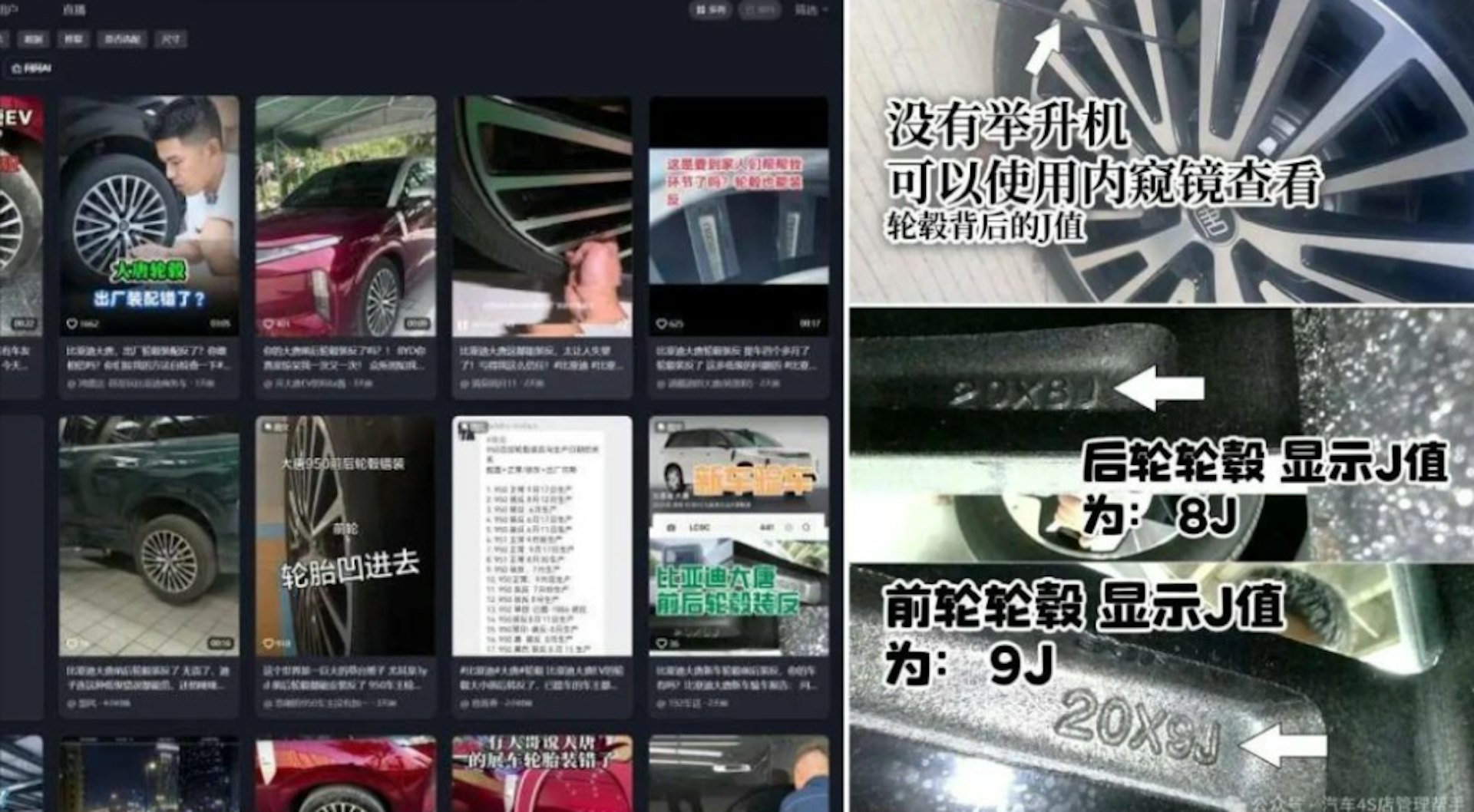
In early November, several owners of BYD’s Tang EV vehicles discovered a serious issue with their cars: the front and rear wheel hubs were installed incorrectly. Many of these car owners reported that they only realized there was a problem after having driven their vehicles for thousands, even tens of thousands, of kilometers. On November 11, BYD officially acknowledged the assembly error and attributed the mix-up to a coding mistake by one of their suppliers. This revelation has raised eyebrows, with automotive bloggers questioning how such a fundamental mistake could pass through multiple layers of quality control, labeling the situation as “unprecedented and unheard of.”
On November 6, a car owner lodged a complaint on the Chinese automotive complaint platform “Chezhiwang,” stating that their vehicle, manufactured in August 2026, had the front and rear wheel rims installed incorrectly. The owner demanded that BYD handle the situation at no cost and compensate for any related expenses.
According to the vehicle owner’s account, the affected cars were primarily the 2026 model of the Tang EV, which boasts a 950-kilometer range with rear-wheel drive. The original design specified that the front wheels should use 8J rims paired with 255/50R20 tires, while the rear wheels should utilize 9J rims with 275/45R20 tires. This means that the rear tires are 20 millimeters wider than the front tires. However, some of the vehicles that rolled off the assembly line had their front and rear hubs completely reversed, resulting in wider tires being fitted onto narrower hubs and vice versa.
One blogger, known as “Tang Shunfengche National Self-Driving Tour,” remarked, “I bought the Tang 950, and on my first day at work, the rear tire blew out.”
Another owner from Shanghai shared that after picking up their vehicle on June 26, 2026, they drove it for over four months and logged 13,935 kilometers before discovering the incorrect wheel installation. This owner demanded the replacement of tires and parts of the chassis that may have been affected by the abnormal stress, as well as an extension of the warranty on these components.
Some car owners revealed that they only went to check their vehicles after seeing complaints online from other customers, as they had not received any prior notification from the manufacturer.
On November 9, customer service personnel from BYD confirmed that they had received feedback regarding the issue and recommended that vehicle owners visit nearby service centers for inspection. After-sales staff in locations such as Ningbo also verified to the media that there were indeed issues with incorrectly installed wheel rims in certain batches, and owners could provide their vehicle identification numbers (VIN) for further investigation.
In a video commentary, an automotive blogger explained that having narrower wheel hubs fitted with wider tires would lead to the tire sidewalls tapering inward, causing the tire to bulge significantly. This deformation affects the tire shoulder, resulting in abnormal support from the sidewalls. Under such circumstances, prolonged driving, especially on highways, could lead to severe uneven tire wear and an increased risk of blowouts.
Conversely, the front wheels having wider hubs with narrower tires would cause the tire sidewalls to expand outward due to the hub width. This misalignment disrupts the contact area between the tires and the ground, which could cause a wobbly driving experience and diminish braking stability. Continuous driving under these conditions, particularly at high speeds, could compromise electronic stability controls such as ABS and ESP, posing a significant safety hazard.
Automotive blogger Wu Xiaotong, who has 880,000 followers on Weibo, stated that the phenomenon of having front and rear wheel hubs installed incorrectly is “unprecedented and unheard of.” He raised doubts about how the assembly and quality inspections could have failed to catch this mistake. He pointed out that after a vehicle rolls off the production line and is delivered to a 4S dealership, the car undergoes further checks, and prior to delivery to consumers, a Pre-Delivery Inspection (PDI) is performed. Why were no problems detected at these checkpoints?
Wu called for a thorough investigation to determine whether this incident stemmed from a systemic assembly defect in a batch of vehicles or if it was merely an isolated mistake affecting a few cars.
On November 11, BYD issued an apology, acknowledging that some Tang models had incorrect wheel hub installations and blamed the error on a coding mistake made by their rim supplier, Hubei Baiyu Industrial Co., Ltd.
BYD has stated that they have completed investigations and corrected the coding errors. The supplier is expected to implement visual error-proofing mechanisms on their production lines. The company also assured that specialized tests have confirmed that the affected vehicles do not compromise driving control and carry no safety risks. For affected car owners, BYD pledged free inspections and replacement of the incorrect wheel hubs, as well as the option for a rental vehicle or transportation costs. They announced that they would recalculate the overall warranty period for the mislabeled vehicles from this day forward.
However, BYD has not disclosed the specific number of vehicles affected or the production batches involved, nor have they provided detailed guidance on whether vehicles that have already been driven thousands of kilometers will need to have their tires replaced, or how to check for potential long-term wear on related chassis components.