
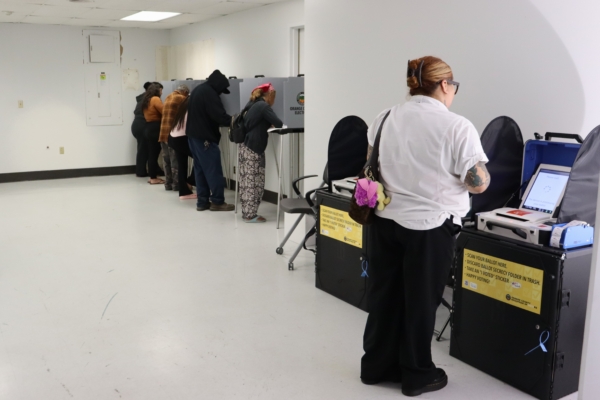
As of November 10, 2026, noon, exactly seven days after the election, two Republican state assembly members from Orange County in Southern California have failed to win reelection. This outcome has solidified the Democratic Party’s position in the state assembly, where they have secured 66 out of 80 assembly seats, amounting to a significant 82.5%. Moreover, the Democrats captured 16 out of 20 state Senate seats, bringing their total to 77% among the 40 state senators.
In the 70th Assembly District, incumbent Tri Ta (R) initially held a lead with 50.5%, ahead by over 1,100 votes, but as the counting progressed, he fell behind by more than 2,700 votes to Democrat Paula Swift, who now stands at approximately 49%. Consequently, Ta has been unable to clinch reelection.
Paula Swift is a small business owner, educator, and social advocate known for her work with youth in the foster care system and survivors of domestic violence. She has an extensive background in nonprofit organizations, public sector initiatives, and private enterprise, actively participating in various community projects and advocating for those in need.
In the 74th Assembly District, incumbent Laurie Davies (R) is trailing Sergio Farias (D) by 3,700 votes, having garnered only 48.9% of the vote. This is a notable shift from the primary election held in June, where Davies had secured an impressive 52.3% lead. The 74th District spans both Orange County and San Diego County, where Davies maintained a strong performance in Orange County with 56.82%, leading by over 11,000 votes. However, she faced a significant deficit in San Diego County, receiving only 41.78% of the vote and falling about 15,000 votes behind Farias. Davies represented the district in three consecutive terms from 2020 to 2024.
Sergio Farias is a city council member from San Juan Capistrano, an entrepreneur, and a community leader. He took over his family’s landscaping business at the young age of 16 after the passing of his father and has since been committed to running the family enterprise.
Typically, incumbents have a higher likelihood of winning reelection compared to newcomers or those without previous office experience. Incumbents tend to have greater opportunities to connect with voters, become familiar figures in the community, and advocate for local constituents’ interests.
In this election cycle, six sitting Republican state assembly members were unable to secure their positions despite leading their opponents in the June primary. These members include Josh Hoover from the 7th District, Jeff Gonzalez from the 36th District, Greg Wallis from the 47th District, Leticia Castillo from the 58th District, Tri Ta from the 70th District, and Laurie Davies from the 74th District.
According to a report from the Secretary of State’s office on September 4, 2026, the number of registered Democratic voters in California is approximately 10 million (10,405,618), accounting for 44.92% of the total electorate. In contrast, registered Republicans number over 5.7 million (5,747,193), representing 24.81% of voters. Additionally, there are more than 5.3 million (5,313,596) voters who are registered as independents, which constitutes 22.94%, while other voters number close to 1.7 million (1,698,570), making up 7.33%.
From the perspective of partisan alignment, the Democrats have achieved a remarkable victory, clinching seats that far exceed their proportional representation among registered voters, which is roughly 45%. As of 1:57 PM on November 10, California officials have counted about 49.5% of the votes from registered voters (excluding total votes cast in the election).