
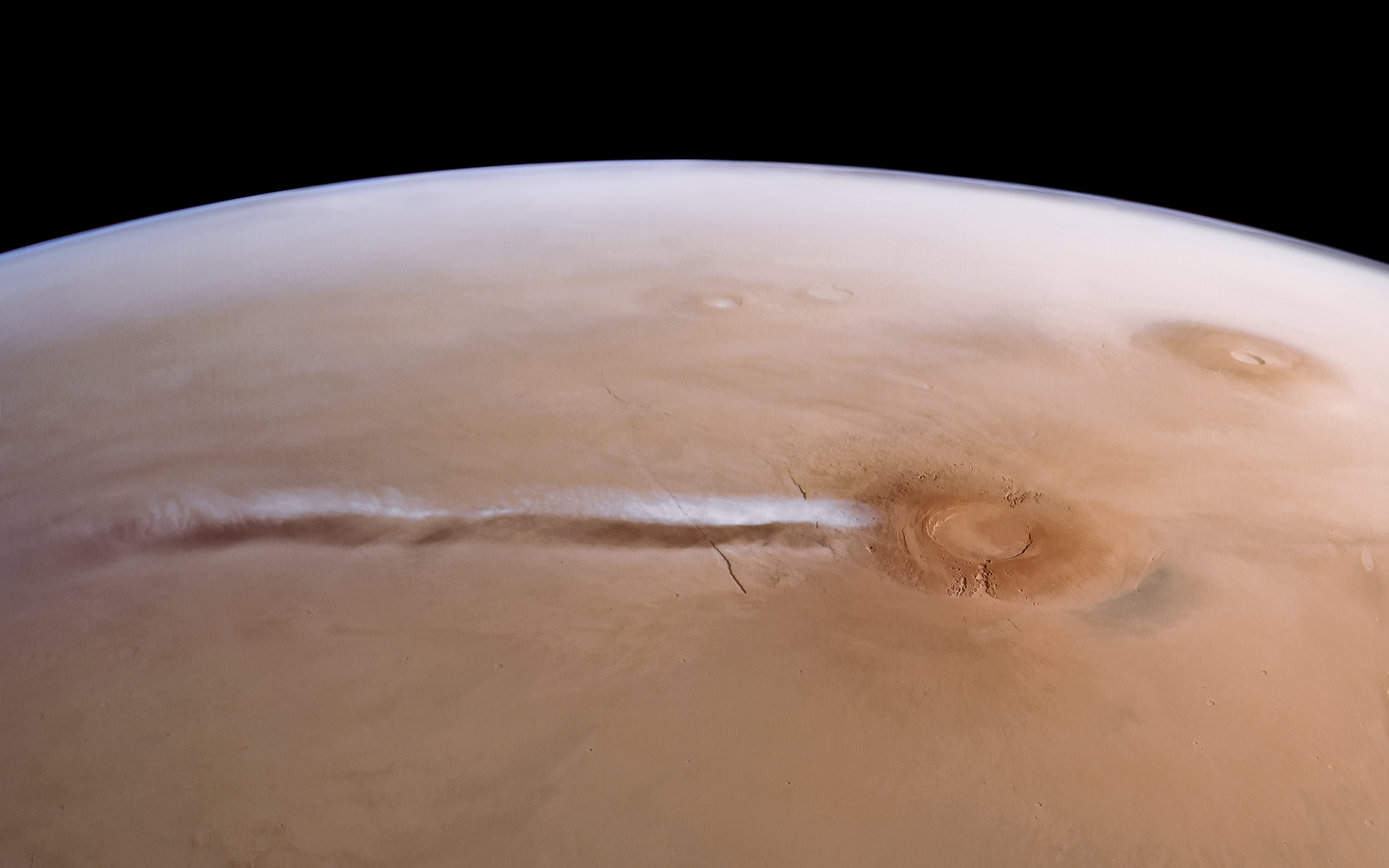
Astronomers may have uncovered a remarkable explanation for a peculiar cloud on Mars that extends for hundreds of miles, surpassing even the north-south span of California, marking it as the largest of its kind within the solar system. The manner in which this cloud forms might involve a physical mechanism that scientists have never directly observed in the atmosphere of any planet.
In 2018, astrophysicist Jorge Hernández Bernal first noticed this unusually long cloud in the clear Martian skies. At that time, Mars was experiencing spring in its southern hemisphere, and the European Space Agency’s Mars Express, equipped with a visual monitoring camera affectionately dubbed the Mars webcam, captured this strange phenomenon.
Upon further investigation, Bernal discovered that images taken as early as the 1970s, during NASA’s Viking 2 mission, had also recorded this cloud.
This phenomenon had long been overlooked, primarily because it appears for only a brief period each day. The water ice cloud forms near the summit of Arsia Mons, an enormous dormant volcano that rises approximately 11 miles (around 17.7 kilometers) above the Martian surface, just at sunrise. Within three hours, the cloud dissipates. Most space photography equipment is constrained by orbital and sunlight conditions, typically capturing images of the area only in the afternoon, which often means missing this ephemeral morning cloud.
Bernal and his team have been tirelessly researching the cause of this cloud phenomenon for several years. One of the first hypotheses to dismiss was that water vapor was being released from the volcano, as Arsia Mons has been inactive for some time, with no current volcanic activity.
The true explanation may be more surprising: the mechanisms of its formation could involve a process that, until now, has only existed in theory and has never been observed directly in the atmosphere of a planet. The findings of this research were published on October 7 in Nature Geoscience, serving as a stark reminder to scientists exploring other celestial bodies that they should not easily rule out rare or unconfirmed extreme physical processes.
The paper suggests that the key to unraveling this mystery may lie in a process known as “homogeneous nucleation.” In this case, water vapor condenses and freezes directly into ice crystals in the air without requiring any particles, such as dust or aerosols, to attach to.
On Earth, clouds typically form when water vapor cools and attaches to microscopic particles like salt, pollen, or dust, a process known as heterogeneous nucleation. Given that Mars’ atmosphere is filled with suspended dust, researchers initially believed that these particles would be crucial. However, when the team used computer weather models to simulate the “Arsia Mons Extended Cloud” (AMEC), they consistently failed to replicate its unusually long tail, indicating that the existing models lacked some fundamental component.
Currently, Bernal, now based at the Université Paris-Sorbonne, and his team continue their groundbreaking research. They found that when strong winds sweep over the towering Arsia Mons, they trigger powerful atmospheric gravity waves within the gaseous atmosphere, lifting moisture-laden air several kilometers within minutes, resulting in rapid adiabatic cooling.
This dramatic dynamic process creates an extreme state of ice supersaturation (where saturation levels can reach up to 10^5), which allows for homogeneous nucleation to occur. The researchers likened this cloud formation process to water droplets not condensing on the surface of a window as usual, but rather forming directly in the center of a room out of thin air.
This discovery confirms that homogeneous nucleation can indeed occur naturally within the atmosphere. Not only does it unravel the mystery of the expansive cloud on Mars, but it also provides a fresh perspective for understanding the cloud physics of other celestial bodies in the solar system, including the upper atmosphere of Earth.