
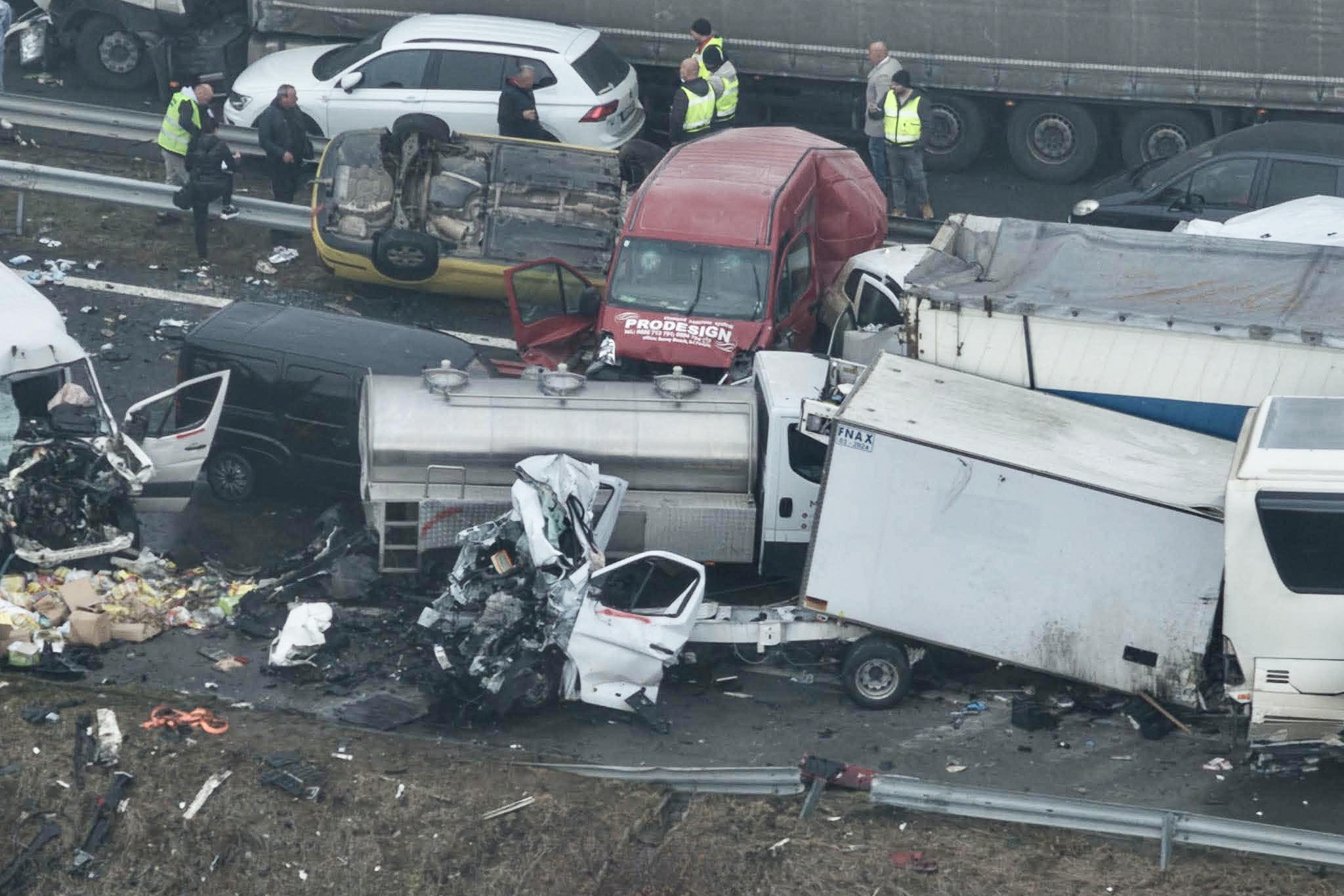
On the morning of November 10, a catastrophic multiple-vehicle collision occurred on a highway in southeastern Bulgaria, resulting in a tragic loss of at least 12 lives and leaving approximately 50 individuals injured.
In the wake of this devastating incident, Bulgarian President Rumen Radev announced that November 11 would be observed as a national day of mourning. He characterized the day as a “dark day for the entire nation of Bulgaria,” reflecting the gravity of the situation.
The accident took place on the A1 “Trakia” motorway near Yambol, which connects the capital city of Sofia to the coastal port city of Burgas. On that fateful day, a sudden and dense fog drastically reduced visibility, leading to a series of widespread collisions involving over 80 vehicles, including cars, buses, and heavy trucks.
As of now, several of the injured remain in critical condition. The scene was chaotic, with multiple vehicles damaged, overturned, and twisted beyond recognition, some even catching fire. Emergency responders faced challenges as several individuals were trapped inside their vehicles during the crisis.
President Radev stated that the government had deployed transport aircraft equipped with medical teams and stretchers to urgently transfer the critically injured to hospitals in Burgas, Sliven, and Yambol.
Coincidentally, as the accident unfolded, European Commission President Ursula von der Leyen was visiting Bulgaria. She expressed her heartfelt condolences to the victims and paid tribute to the rescue personnel before cutting her trip short. In light of the tragic events, Radev also canceled his official engagements for the day and rushed to the scene to oversee the response efforts.
Local authorities activated the emergency alert system (BG-ALERT) across regions including Yambol, Sliven, and Burgas to guide vehicles away from the affected areas.
Preliminary investigations by the Ministry of Interior suggest that the primary causes of the accident were the thick fog and slippery road conditions. The collision was reportedly triggered by a bus colliding with a truck on the road heading towards Burgas.
Lyubomir Nikolov, the chief secretary of the Ministry of Interior, explained, “A truck transporting grains blocked the path of a passenger vehicle, which initiated the first of the chain-reaction collisions.” He added that the poor visibility caused by the fog likely contributed significantly to the disastrous outcome.
During the rescue operations, all traffic on the highway was suspended in both directions for the duration of the day.
According to data from the European Commission, Bulgaria has the highest road traffic fatality rate in the EU, with 71 deaths per one million residents reported in 2025. Experts attribute this alarming rate to factors such as reckless driving, poor road maintenance, a high proportion of older vehicles (approximately half of the vehicle fleet is over 20 years old), and the substantial traffic flow associated with Bulgaria’s status as a key land route into the European Union.
This tragic incident serves as a somber reminder of the critical need for improved road safety measures in Bulgaria and underscores the urgent necessity for continued efforts to address the underlying issues contributing to the country’s high accident rates.