
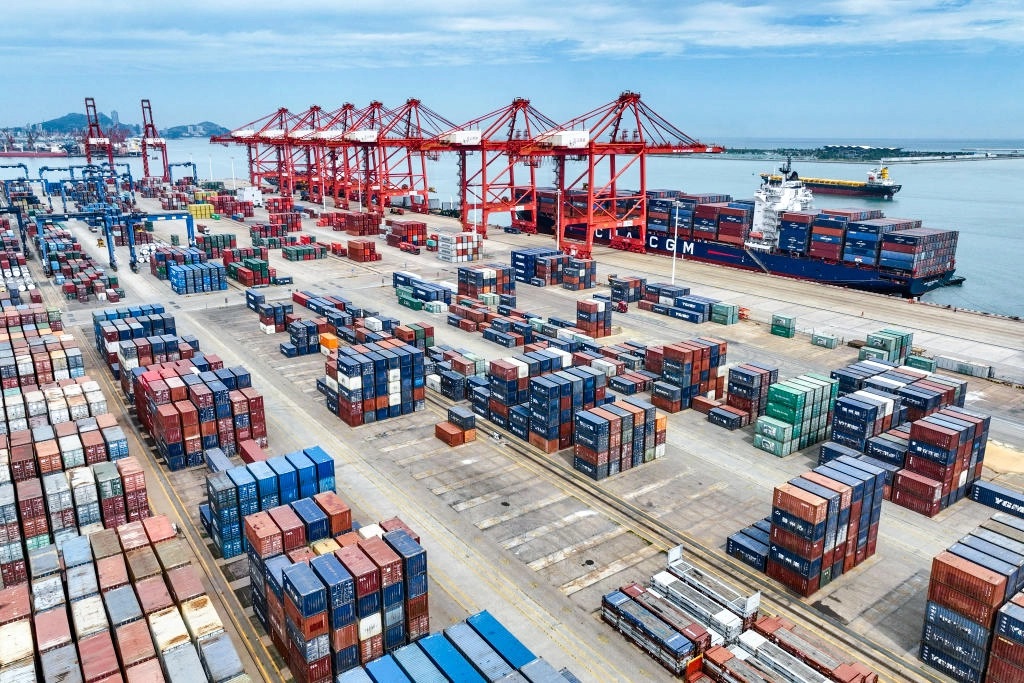
In recent trade reports, China has shown a remarkable export growth of 35.2% year-on-year in October, indicating a robust performance in its international trade sector. Additionally, the country’s trade surplus over the first ten months of 2026 has surpassed an impressive $1 trillion. However, this surge in export activity has not translated into widespread benefits for Chinese businesses. A recent survey conducted by Reuters revealed that factors such as the appreciation of the Chinese yuan, overcapacity, and fierce price competition are severely squeezing profit margins for many companies. Notably, some strategic industries are experiencing profit margins as low as approximately 2%.
The acceleration in China’s export growth is largely driven by rising global investments in artificial intelligence (AI) infrastructure. As major tech companies ramp up the construction of data centers, there has been a marked increase in demand for semiconductors, servers, and related electronic equipment, allowing Chinese supply chains to capitalize on this trend.
However, it is crucial to understand that the increase in export value does not always correspond to a proportional rise in actual shipping volumes. According to a report by the Financial Times, while China’s semiconductor export value soared by 111% in the first ten months of this year, the actual quantity exported increased by a mere 3.2%. This discrepancy is attributed to rising demand and prices for AI-related products, suggesting that a rapid rise in export value may not equate to a comparable expansion in actual output or production volumes.
On the flip side of these impressive export figures lies a troubling reality: corporate profitability has not seen a corresponding improvement. A recent corporate survey by Reuters highlighted that the median net profit margin for 5,209 Chinese publicly listed companies in the first half of the year was only 4.88%, significantly lower than the global average of 8.87% for a comparable group of 9,733 international firms.
In sectors that are prioritized by the Chinese authorities, such as the automotive industry and technology hardware, profit margins are alarmingly low, with figures sitting at only 2.5% and 3.5% respectively. The semiconductor and semiconductor equipment industries have recorded a profit margin of merely 7%, again placing them below their global counterparts. This analysis points to the concern that even in high-tech sectors that the government is keen to develop, an expansion in export scale does not necessarily convert into comparable profitability.
The pressure on businesses is further exacerbated by the rising value of the yuan. Another report by Reuters interviewed several Chinese exporters, revealing how currency appreciation is making products more expensive for overseas buyers, thereby eroding existing profit margins. One business owner from Ningbo, who exports clothing to Europe, lamented that the stronger yuan has severely impacted his firm’s order-taking ability. He indicated that profit margins have become negligible, and if the yuan continues to appreciate, his company may struggle to stay afloat.
Standard Bank estimates suggest that for every 1% appreciation in the yuan’s real effective exchange rate, the average profit margin for Chinese exporters could decrease by approximately 0.3 percentage points.
In addition to currency fluctuations, domestic overcapacity and price competition pose significant challenges for companies seeking to enhance profitability. In an environment where domestic demand is stagnant, businesses are often reluctant to cut production capacity and thus turn to overseas markets in search of buyers. However, when a multitude of companies simultaneously pivot toward exports, competition intensifies.
The National Bureau of Statistics (NBS) of China reported a manufacturing Purchasing Managers’ Index (PMI) of 49.3 for October, slipping below September’s reading of 50.1 and entering contraction territory once again. Among the figures recorded, the PMI for large enterprises stood at 50.2, while medium and small enterprises were significantly lower at 48.4 and 47.5, respectively. Additionally, the new orders index fell to 49.4, and the new export orders index dropped to 46.5, both falling below the critical threshold of 50.
This set of data starkly contrasts with the substantial growth in export totals, illustrating that the strong performance in export value has not translated into a universally improved market environment for manufacturing companies across various sectors.
Weak domestic consumption further amplifies the reliance of companies on international markets. Data provided by the NBS indicated that retail sales of consumer goods in September only grew by 1.1% year-on-year, a figure that is mirrored over the first nine months of the year. Notably, the retail sales of automotive products plummeted by 21.2% in September, with a cumulative decline of 14.9% over the first nine months.
As reported by Reuters recently, the domestic sales of vehicles in China have been on a downward trend for 12 consecutive months, which has prompted companies to vigorously seek opportunities in overseas markets. Concurrently, the persistent downturn in the Chinese real estate market, coupled with falling property prices that erode household wealth, has further dampened consumer confidence, impacting overall spending behavior.