
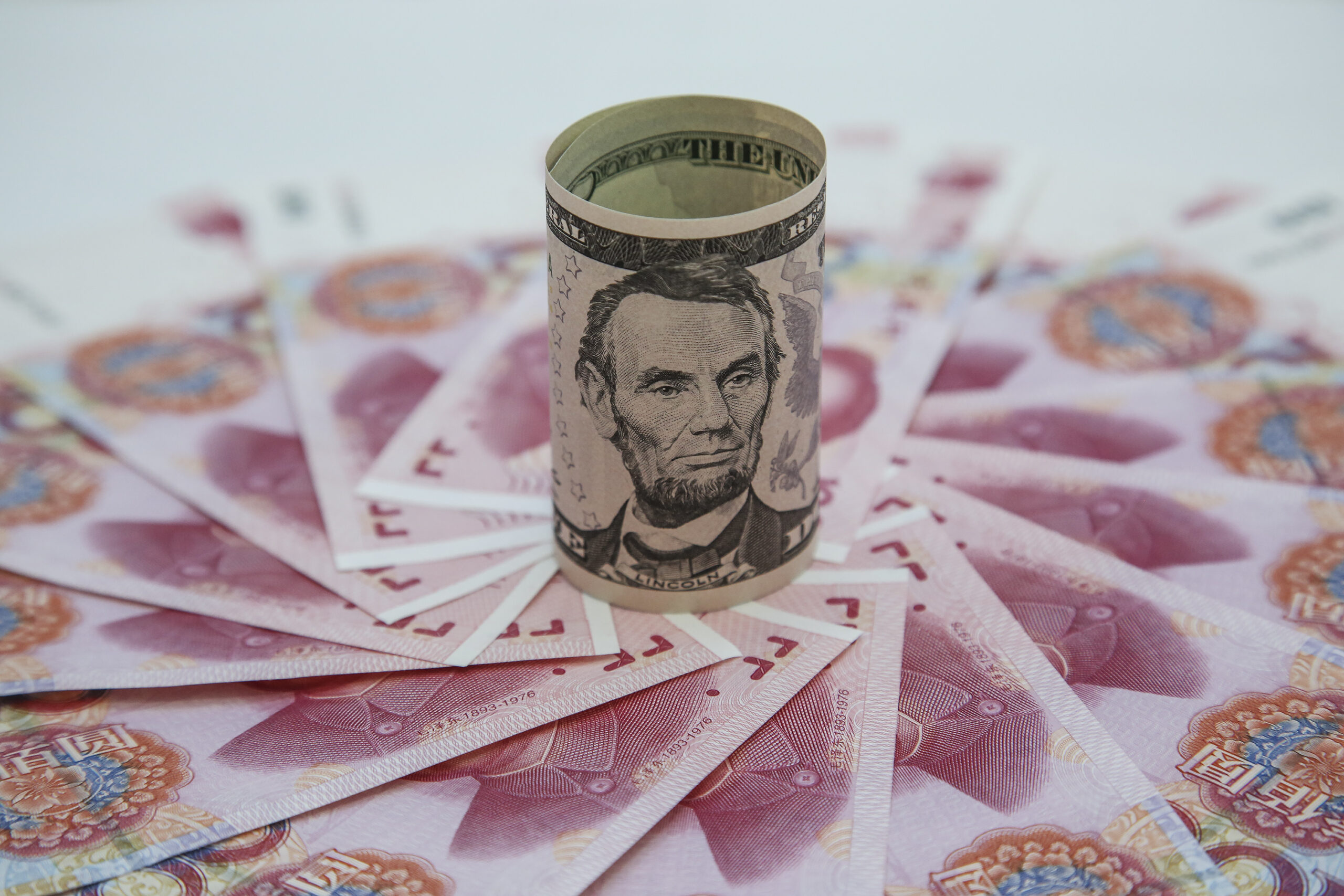
In recent weeks, the value of the Chinese yuan has shown a clear upward trend, encouraged by factors such as a trade surplus and the willingness of businesses to convert currency. Following an announcement from the People’s Bank of China (PBOC) regarding an increase in the foreign exchange reserve requirement ratio for financial institutions, numerous banks across mainland China have significantly raised their dollar deposit interest rates. Analysts believe this measure is aimed at retaining dollar deposits.
According to a report from Reuters on November 9, various banks in mainland China have increased their dollar deposit interest rates, with some even surpassing the benchmark interest rate set in the United States. Professionals in the banking sector pointed out that the rise in dollar deposit interest rates serves to incentivize savers and exporters to hold cash in dollars instead of converting to the lower-yielding yuan. The appreciation of the yuan has started to marginally squeeze the already thin profits of exporters. Since early 2025, the yuan has appreciated approximately 10% against the dollar.
Insiders in the banking sector revealed that in recent weeks, banks—including state-owned, joint-stock, and foreign banks—have raised their dollar deposit rates to the highest levels seen since 2023. However, it remains unclear whether the PBOC has explicitly instructed banks to increase these rates. The central bank typically provides informal guidance to state-owned banks regarding such interest rates, but no response was received concerning requests for commentary on this occasion.
One insider from a state-owned bank noted that its deposit rates have increased by about 80 basis points over the past few months, peaking at 4.5% in late October. This marks the highest level since 2023. The insider added, “This enables the banks to assist firms in avoiding forced conversions of foreign exchange back into yuan, alleviating some pressures.”
Two other individuals from different banks commented that exporters and retail customers are taking advantage of the higher rates to make deposits. Previously, banks in mainland China were primarily utilizing dollars to purchase U.S. Treasury bonds, highlighting a shift in their investment strategies. An insider from a joint-stock bank that had previously purchased U.S. Treasury bonds noted that some banks continue this practice.
According to a well-informed individual regarding interest rates, a large bank has adjusted its dollar deposit interest rate upwards twice in two weeks, with current one-year deposit rates exceeding 4% for balances over $50,000. This has attracted a significant amount of deposits. The current rates are approximately 120 basis points higher than they were a few months ago, when provincial banks first began raising rates above the 2.8% cap set in 2023.
Concurrently, numerous banks in mainland China have repeatedly lowered their yuan deposit rates, with state-owned banks currently offering a mere 0.95% for yuan deposits.
Industry insiders reported that some banks are offering dollar deposit rates that align with the U.S. overnight financing rate, which currently stands at 3.97%, for select high-credit customers.
Song Lin, chief economist for the Greater China region at ING, commented, “The goal of raising dollar deposit rates is to retain dollar deposits and maintain a stable source of dollar funds.” He further stated, “The rising dollar deposit rates may suppress some exporters from exchanging accumulated dollar balances into yuan, thereby reducing the pressure for the yuan to appreciate.”
Over the past two years, record trade surpluses have continued to drive up the value of the yuan. Last week, the exchange rate of the yuan against the dollar reached 6.6449, marking a four-year high. Data from the PBOC indicates that as of the end of September, foreign exchange deposits reached a record $1.2 trillion, representing a year-on-year growth of 17.7%.
On November 7, Sun Lijian, a professor at Fudan University’s School of Economics, wrote that the motivation for the yuan’s appreciation primarily stems from domestic factors. China’s trade surplus during the first three quarters of the year has been substantial, along with a strong willingness among businesses to convert currencies. Additionally, there exists an estimated “dollar dam” of approximately $630 billion domestically, where the total foreign currency deposits stand at $1.2 trillion against loans totaling only $571.9 billion. Should expectations stabilize, these existing dollar balances could rapidly concentrate for conversion, posing risks of increased exchange rates.
The article delves into the challenges faced by the PBOC, noting that price tools (such as the forward foreign exchange risk reserve ratio) have already fallen to zero, leaving no room for further manipulation. The costs associated with directly intervening in the market using foreign exchange reserves are deemed too high.
Recently, the PBOC announced that starting from November 15, it will raise the foreign exchange reserve requirement ratio for financial institutions from 4% to 6%. The anticipated increase in the reserve requirement is expected to freeze approximately $24 billion, signaling a strong and clear “cooling down” message to the markets. This policy, which takes effect on November 15, arrives just ahead of the peak period from November to January when companies typically focus on converting their exports.